Showing posts with label fertilizer. Show all posts

Tuesday, June 23, 2015

Water and Food...Well, Food, Anyway


My son asked how we were supposed to reduce our water usage 25% to meet our new rationing targets. I pointed to the lawn (pictured above) and told him that was our sacrificial lamb for the drought.

A robo call from the water company informed us that we are only allowed to water two times a week now. No word on how much we can water on those days, plus my timer doesn't go on 7 day cycles so the best I can do it set is do only go off every three days. That's what I'm doing, at 25 minutes per watering.  

That cycle also waters our roses and some potted plants that are on drippers.

Since we have a drip irrigation system on the rest of our garden, we're exempt on most water laws so we can concentrate on that while the lawn slowly goes to brown.


This week is the week for feeding.  I've been using this fertilizer but it's not as good as the Schultz fertilizer I used a few years ago but it's way better than the chicken droppings I used a couple of years ago.


The tomato seems to be happy with it but as soon as it runs out, it's back to Schultz.


Darryl
Copyright - Darryl Musick
All Rights Reserved

Tuesday, April 8, 2014

This Year's Feeding Schedule


My new lawn is looking a bit spotty in parts. Although it's still pumping up a lot of grass (with a lot of mowing), I think maybe the two weed 'n feed treatments might have given it a bit of indigestion.


I think it might be hungry but for food not laced with poison.


It's off to my friendly garden center to pick up some nitrogen-rich fertilizer.


The nurseryman there says I've got great timing. A rare rain shower is forecast tonight and putting fertilizer on your grass just ahead of the storm is the peak time to do it.


I load about three pounds into my feeder and shoot it out across the lawn.  Let's see if the grass likes it.

My lawn feeding schedule will be once a month for this season.


The other plants will be getting this liquid fertilizer.


Just dilute into a water pan and sprinkle on everything. This will happen every two weeks.

Hope the plants are happy with the food.


Darryl
Copyright 2014 - Darryl Musick
All Rights Reserved

Thursday, September 5, 2013

Avoiding the Labor on Labor Day


We had triple digit temperatures and high humidity this weekend in L.A. so I was mostly trying not to get heatstroke.


Gardening chores were mostly of the mundane and easy variety like fertilizing and some light weeding. Since the front lawn is mostly a scorched brown, I was able to get away with weed whacking the few growing green spots on it, saving me from mowing for another couple of weeks. That will be this fall's number one project...aerating the lawn and overseeding with a heat and drought resistant mix.

I did have a chance to look around to see what I could harvest and anything else that needed attention. Pulling back the prickly canes of our dragonfruit showed a couple of beauties ripening against the wall (above). There's also a couple of greener fruit on the front of the plant.


I noticed something has been chewing on my newly sprouted zucchini plant, so I put a few more seeds in the soil and covered with a critter cage.


The spurge is always surging so I spent some time yanking it out too.


Bell peppers are almost ready to pick. These might be on the menu next weekend and I'm hoping to get a couple more harvests before they're done for the year too.


The sweet onions just won't stay good in the ground anymore, so I harvested the last of it too. The onions have been a very delicious addition to our summer menus.

Lastly, the garlic chives are blooming in our herb corner. Trying to decide whether I should let them propagate or cut off the flowers. They're delicious but the get fairly weedy.


Darryl
Copyright 2013 - Darryl Musick
All Rights Reserved

Tuesday, June 4, 2013

A New Month and Some Old Chores


A touch late today but worked up a nice sweat in the garden this weekend, starting with mowing the lawn. I like to do the hardest chore first. Then, each chore after that get progressively easier and more enjoyable.


The lavender is getting rangy so I need to give it a trim.


No big trick to it except that you want to try to avoid the bees that swarm all over it. Luckily, most of the bloom is done so no bees today. In bloom, you'd want to do it early in the morning before the bees start their pollen runs.


The zucchini is putting out fruit. Need more? Wait a few hours and we'll harvest again.


Not only do we grow veggies and fruit but we've got quite a few herbs in the garden too. Here, you see the oregano overflowing into the walkway.


I trim it back, put it on top of our fire pit's grate, and let it sit in the sun a few days to dry out.


It's also time to treat the grapes and the front yard roses with sulfur dust again to fight off mold and fungus. Soon, I'll be draping the wildlife netting over the grapes to keep the critters from eating them.


Lastly, I'll fertilize before calling it a day.


Darryl
Copyright 2013 - Darryl Musick
All Rights Reserved

Tuesday, May 7, 2013

May's Gray Days...


Not a lot to do on the gardening front this weekend as clouds moved in for a spring shower.  Deadheading a few roses, mowing the lawn...not the most visual or interesting chore to talk about (although it is good exercize), sweeping, and fertilizing.

Still, this gives me more time to just enjoy the garden, look around, and take stock of where we're at.


There are a lot of things about to happen, as evidenced by the little flower buds popping up here and there. The corn stalks are shooting up flowers, it won't be long till we see some ears developing along the sides.


The grape vine is in full bloom. Not spectacular flowers, hard to even see, but it'll be much nicer when these polinated blooms mature into delicious fruit. It's looking good right now but there'll be a battle coming up on to fronts...the animals that like to eat the grapes and the fungus that'll destroy them if I don't treat at just the right time.


Chiles getting ready to bloom. No problems here, just waiting for all that flavor to be ready to pick.


Squash blossom...zucchini and summer squash will be very dandy when they come up.


A little beyond the flowering stage, our citrus is now showing tiny, little fruits.

The guava tree is showing a ton of blooms. This has been a rehabilitation project for us. We used to have it in a container and winds kept blowing it over. We moved it into the ground but haven't had any fruit for three seasons. We're crossing our fingers because we haven't seen this many buds on it for a long time either.


Lastly, on the beauty front, these little buds will open up to the very fragrant and pretty plumeria flowers soon.

Darryl
Copyright 2013 - Darryl Musick
All Rights Reserved

Tuesday, March 26, 2013

Patching up the Patch - Our Weekly Chores


It's a light gardening weekend in the Cheapskate's patch this weekend. Starting with weeding. First, is an interesting one. One that some people would value as a volunteer. Above is Nicotiana bigelovi, also know as Indian tobacco. It's a California native and was used to smoke (still is in some places) in ceremonies or just to pass time.


It has fairly showy white flowers and can grow 6-7 feet tall in a gangly, thin bush. Some people want it but I don't want it in this hanging basket so out it goes.


I don't have a lot of weeds this week, thank God, so it's just hand-pulling the little buggers out, mostly just grass sprouts.


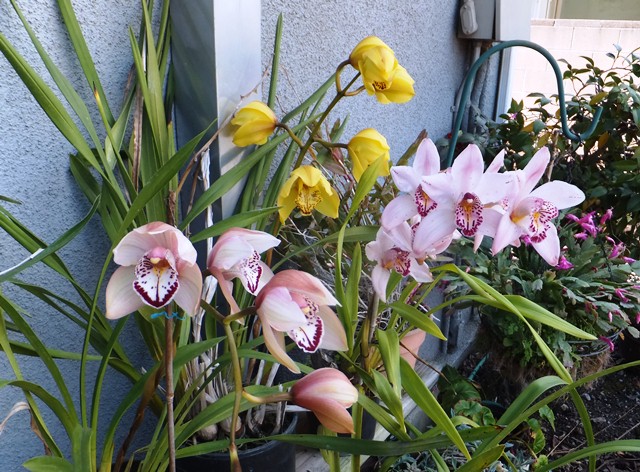
A couple of weeks ago, when I was talking about cymbidium cultivation, I mentioned you could tell the flowers were done blooming when the center lip turned red. Above, is an example of this. Some of the earlier cyms are starting to die back now.

I also planted a few more lettuce, corn, and squash seeds because I really wasn't happy with the poor germination on those plants, plus some critters are eating some of my seedlings. Guess I'm going to have to deal with that some way too.


I have this unused spot to put a dripper for a hanging basket so I ordered some cherry tomatoes today and will plant them in a basket here when they arrive.

I do my bi-weekly fertilizing and plant some feverfew around the front rose garden to try to dissuade the bugs from eating them.


Last chore is to fill in the potted plants where the mix is degrading. I simply grab a big bag of Gromulch...


...and fill in to the top of the container. Now our bougainvilleas...and other container plants...have a topping of fresh, nutritious mix to start their season.

Happy Spring, everybody!


Darryl
Copyright 2013 - Darryl Musick
All Rights Reserved

Thursday, February 21, 2013

Cym City


Many orchid nurseries will tell you that cymbidiums are the easiest orchid to grow. Not really, many...like bletillas and dendrobiums...are easier. Others, like vandas and phalaenopsis, are harder. Cymbidiums are really more in the middle.


Cymbidiums are terrestrial orchids that are native to mid and southeast Asia. Terrestrial means that they grow naturally in the ground, as opposed to epiphytic orchids that cling to the sides of trees and rocks.

You can see in the header above which zone I live in. I'm in the foothills of the San Gabriel Mountains east of Los Angeles at an elevation of 600 feet. It gets extremely hot here in the summer and occasionally dips below freezing in the winter.


Thinking of their natural habitat, you can see that cymbidiums thrive on heat and humidity.  They can tolerate a couple of nights down to 28 degrees but more than that, you better move them inside until the thermometer rises again.


This is our cymbidium bench.  It's on the north side of our house which many orchid growers will tell you will not work but it seems to work for us. They tell you this because the prime motivator for orchids to bloom is sunlight. 

One of the few professional gardening jobs I had was at an orchid nursery. We told our customers that they needed 55% sunlight.  That is, if you put the plant in direct sun, you could cover them up with the shade cloth that blocked out 45% of the light...which we conveniently sold.


In reality, as you can see on our bench, you need good light but not necessarily 55%, or any direct sunlight at all.

They only really need water once a week in cooler months, maybe twice in the hot season. Our bench has an automatic sprinkler at each end to take care of this (see our Poor Man's Sprinkler System to see how I do this).


You might imagine that with big blooms and buds like these that the flower stems might get very heavy and break off.  You would imagine right.  A stiff gust of wind can easily snap them in two.


To prevent this, you need to stake the flower stems. I use a cheap bamboo stick and a twist-tie. I cross the twist-tie between the stake and stem to provide some cushion and separation from the stake.Being a Cheapskate, I naturally recycle these stakes year after year, until they literally fall apart and I can't use them any more.

Fertilize during the non-freezing months once a month to every couple of weeks with a fertilizer that has at least 10% potassium. I use a liquid 10-10-5 fertilizer that works good on my entire garden.

The blooms on cymbidiums are thick and waxy. They can easily last two months indoors. Theoretically, they can last longer outside but they are subject to pollinators out there. Once pollinated, they will fade and drop off quickly. 

You can tell when a cymbidium bloom is about done when the central lip turns red.


I repot ours about every three years.  The one above was repotted last summer. Notice the mix still looks fresh and there is a couple of inches for the plant to grow in each direction. Even the little weed seems to like it.


This plant is in need of repotting this year...you can't even tell it has any mix.  When you repot it, you can also put those dead-looking bulbs in their own small pots and new plants will grow from them.

I'll post another report on repotting a cymbidium later this year, you want to avoid repotting during the blooming season. Right after they're done is the best time.

Their pretty tough, hardy, don't take a lot of fawning over. That's the number one killer of orchids right there...treating them like their a delicate, fragile, little snowflake. Go ahead...let them show you what they're made of. The rewards are great when you let them go their own way.


Darryl
Copyright 2013 - Darryl Musick
All Rights Reserved.

Tuesday, February 19, 2013

Work, Work, Work, Work...Work!


It's chore time for the Cheapskate...

Trying to put the finishing touches on my overwintering chores today, starting with mowing the lawn, then moving on to finishing covering up my new rose garden barrier with river rock.


Next up, I've got to move those pots out of the way so I can prepare that space to be another garden bed.


I've dug up and tilled the ground, now I'm putting in a couple cubic feet of Kellogg's Amend to give it a little kick start.


All done, now this will become the cornfield portion of this year's vegetable garden.


Next, the plants are really starting to take off as you can see with the front yard roses that I pruned a couple of weeks ago.


Time to give these fast awakening plants their first feeding of the season.


Finally, inspect the garden and see what I can find. Oh...look...the dendrobiums are in bud!


Darryl
Copyright 2013 - Darryl Musick
All Rights Reserved.

Wednesday, November 14, 2012

It's Beginning to Look a lot Like Citrus


Fall weather has finally arrived here in Southern California which means there's just a hint of cool in the very dry air. The leaves are turning brown (no color here) and they'll soon drop.

Winter's arrival means that citrus season is here. At the top of this post is a little bit of our harvest from last year, cara cara navel oranges and Meyer lemons.


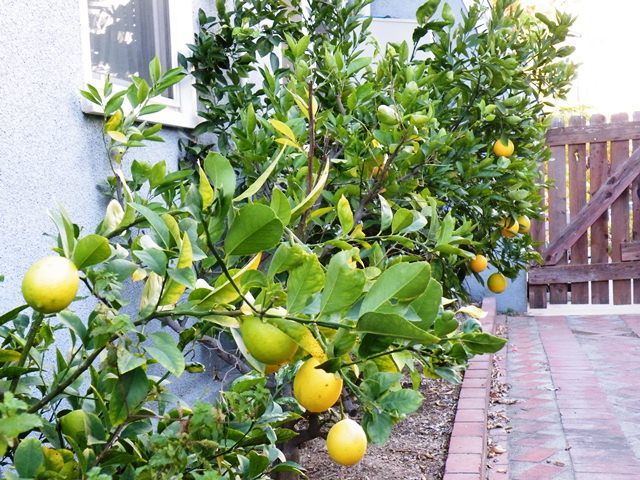
This is our "citrus grove," consisting of three dwarf citrus trees...


...the Meyer lemon...


...the cara cara navel...


...and this rescue of a tangelo that was near death when I got it last year and nursed it back to health.

I get a few fruit each year but nothing like friends and family that have old trees in their yards that they don't even pay attention to and, yet, get hundreds of fruit that end up rotting on the ground.


I try to ignore mine and get even less fruit. The leaves shrivel and get mottled, so I treat 'em well, they look better, and I get a few fruit but not much.

Still trying to figure this citrus thing out. I fertilize every two weeks, water regularly, and treat with ironite once a year and the harvest doesn't change much.

Hmm...one of these days.

Darryl
Copyright 2012 - Darryl Musick
All Rights Reserved