Showing posts sorted by relevance for query los angeles. Sort by date Show all posts

Wednesday, August 8, 2018

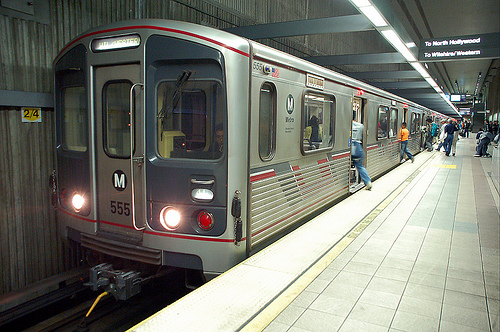
PUBLIC TRANSIT OPTIONS FOR THE DISABLED: Riding On The Los Angeles County Metro Rail System - A Little History


As I have discussed many times in other posts here on The World on Wheels, living life with a disability of any kind comes with its own set of various challenges and obstacles that people like me have to face on a daily basis. One of those is figuring out how to get from point A to point B when we want or need to go somewhere.


For many years while I was growing up as a kid in Southern California, there really were not too many public transportation options for people with disabilities to get around on besides a few Metro and Foothill Transit bus routes here and there. The lack of multiple transportation options began to change in our area where we live when the Los Angeles County Metro Gold Line light rail train line was opened and began operation on July 26, 2003 from the Sierra Madre Villa in the eastern part of Pasadena, California.

Since then, there have been two extensions of the Metro Gold Line completed with a third one still to come and possibly a fourth one as well. The first extension of the line was opened on November 15, 2009 and it was called the Eastside Extension. That extension was built starting from Union Station in downtown Los Angeles all the way to the Atlantic Station located on Atlantic Boulevard in East Los Angeles near Monterey Park.

The second extension of the Gold Line was known as the Gold Line Foothill Extension. The first phase of the Gold Line Foothill Extension opened on March 5, 2016 and the second phase of the this extension is scheduled to be opened sometime in the year 2026. The first phase of this extension of the Metro Gold Line was built starting from the Sierra Madre Villa Station in Pasadena and runs all the way to the Azusa Pacific University (APU)/Citrus College Station in the city of Azusa. When the second phase of the Gold Line Foothill Extension does open in 2026, the line will then run even further from the APU/Citrus College Station all the way to the city of Montclair, California at the Montclair Transcenter.

In addition to those extensions of the Metro Gold Line mentioned above, there is also supposed to be a second phase of the Eastside Extension of the line extending it from Atlantic Station in East L.A. to either the city of South El Mente or Whittier or possibly both. Such an extension of that part of the Metro Gold Line is in the under consideration discussion phase at this time and therefore has not yet been fully approved to start being constructed.

Of all the line extensions that have been finished and completed up to this point of the Metro Gold Line, the one that has been the most beneficial to my family and I by far has been the Foothill Extension. That's because my family and I live not too far away from the Duarte/City of Hope and Monrovia stations just east of Pasadena, California.

Besides the Gold Line there are a total of 3 other light rail lines (Blue, Expo and Green) and 2 color coded heavy rail subway lines (Red and Purple). That makes for a grand total of 6 rail lines that are currently in use on the Los Angeles County Metro Rail transportation system.

The Blue Line route runs from the 7th Street/Metro Center station in downtown Los Angeles to the Downtown Long Beach station in the city of Long Beach, California. The Blue Line is also the oldest of all the current rail lines in the Los Angeles area having been in operation since July 14 of 1990.


The Expo Line, which is the newest and most recent one opened in 2012 and goes from the 7th Street/Metro Center station in Los Angeles all the way to the Downtown Santa Monica station in Santa Monica, California.

The route of the Green Line which debuted in August of 1995 currently starts at the Redondo Beach station in the west from Redondo Beach, California and runs all the way to the Norwalk Station in Norwalk, California in the east. There will also be a couple of future extension projects over the next few years in which the Green Line will be connected to the upcoming future Crenshaw/LAX line which is scheduled to be opened sometime in late 2019.

The other possible future extension project for the Green Line is the South Bay extension which, if built, would run from the Redondo Beach station and head southeast to the Torrance Regional Transit Center (RTC) in Torrance, California. This extension project seems to be a ways off from happening since it would not be opening until sometime between the years of 2030 and 2033.

The other current lines on the system are of the heavy rail type that runs entirely underground like a subway train. They are the Red and Purple Lines. The Red Line opened on January 30, 1993 and currently runs from Union Station in the south all the way to the North Hollywood station in the north. While there have been discussions about possible extensions of the line to the North, South, East and the Arts District, it appears that there are no firm plans in place as of right now to extend the Red Line anytime soon.


The Purple Line was also opened on January 30, 1993 and currently goes from Union Station in the east all the way to the Wilshire/Western station in the west. Unlike the Red Line, there is a future extension plan in place to extend the Purple Line from the Wilshire/Western station all the way to the new Westwood/VA Hospital station by the year 2026.


Besides those lines and extensions mentioned above, there will also be a mostly underground Regional Connector light rail line that will connect the current Blue and Expo lines to the current version of the Gold Line and Union Station in downtown Los Angeles. This Regional Connector line is supposed to be opening by sometime in December of 2021.

Finally the only other transit project here in the Los Angeles area that is currently in the under construction phase is the Airport Metro Connector automated people mover train which will connect the LAX airport terminals and a new rental car facility to the Los Angeles County Metro Rail system via the Green Line and the new Crenshaw/LAX line at the new Aviation/96th Street station which is currently under construction. This station is expected to be opened by sometime in the year 2021.

While it is true that my family and I have had the opportunity to ride on all of the lines that are currently in operation for the Los Angeles County Metro Rail system at various times over the last few years, the one that we have been on the most by far as I mentioned up above earlier is the Gold Line since the route runs very close to our house in the foothills of the San Gabriel Valley.


In my next post, we'll go over how we use it. Until then...

Tim Musick
Copyright 2018
All Rights Reserved


Wednesday, January 3, 2018

TRANSIT REPORT - Los Angeles 2018


There's been some big moves in Los Angeles public transit since we last took a look.  See the updates below, in red.

UPDATE: January 2018

Does Los Angeles now have the most extensive, wheelchair accessible rail system in the USA? Let's do a little comparison (stats below do not include inter-urban commuter rail)...

New York has 651 miles of rail transit with 96 accessible stations out of 425, or a little less than 1 out of every 4.

Boston has 78 miles of rail transit with 97 accessible stations out of 133, or about 3 out of every 4.

Chicago has 102 miles of rail transit with 99 stations out of 148, or about 2 out of every 3.

Los Angeles has 105 miles of rail transit with 93 stations, all accessible. Plus, there is another rapid bus line that runs just like rail transit on it's own right of way for 18 miles with 29 accessible stations.

Maybe New York can make the claim but, otherwise, it sure looks like L.A. has the most extensive, accessible system.

Since our last update, the Expo Line has opened up connecting downtown Los Angeles with the beach at Santa Monica. This is the second line that has connected to an oceanfront area as the Blue Line connects to Long Beach. Soon, the Crenshaw Line will open up, making a connection between the Expo and Green Lines, with a connection to a new people mover to Los Angeles International Airport finally making rail service into LAX a reality and construction just started on another 12 mile extension to the Gold Line that will take it to the edge of San Bernardino County in Montclair.

Angels Flight is back in service with a dollar fare (50 cents for TAP card holders).

UPDATED: March 2016 - see red section, below.


Watch the Video!


Just a touch over six years ago, we wrote the following on the last day of operation for the old El Monte bus station:

This week marked the end of the original El Monte Bus Station.  Built in 1973 and looking like a flying saucer, it was the first modern public transit structure to be built since the end of the trolley days here in Southern California.  It anchored the El Monte - Los Angeles busway...a dedicated lane for buses along Interstate 10.  Riders came here and used it much like a subway station to catch express buses into Los Angeles, bypassing the traffic jams on the San Bernardino Freeway.

The station is set to be demolished and replaced with a new station, opening next year.

(See photo of the new station, below)


The station is round and has its own roadway onto the busway.  Riders entered from below and used stairs, an escalator, or an elevator to get to the upper level.  Originally, there were 10 berth were buses could pickup and discharge passengers.  This was later reduced to 8 when Foothill Transit started the Silver Streak line, using longer articulated buses that needed longer platforms.  The final nail in the coffin was Metro's introduction of the Silver Line, which also used buses that were longer than the platform.


The upper level consisted mainly of walkways that increasingly got crowded.  The lower level had a big plaza that was pretty much unused.  


Greyhound had a ticket office on the lonely lower level.


September 12, 2010, marked the last day of operations here.  One of the last Silver Line buses awaits departure.


UPDATE: Sunday, October 14, 2012, marked the debut of the new El Monte Bus Station. Certified LEED for energy efficiency, the new station loads buses on two levels and increases daily passenger capacity from 22,000 to 40,000...now they need to work on getting parking space for those 40,000 passengers. 

The station is the main point for Silver express service to downtown Los Angeles and beyond.  New is the fare sharing for both of the Silvers...Foothill Transit's Silver Streak and Metro's Silver Line will both use the same fare, $2.45. Either lines passes will also be honored on the other. 

Note for handicapped passengers: Foothill does not have disabled discounts during rush hours...use the Silver Line instead if you want to use a discount.


If you’re in a wheelchair, and heading to Los Angeles, your transit options got a big boost last fall. The Silver Line express bus service incorporates accessible buses that travel, for the most part, on their own dedicated roadways along the center of the 10 and 110 freeways, from the El Monte Station to Torrance. The line leaves the busways in downtown Los Angeles for several local street stops including Union Station (home to several rail lines), 7th Street Station (start of the LA-Long Beach Blue Line light rail), Staples Center, Disney Hall, Grand Central Market, and more. Full fare is $2.45. Disabled discounts are available but Metro has been criticized lately for ignoring disabled passengers needs, such as securing wheelchairs with tie-downs.


MARCH 15, 2010 UPDATE:  L.A.'s oldest public transportation, Angel's Flight, resumed service on March 15, 2010.  It was originally built in 1901, the little orange funicular tranported residents of Bunker Hill down to the shops of Downtown Los Angeles.  It was removed in 1969 when Bunker Hill was redeveloped into high-rise office buildings and put in storage.  It opened again in 1996 just south of the original site, at the back entrance to the Grand Central Market and now connects the market to the Water Court on top of Bunker Hill.  A fatal accident closed it again in 2001.  Since then, reconstruction has replaced what was faulty back then and 9 years later, here we are again.  One car is accessible.  Cost is a quarter each way.

March 2014 UPDATE: Again, Angel's Flight is down. one car derailed last fall and extremely shoddy maintenance and operation practices were revealed, including staff taking a branch from a nearby tree and disabling the emergency stop with it. Repairs have been made and the funicular is in testing mode now but not currently open.
The similarly named and routed Silver Streak runs basically the same route from the El Monte Station to downtown where it terminates. However, the Silver Streak…run not by Metro but by Foothill Transit instead…starts in Montclair, about 30 miles east of El Monte. The Silver Streak uses 60 passenger articulating, low-floor buses with two wheelchair anchor points on each coach. Foothill is usually a little nicer with cleaner coaches and less crowding. Full fare is $2.50 and no disabled discounts are given during rush hours.


In November, the Gold Line light rail line was extended from Union Station to the eastern edge of East LA. You now have a one-ride option from the east side of Pasadena through to East LA. Several nice areas can be accessed through this line…Old Town Pasadena, Pasadena City College, South Pasadena, downtown Highland Park, Chinatown, Union Station (with Olvera Street and Phillipe’s adjacent), Little Tokyo, Mariachi Plaza, and the many fine Mexican restaurants of East LA.


The Expo Line is now open on its first segment from downtown to Culver City, going by USC and Exposition Park along the way. The next phase of the Gold Line, extending it from Pasadena to Azusa, broke ground in June (personal note, back when Tim was on the radio he got to interview the CEO of the Gold Line Foothill extension who was none to pleased with the MTA's foot-dragging in building this line).

The Gold Line Extension is now open, going east to Glendora at Citrus College with stations in Arcadia, Monrovia, Duarte, Irwindale, and Azusa in between.

On May 20, the Expo Line will open its next segment terminating at Santa Monica Pier (the western terminus of Route 66) marking the first light rail or subway line to reach the beach in the modern era.


These join the existing Red Line subway… going from Union Station to North Hollywood via Hollywood and Universal Studios, the Purple Line subway…Union Station to Wilshire Bl. and Western Ave. (home of the Wiltern Theater), the Blue Line light rail…from downtown to Long Beach, the Orange Line busway…running from Woodland Hills to the North Hollywood Red Line terminus (note: the Orange Line has been extended to Chatsworth), and the Green Line light rail running from Norwalk to Redondo Beach via the median of the 105 freeway.

Metrolink also runs several commuter rail lines converging on Union Station from San Bernardino, Oxnard, Oceanside, Riverside, and Palmdale.  Metrolink has had its issues too, but in general, they are very accessible and responsive to wheelchair needs.


All of Los Angeles' rail lines, stations, and bus lines are wheelchair accessible.

Next time you visit, try some of the areas transportation options.  LA’s still not a transit paradise but we’re taking baby steps out of the car and onto the rails. 


Darryl

Copyright 2009 - Darryl Musick
Pictures courtesy of Wikimedia Commons
The Port of Authority
Alossic under CC-BY license
Foothill Transit under CC-SA license
Justin N under CC-SA license


Wednesday, August 15, 2018

PUBLIC TRANSIT OPTIONS FOR THE DISABLED: Riding On The Los Angeles County Metro Rail System - Using it in Real Life


Last time, I gave you an overview of how Los Angeles has built a new rail transit system from the ground up in the last quarter century.

Over the last couple of years we have been doing more than our fair share of riding on the Gold Line. Before he retired from work earlier this year as an IT Specialist, my dad would ride it to and from his office in downtown Los Angeles. Besides that, we have ridden on the Gold Line on many occasions to some of the other cities that it goes through such as Pasadena, Arcadia and Azusa. Of those stations, our favorite one to go to would probably be the one in downtown Azusa.


In each of those cities there are stations along the line that are located in some very nice downtown or industrial areas. In Pasadena there are the Memorial Park and Fillmore stations that we like to go to quite often. The Memorial Park station is located in the Old Town neighborhood of Pasadena and the Fillmore station is located close to the Huntington Memorial hospital. At the Fillmore station there is also a really good pizza place that we like to eat at called Pitfire Pizza.


The Arcadia station is located in a mostly industrial area in the city of Arcadia. Other than a few businesses that are within walking distance from the station, there is not much to see when you are there. The two biggest attractions or places of interest that are near there are the Mt. Lowe brewery and a 24 Hour Fitness gym.


Between those two places, the one that my family and I go to the most often is the Mt. Lowe brewery. In addition to having a very good selection of beer to taste, the Mt. Lowe brewery also plays host to a wide variety of food trucks that stop by there and serve many different food items throughout a given week.

The best station on the new Foothill Extension section of the Gold Line however is probably the one that is in downtown Azusa. This particular station is very close to many of the restaurants and shops in downtown Azusa such as Max's Mexican restaurant, Congregation Ale House and a Target store that greets the riders when they first get off of the train.


For us, when we have taken the train to the downtown Azusa station, one of our favorite things to do is to go over to Max's and have a meal and a round or two of some very good Cadillac margaritas.

There have also been times in which my family and I along with some of our other family members and friends have taken the Gold Line all the way to the East Los Angeles area for the start of an all day pub crawl. When we have done these pub crawls in the past, after we start the day somewhere in East L.A. for breakfast, we will then usually make our way at a very leisurely pace all the way to the other end of the line in downtown Azusa at either Max's or Congregation Ale House for dinner.

Moving on from that brief discussion of some of the fun things that you can do when riding the Gold Line, the next thing that I would like to talk about are some of the basic fundamental things that you may need to know when riding the Gold Line or any of the other light rail or subway lines on the Los Angeles Metro Rail system.


The first thing to know is that when you arrive at a station to board a train is that there are ticket fare scanners which are located at the station entrances where you have to scan your ticket or fare card before going on the train. One of the most common forms of ride fair on the entire public transportation system in the Los Angeles is known as the Transit Access Pass or TAP card for short.

If you are someone who is disabled and or uses a wheelchair like me to get around, then you can use your ID card that you get from Access Services paratransit for your ride fare if you have one and are an eligible member of Access Services paratransit. If you do have an Access Services ID card then you and one Personal Care Attendant or PCA can ride for free anywhere on the public transportation system in Los Angeles.


Once you get to the scanners at the entrances to the stations, you will then have to place your TAP card or any other acceptable form of ride fare in front the scanner screen until it makes a beeping sound and displays the word "GO" in big bold letters before proceeding to the station boarding platforms.

When you get to the boarding platforms, the waiting time for the train can range from 6 to 12 minutes during the rush hour periods in the morning and early evening to as much as 20 minutes when routine track maintenance is being performed on certain portions of the railroad tracks.

For disabled people and or wheelchair users, depending on which direction you are going, after the train arrives at the station, the train car doors will then usually open up by themselves and you can go inside the train. Once you are inside there are usually a couple of designated areas of space for people with disabilities or who are in wheelchairs that are marked by a blue colored sign on the walls of the train with either a stick figure person who is sitting in a wheelchair or is using a walking cane. The seats in each of these disabled person seating areas are able to be folded up or down in order to make access a lot easier for people who are disabled. Sometimes there will be passengers who are already on the train who may already be using those seats in the area where you need to sit at that you will have to ask them very politely to move to another seat in the train so that you can sit there and they usually are very nice about moving and giving up their seat.


If you use a wheelchair when you are on the train, the proper way to park your chair once you are in the designated seating areas is to put in the vacated area of space that should be available after you fold up the seats next to the windows of the train car facing forward. Sometimes there have even been instances when I've been on a Gold Line train in which even though I have parked my wheelchair in the forward facing position to begin with, it will feel like I am riding on the train in a backwards direction depending on which way the train is going toward either downtown Los Angeles and East L.A. or Azusa. The first few times that this happened it did take some time to get used to riding it like that but the more frequently it occurred it was not too bad.

Another thing that I had to learn about and get used to after a while whenever I have been riding the train was to successfully be able to drive my wheelchair in to and out of the space where I parked while the train either starts to move or is still moving and getting close to the station where I am planning on getting off the train is. During this portion of the train riding experience, it is usually a little easier for me to park my chair in the designated seating area when I am getting on the train than when I am getting off. That's because when I am getting off the train, I almost always have to start driving my chair very carefully towards the nearest exit with the automatic sliding doors before they open and close and the train leaves for the next station. If for some reason I am not quick enough when preparing to drive my wheelchair off of the train, then I run the risk of possibly missing the station stop that I want to get off at. Luckily my wheelchair driving skills up to this point have been good enough that I have not had too many problems or close calls when departing the train so far. I have also been fortunate to have either one of my parents to help me by giving me instructions and giving me regarding the proper way to park whenever we have ridden the train as well as helping me to navigate through any obstacles that I may have while boarding and leaving the train.


One last thing that I want to point out about the disabled access seating areas on the Gold Line trains is that on the newer model of train cars that the line currently uses is that the signs for these seating areas are a little bit more specific in comparison to the older model of trains with regards to the instructions of how those areas are to be used. From what I have seen in the newer train cars, people who use a wheelchair like me are supposed to sit in the seating area with the blue sign that says it is reserved for people who used "mobility devices" such as a wheelchair. All other people who have a disability or can walk with a cane are supposed to sit in the seating area with a sign that says that this seating area is reserved for "seniors and other persons with a disability."

(Update: based on the last few times that my family and I have ridden on the Gold Line, I can now confirm that both of the older and newer model train cars actually have the same exact signs for the disabled access seating areas.)

It is also worth mentioning that based on the numerous riding experiences that I have had so far on the Gold Line that the aisle ways which are inside the newer model of cars are a little bit wider and more spacious than those in the older model of cars. This added room of extra space makes it a little bit easier to maneuver a wheelchair like mine into one of the designated disabled persons' access seating areas.


So there you have it. That's just about everything that you need to know about the ins and outs of riding on the Los Angeles County Metro Rail system from a very knowledgeable and well traveled rider of the metro rail system here in the Los Angeles area. This is particularly the case with the Gold Line where I don't even need to look at the route map of station stops to know where it goes because my family and I have been on it so many times from one end to the other throughout the years.

Tim Musick
Copyright 2018
All Rights Reserved

Wednesday, December 12, 2018

The Secret Gardens of Downtown Los Angeles


I'm not going to try to lie to you or sugar coat in, downtown L.A. is pretty much a dirty, depressing concrete jungle filled with all kinds of different characters.  At night, it pretty much becomes a ghost town.  Still, it's a big destination for tourists.


I've spent years here, exploring the area, and every now and then I come across some hidden little gem.  Here are some of them, little pocket gardens and parks that you wouldn't know were there without looking.

Let's start off at Union Station because this is where you should begin.  It's where the light rail, subway, commuter rail, and many bus lines converge.  Chances are you'll arrive in downtown here.

Union Station has two beautifully landscaped garden areas on each side of it's massive lobby.  The south garden is heavily tracked and most people see that.  Head out the north side, however, and you come across this quiet, walled garden with a tiled waterfall built into the wall.  A great place to relax, meditate, and get control of your day.

ADDED FEBRUARY 2014


We'll start with this garden that's gone unnoticed while I spied the larger gardens nearby. In addition to the main plaza and garden at the Cathedral of Our Lady of the Angels, if you wander way around the back, over to where the large tower is, you'll find another quieter and smaller garden complete with a fountain offering a solitary place of meditation.


On top of Bunker Hill, behind the Wells Fargo Center and next to the ARCO building, sits this quiet park. It's also home to one of the weekly farmer's markets here in downtown and features a large, dramatic, and sunken waterfeature with 4 waterfalls streaming into it.


Down on Hope Street, between 6th and 7th, the Chrisian Science Reading Room opens this garden to the public during their open hours.


A little farther south, just beyond 9th Street and stretching from Grand Avenue to Hope Street is Grand Hope Park, a rather large piece of land with many shady nooks, fountains, meadows, and flowers to meditate among.


Going back north, just before 1st street on Hope, this very well hidden but kind of dull space occupies the land between three condo towers.


Between Union Station and the county jail, at the southeast corner of Ceasar Chavez and Vignes Street, this large lawn is inviting but also attracts it's share of homeless and recently released cons from the jail across the street.


ADDED OCTOBER 2013


The Deparment of Water and Power Building sits like a fortress across from the Music Center and at the top of the long ribbon of green know as Grand Park. You might expect them to have some tips on water-saving plants, and they do.  You can check it out at their drought-tolerant, sunken garden in front of the building.


Over on Spring Street...well, actually between Spring and Broadway...Biddy Mason Park celebrates an historic L.A. figure at the back porch of the historic Bradbury Building.


ADDED JULY 2013


Welcome to Downtown's newest park, Spring Street Park, on it's namesake street between 4th and 5th Streets. It's a little less than an acre and already the pro-dog and anti-dog forces are at each others throats, mostly because a good number of dog owners let their pets run off leach and don't pick up after them.


Still, it's a lovely little park with lots of nice, shady nooks to sit in and a cool fountain to meditate by.


Here's the very well padded playground for the little ones.


Over at Olvera Street, next to the old Catholic church, workers found bones, lots of them, hundreds of them, and then it was realized they'd found an old, forgotten cemetery.  The remains were re-interred and now we have this new, memorial garden in it's place on Main Street, across from Olvera Street next to the church.

ADDED 8-24-2012


Not really a secret garden but upgraded from one of our "forbidden" places below, phase 1 of Grand Park is now open. The entire park will stretch from the Music Center on Grand Avenue to the City Hall, three blocks west. Phases 2 and 3 will open in the fall, in the meantime, you can grab a drink and snack from the onsite Starbucks and splash in L.A.'s grandest fountain.


North of Chinatown, stretching to the Los Angeles River is the Los Angeles State Historic Park...more commonly known as the cornfield for an art installation of corn planted there when the park first opened. Formerly the city's freight rail yard, the subway scenes from "Moneytrain" were filmed here on a giant set.  Now, it's several acres of open space to get lost in that still needs to have its landscaping fill in. Above, the park is in the near distance as seen from the adjacent Chinatown Gold Line train station.


Down on 11th Street, not too far from Staples Center is the former Occidental Building, which long ago used to be the tallest building in town and have a nice restaurant on top. I think it belongs to AT&T now and the restaurant is long gone. At ground level, though, is this nice, meditative bamboo garden.

ADDED 11-16-2011


A brand new park has just been unveiled in Little Tokyo in the last couple of weeks. The kind of stark and harsh Toriumi Plaza sits where a portion of Parker Center's parking lot used to be on the corner of 1st Street and San Pedro.


Designed to not be homeless friendly, nevertheless, there are little gems hidden around the bamboo and ginko landscaped park such as these shadow boxes embedded in the sidewalk.


Here's another Union Station secret garden, one I didn't know existed until I extended my walk a little further than I ever had before. In the extreme back end (east side) of the station, around and behind the MTA headquarters building, is this little park filled with benches to sit on, pretty gardens, fountains and waterfalls.


Here you can see the nice, stepped waterfall that leads down to Vignes Street.


Between Spring and Broadway Streets, midway between 4th and 5th Streets, is this plaza that marks a walkway connecting Spring and Broadway. With a number of fast food establishments adjacent to it, it makes a nice place to sit and have lunch.

ADDED 6-30-2011


The Little Tokyo Mall, at 3rd and Alameda, is kind of depressing inside, but walk through and you'll get to this converted alley that has dining tables and a couple of small waterfalls.


This is another of the several Zen gardens that are located in Little Tokyo. This particular one is at the Buddhist temple on the corner of 3rd Street and Central Avenue.


Along Spring Street, adjacent to Olvera Street, is another new park. Mostly build to be used as an amphitheater, it is not yet open regularly.


Right next to the above park is this vertical garden, a wall planted with various ornamental and edible plants.


Next to the old cathedral, now just simply called Vibiana, is this garden. Only open for events the old cathedral is rented out for, this used to be the archbishop's personal meditation garden.


This is a new pocket park just north of the corner of 3rd and Main Street behind a new condo project called The Medallion.  A nice grassy area overlooking a food court (that is still waiting for it's first tenant). Kind of a lonely place right now.


ADDED 5-26-2011


This plaza, for which I don't know the name, sits directly behind the Federal Building located at 300 N. Los Angeles Street...about a block south of Union Station. It separates the Federal Building from the Roybal Courthouse and the Metropolitan Detention Center.

There is this nice, shady lawn area and there's a cool fountain on the other side of those columns.  A big sculpture of two guys fighting with a lot of holes in them is at the other end.  The official name of it is "Molecule Man" but most people call it the "Drive By."  The columns are also covered with a bas relief sculpture that a federal judge tried to have removed as obscene...he didn't succeed.

It's a safe place to take a break as it is well guarded on all sides by U.S. Police and marshalls, even if you do hear the taunts of the prisoners in their exercise yard up above.

Note for wheelchair users: you can access the plaza via the veranda surrounding the Federal Building. There are two ramps, one starting at the corner of Aliso and Los Angeles Streets and the other about 50 feet east of the corner of Temple and Los Angeles Streets.


Angel's Knoll is a small park situated between the bottom of the Angel's Flight funicular and the entrance to the Pershing Square station of the Metro subway.  It's pretty, provides a lot of shade on hot days, and is relaxing.  The downside is that it attracts a lot of homeless.  It's at 356 S. Olive on the corner of 4th Street.  A ride to the top of the hill on Angel's Flight is only a quarter.


This is the Lincoln Plaza on the corner of Grand and First, across from the Disney Concert Hall.  Just a small, shady plaza with a bust of our 16th president to sit by.

ADDED 4-29-2011 - These next three I'll call "Forbidden and Forbidding." 


Grand Avenue Park - This will not be so hidden when it's done.  Running from the Music Center to City Hall, this was a very nice pedestrian mall, a great place to take a break from the neighboring office building and home to my favorite fountain in the city.  It's all been ripped out now, with a new park being built in it's place and Los Angeles' largest fountain will be restored when it's done.  For now?  Keep out!  It's a contruction zone.


Underground Archive - On 1st Street, across from the Los Angeles Times building is this.  Underneath is a large bunker that used to house the city's historical archives.  When it was closed, drug dealers and the homeless moved in making it something like a George Romero movie.  The riff-raff and down-and-out were swept away, the entrances sealed, and the park above fenced off.  It's very pretty and includes a nice rose garden, it's a shame that the city doesn't at least keep this part above ground open as a park.


Parker Center Plaza - At least this one's open to the public.  This forbidding, concrete plaza between the old Parker Center LAPD building and City Hall South is home to this art installation called "Eye of the Storm."  The posts represent the malevolence of the city while the little shelter in the middle represents the LAPD's protection against it.  Could use a little care and cleaning these days.

ADDED 3-23-2011


This pocket park, with a large lawn dominating it, is on Second Street between Main and Spring Streets.  Great place for frisbee or just laying on the grass looking up at the dominating skyline overhead.


At the new L.A. Police Headquarters, across the street from City Hall, I found this little memorial garden up on the second floor.  Almost invisible from street level, if you didn't know it was there, you'd definitely miss it.  Accessible via a stairway next to the newsstand on Main Street...just south of first...or via a ramp on the west side of the Ronald Deaton Auditorium, adjacent to the LAPD building.  A very quiet, sparse, and pretty place made for some personal reflection.

ADDED 3-3-2011
Fletcher Bowron Square is perched atop the underground L.A. Mall, between Main, Los Angeles, Temple, and Arcadia Streets.  The persistent homeless population means it's not the most pleasant place on this list, but the gardener assigned to it is persistent and does a good job keeping it pretty.  It's a frequent location of celebrations and commemorations.  Loction film shoots use it a lot as an outdoor dining room for their craft services units.

It's also the home of the boondoggle known as the Triforium (on the left side of the picture above), a supposedly musical sculpture installed at a cost of one million dollars in 1975 that's never worked right.  Today, it looks like an old alien craft waiting for the mothership to arrive.
At the corner of Broadway and Temple Street is the central heating and air conditioning plant for the Civic Center.  Around the back is one of the most well hidden of downtown's secret gardens.  I can't find any information for this one but apparently it is a xeroscaped garden...meaning landscaped for minimum water usage...that is well maintained and very pretty.  A chain across the driveway discourages visitors but you can walk around that to enjoy this litte park all by yourself.


This fountain dominates an unpopulated plaza between City Hall East and City Hall South along Main Street.  Wheelchair users, enter on Los Angeles Street where you'll find a stair lift.  There are a lot of benches, trees, arbors, and picnic tables here that are very enticing to just relax on.

Incongruously located in the middle of a large parking lot, just to the north of the Geffen Contemporary Art Museum on Temple Street.  Originally, the entire parking lot was supposed to be turned into a park.  This monument to Japanese Americans that served the U.S. side in World War II is all that made it.


Nearby in Little Tokyo, this Zen garden is very hard to find but it sits behind an office building at the Japanese Plaza, near the corner of San Pedro and 2nd Streets.


Still hidden is this other Zen garden but the directions are easier.  Go into the lobby of the Kyoto Grand Hotel on the corner of 2nd and Los Angeles Streets.  On the south side of the lobby are two elevators, take them to the 3rd floor and you'll exit into this lovely garden that also has a beer garden in the summer.


Getting away from Little Tokyo, the new LAPD headquarters was supposed to be another park here in downtown that was cancelled but the front plaza, combined with the south lawn of City Hall makes for some good, green open space here in downtown.  The only problem is 1st Street running through the middle of it.


The Church provides the next respite, on the corner of Temple and Hill Streets is the new cathedral.  The interior courtyard is full of gardens, fountains, and meditation gardens.  There's also a nice cafe here.
The last one is well hidden.  You have to know it's there or you'll never see it.  Find the Disney Hall on the corner of Grand Avenue and 1st Street.  Walk around to either side.  Find the staircase and climb (there's an elevator for wheelchair users on the 1st Street staircase).  At the top you'll find this jewel of a pocket park complete with private tables, viewing terraces, and that delft fountain that looks like a rose.

That's just a few...I'll update this post as I add pictures to the collection.  Next time you're in downtown L.A. and looking to get away from it all for a few minutes, try one of these secret gardens.


Darryl
Copyright 2011
All rights reserved.