Showing posts with label light rail. Show all posts

Friday, April 23, 2021

Classic Trip: Seattle, Washington - Part 2


(Please read our Covid 19 Statement first - Ed) We'd saw some overpriced baseball, met some TV stars, watched big fish swimming underwater, and just missed having to be evacuated from a monorail.


The next morning, we decide to walk downtown. A bit of a mistake when we pass a rough section where drug deals are taking place out in the open and a couple of guys start to fight because one thinks the other shorted him out of a couple of rocks of crack. It’s just a short strip down the wrong street but next time we’ll get back on the bus instead.


At the ferry terminal, we buy our tickets and take a 30 minute trip across the sound to
Bainbridge Island. It’s about a half mile walk from the ferry terminal to the middle of town…there are also buses if you can’t walk that far…where we find a delightful little farmers market going on with some unusual fruit and vegetables. We buy some to make a picnic with later. Down at the waterfront, we find a boardwalk and dirt trail along the water that allows us to hike about half a mile up an inlet where we see some old ferries being mothballed, many blooming flowers, birds, and some beautiful houses.


Back in town, we buy some burgers to go with our fruit for a waterfront picnic.

After spending the morning in Bainbridge, it’s back on the boat. My wife wants some seafood, which curiously, we cannot find a whole lot of here. Some guides suggest Ivar’s, near the ferry terminal, so we head to an outdoor counter there where you can buy food to eat in a nearby dining area.


Ordering here is unique…basically there is no line, no system. Everybody crowds in and when the order taker is ready, everybody just kind of shouts their orders in at the same time. I’m told this is just the traditional way to do it here. We do eventually get our food but it is very chaotic and confusing…not really my cup of tea. The food is good, but it is heavy on the “deep fried” variety of seafood.


Earlier in the week, we walked through the Seattle Center where the Space Needle is located. We had learned that it would be $16 just to take a ride up in the elevator. That’s quite steep. I also learned there are a couple of alternatives.


The circa 1914 Smith tower (of Smith/Corona typewriter fame) near Pioneer Square is one of them. Just a bit shorter than the Space Needle (522 feet vs. 605 feet), the observation deck is actually 2 feet higher than the Space Needle, which has a deck at 520 feet. It’s only $7.50 to go up here to the famous Chinese room and to step out into the fresh air.


It’s very beautiful up there, and it’s not just the view. The owners have amassed a collection
of Chinese antiques and furnishings to enhance the surroundings. A chair up there is supposed to grant magical powers to single women that sit in it…they are to find their groom after doing so.


It is at this point where I’d usually say we went back, had another nice night in the hotel, and went back home but there is one more adventure that would await us. I called the same taxi company that brought us from the airport and reserved an accessible cab for noon the next day to take us back.


At noon, waiting in the rain in front of the hotel…nothing. At 12:20, I called the cab company and asked where the cab was. The man on the phone said, quote, “just because you reserved a cab doesn’t mean one will show up.” When I asked for an ETA, he hung up the phone somewhere between the letters T and A.


Where I come from a reservation means they will set aside the item to be reserved. Also, when a paying customer calls and…politely I might add…asks where the item to be reserved is and when it will be there, you don’t hang up on them.


We had a problem; the airport is 15 miles away on the other side of town. We had no idea when, or even if, our ride would get there. We had one slim chance to get out of town in time to make our 2:40 flight.


Grabbing our bags, we hoofed it to the busiest bus corner about two blocks away. When a bus pulled up, we ask the driver the quickest route to get to the airport. She said, “hop on.”

At Pioneer Square, she dropped us off at the Downtown Transit Tunnel and told us to catch a bus down there (the transit tunnel is like a subway, only used by buses instead). We find the bus, get on, and make it to the airport about an hour before departure. Indeed, Seattle transit workers are the nicest and most accommodating we’ve ever encountered…they really saved the day, and our vacation, by their actions.


As I’m waiting in the departure lounge, my cell phone rings. It’s the taxi driver. He’s in front of the hotel, wondering where the hell I am. I said to him “do you know what your dispatcher did to me when I called?” He said no. I pressed the disconnect button.


Darryl
Copyright 2009 - Darryl Musick
All Rights Reserved

Monday, October 14, 2019

Coming Down from a Rocky Mountain High: Moving on to Calgary


Catch up below:
Part One
Part Two
Part Three
Part Four

After several nights of great, cozy sleep and enjoying the natural attractions of Jasper National Park, it's time to move on from the mountains and come down to the big city. While we took all day to make a stop-filled, scenic trek up to Jasper, today we're just moving as fast as we can.


We make a quick, unscheduled stop to take pictures of the magnificent Weeping Wall falls along the Icefields Parkway and to stop for some expensive gasoline at Saskatchewan Crossing.


The lonely highway gets decidedly less so as we come back into the crowds of Lake Louise where a four-lane expressway will take us the rest of the way to Calgary.

For some reason, our car's GPS unit doesn't have our hotel loaded into it's files (other Homewood Suites in the city are) but I know it's just east of City Hall so that is our destination where I can easily find it once we're there.


Watch the Video!


This causes no end of consternation from the unit which keeps admonishing me to make a u-turn and go back when I get to the hotel.

I pull up into the valet but no one is coming out to get the car. Letty and Tim disembark. I put the luggage in the lobby and park in the public pay lot across the street which saves me from $13-31 a day, depending on which day of the week it is. Valet costs $35 per day, the lot $22 on weekdays and $4 on weekends.

I take note of the website on the back of the parking lot ticket which let's me keep up on paying for the parking online, saving me a ton of time and money (future travel tip in the making?).

Once inside, the desk agent is a bit off the game not giving me the perks of my Hilton membership but right now, I'm tired and want to get to the room. I make a note to come back later to discuss that.

A gentleman now comes up as I have the luggage trolley loaded up and heading to the elevator wanting to know if I want to valet park the car. I tell him I did but it's a little late for that now.

The room is good. We have a view of the Saddledome Arena where we'll be taking in a hockey game later this week. We all have our own queen size bed to sleep in, Tim's is the sofabed in the living room while Letty and I are in the bedroom (as he's gotten older, Tim really likes to have his own room when traveling).

Looking out and down from the window, I see a little shipping container park has been set up next door. We'll have to check that out.

Once we get settled in, we decide to look over the nearby area of downtown Calgary. The desk clerk tells us that the light rail system is free in the downtown area so we hop a train at the nearby station.

We travel about three stations down. The C-Train, as Calgary's light rail is called, goes along 7th Avenue.


Letty's getting depressed. The buildings here seem to be all boarded up and stray pieces of litter blow coldly along the street. Far from looking interesting, this piece of downtown looks like it withered up and went away.

We walk over to another block and, while the scenery changes for the better, it still looks abandoned (this is late on a Thursday afternoon).

Things are not looking up at the moment so we retire back to the hotel where a light dinner is being served. A salad with no dressing, bread with no butter, and some uninspired pasta to go along with lemonade and tea. Ugh.

This is not how you want to start off a stay at a destination.

"How about a drink to take the edge off?" I ask my wife and Tim.


We go over to the container park next door where a local craft brewery (National Brewing) has set up a little pop-up beer garden.


A couple of cold ones, a relaxing atmosphere...well, as relaxing as you can get with a loud hip-hop group freestyling onstage...and a little laugh at it all help to put a smile on our faces.

We'll go back to the hotel, rest up, and see if we can find a brighter side of Calgary starting tomorrow.

Darryl Musick
Copyright 2017 - All Rights Reserved

Photos by Letty Musick
Copyright 2017 - All Rights Reserved

Wednesday, January 3, 2018

TRANSIT REPORT - Los Angeles 2018


There's been some big moves in Los Angeles public transit since we last took a look.  See the updates below, in red.

UPDATE: January 2018

Does Los Angeles now have the most extensive, wheelchair accessible rail system in the USA? Let's do a little comparison (stats below do not include inter-urban commuter rail)...

New York has 651 miles of rail transit with 96 accessible stations out of 425, or a little less than 1 out of every 4.

Boston has 78 miles of rail transit with 97 accessible stations out of 133, or about 3 out of every 4.

Chicago has 102 miles of rail transit with 99 stations out of 148, or about 2 out of every 3.

Los Angeles has 105 miles of rail transit with 93 stations, all accessible. Plus, there is another rapid bus line that runs just like rail transit on it's own right of way for 18 miles with 29 accessible stations.

Maybe New York can make the claim but, otherwise, it sure looks like L.A. has the most extensive, accessible system.

Since our last update, the Expo Line has opened up connecting downtown Los Angeles with the beach at Santa Monica. This is the second line that has connected to an oceanfront area as the Blue Line connects to Long Beach. Soon, the Crenshaw Line will open up, making a connection between the Expo and Green Lines, with a connection to a new people mover to Los Angeles International Airport finally making rail service into LAX a reality and construction just started on another 12 mile extension to the Gold Line that will take it to the edge of San Bernardino County in Montclair.

Angels Flight is back in service with a dollar fare (50 cents for TAP card holders).

UPDATED: March 2016 - see red section, below.


Watch the Video!


Just a touch over six years ago, we wrote the following on the last day of operation for the old El Monte bus station:

This week marked the end of the original El Monte Bus Station.  Built in 1973 and looking like a flying saucer, it was the first modern public transit structure to be built since the end of the trolley days here in Southern California.  It anchored the El Monte - Los Angeles busway...a dedicated lane for buses along Interstate 10.  Riders came here and used it much like a subway station to catch express buses into Los Angeles, bypassing the traffic jams on the San Bernardino Freeway.

The station is set to be demolished and replaced with a new station, opening next year.

(See photo of the new station, below)


The station is round and has its own roadway onto the busway.  Riders entered from below and used stairs, an escalator, or an elevator to get to the upper level.  Originally, there were 10 berth were buses could pickup and discharge passengers.  This was later reduced to 8 when Foothill Transit started the Silver Streak line, using longer articulated buses that needed longer platforms.  The final nail in the coffin was Metro's introduction of the Silver Line, which also used buses that were longer than the platform.


The upper level consisted mainly of walkways that increasingly got crowded.  The lower level had a big plaza that was pretty much unused.  


Greyhound had a ticket office on the lonely lower level.


September 12, 2010, marked the last day of operations here.  One of the last Silver Line buses awaits departure.


UPDATE: Sunday, October 14, 2012, marked the debut of the new El Monte Bus Station. Certified LEED for energy efficiency, the new station loads buses on two levels and increases daily passenger capacity from 22,000 to 40,000...now they need to work on getting parking space for those 40,000 passengers. 

The station is the main point for Silver express service to downtown Los Angeles and beyond.  New is the fare sharing for both of the Silvers...Foothill Transit's Silver Streak and Metro's Silver Line will both use the same fare, $2.45. Either lines passes will also be honored on the other. 

Note for handicapped passengers: Foothill does not have disabled discounts during rush hours...use the Silver Line instead if you want to use a discount.


If you’re in a wheelchair, and heading to Los Angeles, your transit options got a big boost last fall. The Silver Line express bus service incorporates accessible buses that travel, for the most part, on their own dedicated roadways along the center of the 10 and 110 freeways, from the El Monte Station to Torrance. The line leaves the busways in downtown Los Angeles for several local street stops including Union Station (home to several rail lines), 7th Street Station (start of the LA-Long Beach Blue Line light rail), Staples Center, Disney Hall, Grand Central Market, and more. Full fare is $2.45. Disabled discounts are available but Metro has been criticized lately for ignoring disabled passengers needs, such as securing wheelchairs with tie-downs.


MARCH 15, 2010 UPDATE:  L.A.'s oldest public transportation, Angel's Flight, resumed service on March 15, 2010.  It was originally built in 1901, the little orange funicular tranported residents of Bunker Hill down to the shops of Downtown Los Angeles.  It was removed in 1969 when Bunker Hill was redeveloped into high-rise office buildings and put in storage.  It opened again in 1996 just south of the original site, at the back entrance to the Grand Central Market and now connects the market to the Water Court on top of Bunker Hill.  A fatal accident closed it again in 2001.  Since then, reconstruction has replaced what was faulty back then and 9 years later, here we are again.  One car is accessible.  Cost is a quarter each way.

March 2014 UPDATE: Again, Angel's Flight is down. one car derailed last fall and extremely shoddy maintenance and operation practices were revealed, including staff taking a branch from a nearby tree and disabling the emergency stop with it. Repairs have been made and the funicular is in testing mode now but not currently open.
The similarly named and routed Silver Streak runs basically the same route from the El Monte Station to downtown where it terminates. However, the Silver Streak…run not by Metro but by Foothill Transit instead…starts in Montclair, about 30 miles east of El Monte. The Silver Streak uses 60 passenger articulating, low-floor buses with two wheelchair anchor points on each coach. Foothill is usually a little nicer with cleaner coaches and less crowding. Full fare is $2.50 and no disabled discounts are given during rush hours.


In November, the Gold Line light rail line was extended from Union Station to the eastern edge of East LA. You now have a one-ride option from the east side of Pasadena through to East LA. Several nice areas can be accessed through this line…Old Town Pasadena, Pasadena City College, South Pasadena, downtown Highland Park, Chinatown, Union Station (with Olvera Street and Phillipe’s adjacent), Little Tokyo, Mariachi Plaza, and the many fine Mexican restaurants of East LA.


The Expo Line is now open on its first segment from downtown to Culver City, going by USC and Exposition Park along the way. The next phase of the Gold Line, extending it from Pasadena to Azusa, broke ground in June (personal note, back when Tim was on the radio he got to interview the CEO of the Gold Line Foothill extension who was none to pleased with the MTA's foot-dragging in building this line).

The Gold Line Extension is now open, going east to Glendora at Citrus College with stations in Arcadia, Monrovia, Duarte, Irwindale, and Azusa in between.

On May 20, the Expo Line will open its next segment terminating at Santa Monica Pier (the western terminus of Route 66) marking the first light rail or subway line to reach the beach in the modern era.


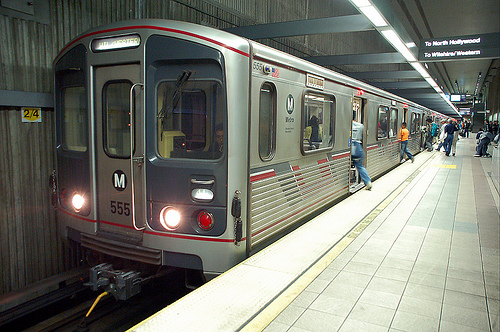
These join the existing Red Line subway… going from Union Station to North Hollywood via Hollywood and Universal Studios, the Purple Line subway…Union Station to Wilshire Bl. and Western Ave. (home of the Wiltern Theater), the Blue Line light rail…from downtown to Long Beach, the Orange Line busway…running from Woodland Hills to the North Hollywood Red Line terminus (note: the Orange Line has been extended to Chatsworth), and the Green Line light rail running from Norwalk to Redondo Beach via the median of the 105 freeway.

Metrolink also runs several commuter rail lines converging on Union Station from San Bernardino, Oxnard, Oceanside, Riverside, and Palmdale.  Metrolink has had its issues too, but in general, they are very accessible and responsive to wheelchair needs.


All of Los Angeles' rail lines, stations, and bus lines are wheelchair accessible.

Next time you visit, try some of the areas transportation options.  LA’s still not a transit paradise but we’re taking baby steps out of the car and onto the rails. 


Darryl

Copyright 2009 - Darryl Musick
Pictures courtesy of Wikimedia Commons
The Port of Authority
Alossic under CC-BY license
Foothill Transit under CC-SA license
Justin N under CC-SA license


Friday, March 11, 2016

Riding the Rails in the SGV: What to do Along the new Gold Line Foothill Extention


Residents along the foothills in the eastern end of the San Gabriel Valley have been waiting decades for this day. The Gold Line extension has finally opened, bringing light rail east from Pasadena to the edge of Glendora.

As the traffic woes of Route 66 and the 210 Freeway continue to build, this will provide just a bit of relief valve for those crowded roads as workers can now commute easier to jobs in Los Angeles, Pasadena, and beyond without having to drive.

This also opens up many more opportunities to get out and enjoy our region without the hassles of traffic, worrying about having too many drinks or finding a place to park. You can find dozens of articles this week about what there is to do near the new Gold Line stations but a problem I've found with them is that nothing they list is remotely within walking distance...Din Tai Fung is great but it's two miles from the Arcadia station and the Santa Anita Racetrack is almost as far; we love Old Town Monrovia but that's another mile hike and uphill at that; Slaw Dogs is one of the few good places to eat in Duarte but be prepared for another two mile jaunt.

With that in mind, here are our suggestions of attractions, sights, and places to eat and drink within walking distance (our limit is two blocks) of the new stations (follow the links for more information)...


Arcadia - Going east from the former eastern terminus of the line, the first station is in the town that Lucky Baldwin built.  Santa Anita Racetrack is here but that's about a mile slog from the station.  Nearer is Arcadia Regional Park (formerly known as Santa Anita County Park, two blocks south on Santa Anita Avenue) where you can picnic, climb trees (really, a place you can still do that!), lawn bowl, and even golf 18 holes.

Outdoorsy types can hit up the REI store, right next to the station, for all their equipment needs.

I'm Hungry, Where Can I Eat? - Nearer the station, you can grab some Mexican food and a margarita at Villa Catrina, just west of the station, across Santa Anita Avenue.  Of course, Arcadia is known for Chinese restaurants but the pickings are slim around the station. Asian food fans will love the Korean barbecue at Young Dong Garden, on Huntington Drive just west of Santa Anita. There's an old-fashioned, double-drive thru In 'n Out just northwest of the station at Santa Anita and Colorado Boulevard.  You can pick up sandwiches at Claro's Italian Market and Deli and have a picnic across the street in the park. Don't forget to have an incredibly good Liege waffle, some ice cream, and a great cup of joe at Taza, just west of Santa Anita on Huntington next to the Jiffy Lube on the corner.


A block or two to the east, on Huntington Drive, a lot of people like the beer and sandwiches of Matt Denny's Ale House (I'm not one of them) and there are a number of chain restaurants like BJ's Brewhouse, Claim Jumper, Red Lobster, Olive Garden, plus a very solid Chinese restaurant...Gold Dragon.


Monrovia - The city has big plans for it's station and will eventually develop the entire stretch on Myrtle to connect it to Old Town Monrovia about a 1/2 mile north.  For now, a new park and plaza at the station provides occasional entertainment at the attached amphitheater and kids can burn off energy at the new playground.

The old train station is yet to be developed but it should be a very nice place to stop in a few years.  Bill Monroe (the town's namesake) and other names from local history are buried at Live Oak Cemetery, one block west on Duarte Road.

I'm Hungry, Where Can I Eat? - For now, places to eat are very limited within walking distance. Aside from the Jack in the Box, across the street, there's a taco stand next to the adjacent car wash; a donut shop and burger stand a block south, and a dive bar that serves a better than expected breakfast (Tall Pines) a block north, near the 210 Freeway.

More is planned.  Expect to see food trucks take up the slack soon and Paul Kalemkiarian, owner of the Wine of the Month Club, has secured the right to develop the area around the station parking lot.  Expect a wine bar and cafe in the near future.

One block south, just past the donut shop, is Pacific Plate Brewery, a small purveyor of some mighty fine craft beer to wet your whistle.

Continuing on from Monrovia, be sure to look on the left side of the train before it gets to the next station to get a glimpse of the massive train yard for the Gold Line trains.


Duarte - This is a 'waiting for future development' station but there's still a little bit here.  Directly across the street is the City of Hope, one of the worlds premiere cancer research and treatment hospitals.  Between the station and the hospital itself is an outstanding rose garden to wander through.

I'm Hungry, Where Can I Eat? - Not too much around here but there are a couple of Mexican restaurants and a decent burger stand a couple of blocks west at the corner of Duarte Road and Buena Vista Avenue. On the other side of the 210 Freeway at Buena Vista is an outlet of the Old Spaghetti Factory housed in an historic Duarte schoolhouse.


Irwindale - This is mostly just a commuter stop and start point. Thousands of workers are expected to commute to jobs at the adjacent Miller Brewery (no tours, sorry) and the large Southern California Edison complex. The giant parking structure is in hopes that a lot of other workers will start their commutes to Pasadena and Los Angeles from here as well.  It would do well to get those cars off the 210 before clogging up the choking points at the San Gabriel River.

I'm Hungry, Where Can I Eat? - You're in a decidedly blue collar neighborhood here but that doesn't mean there's nothing to eat. McDonald's and Farmer Boys sit next to each other across the freeway. Callahan's is a decent watering hole with decent food, as well, a couple of blocks south. Picasso's server some more upscale food at it's deli one block south but closes before dinnertime as does Chica's Place across the street.


Azusa - Humble Azusa is primed to give the other stations on this segment a run for it's money in the dining and drinking sweepstakes.  Just a few blocks south of the entrance to the new San Gabriel Mountains National Monument (or Azusa Canyon, as it's known to locals), the train lets you out at the entrance to a monumental sized Target store and a block east of the pretty, old City Hall and Civic Center.

I'm Hungry, Where Can I Eat? - Right now, Azusa probably has the best and most varied selection of great places to eat within walking distance of the station.  A block south on Azusa Avenue is a burgeoning restaraunt row featuring City Cafe, Congregation Ale House, Bambino's Pizza, and Max's Mexican Cuisine who also serves one of the best margaritas in Southern California.  On the other side, a very short block west, you have Canyon City Barbecue, a donut shop, Cocinero's Express (for tacos and such), and Flo's Coffee Shop for breakfast and lunch.  On the other side of City Hall is California Grill...an excellent slightly above fast food place with beer and wine on tap...Taco King, and Tom's Burgers. Adjacent to the station is Tardino's Italian Deli and Kanpai Sushi.


Picture courtesy of Wikimedia
Simon Sheck under CC BY 2.0 license


Azusa/Glendora - Won't anyone think of the kids? Well, Metro did here by putting the last station on the line here, across the street from two colleges. Students of Citrus College and Azusa Pacific University can now take the train to classes helping to ease up congestion in their massive parking lots.

I'm Hungry, Where Can I Eat? - Other than college cafeterias and snack bars, there's really nothing adjacent to the station. A burger shack sits two blocks east on Foothill Boulevard and you can walk two long blocks south to Citrus and Alosta where you can find many chain outlets like Chick Fil A, McDonalds, and Applebees.

There you go, all the good places you can hit with your $1.75 basic fare.  If you've got more time and a thirst for more, you can go beyond to Pasadena, downtown L.A., Long Beach, Hollywood, and beyond.

Darryl
Copyright 2016 - Darryl Musick
All Rights Reserved

Wednesday, November 14, 2012

TRANSIT REPORT: Denver, Colorado


Denver is a very large city surrounded by a patchwork of smaller towns, plains, and mountains.  It's transit system is actively growing and is not quite a mature system.  Some things work quite well, others are OK, and there are still patches where transit is not yet a viable option.

Public transit here is provided by the Denver Regional Transportation District (RTD) and is a mix of light rail and buses.


LIGHT RAIL - Currently, there are five lines that make up the light rail system.  It runs two lines to the south to Englewood and Littleton and terminates at two points to the north of downtown, 30th and Downing and Union Station at the western end of the 16th Street Mall.

Inside, the trains are clean, modern, and fast. For wheelchair users, there is a raised platform at the end of each station at the driver's end.  A manual ramp is deployed by the driver to allow chairs and strollers to board.  In this configuration, up to three wheelchairs or strollers can be on any given train.  The trains themselves have a much larger capacity.  Either 12 or 18 chairs/strollers can be on a train (depending on if it is a 2 or 3 car train) and if the platforms were built to train level instead of below it, more chair users could be accomodated. 

New lines under construction are also following the lower platform model the current stations have.

Chair users must tell the driver where they plan on exiting so the ramp can be deployed.  This seems like a missed opportunity in universal design and puts an extra burden on wheelchair users that the general public does not have.

Another egregious lapse in the system is that it does not serve the airport but a line is under construction and service to the airport is expected to begin in 2016. To the west, a new line to Golden that will get you close...but not quite...to the Coors brewery will open in 2013.

BUSES - The buses run by the RTD are like most cities in the U.S.  A lift or ramp is deployed from the front door and up to two wheelchairs can be accomodated in each bus.  Tie-downs are installed in each position.

The bus system covers a much larger area reaching towns in the nearby Rockies to the west; Boulder to the north; Denver International Aiport to the east, and the county line to the south.

16th STREET MALL FREE SHUTTLE - One of the stars of the transit system here is the shuttle that moves people back and forth along the mile long 16th Street Mall from Union Station on the west end to the Capitol Building on the east end.  Just about anything you want to do in downtown is within 3 blocks of this route.

The buses are electric/hybrids and have multiple entry doors like trains.  Wheelchairs enter via the second door where the driver can deploy a manual ramp.  It's an easy entrance into the two wheelchair locations and tie-downs are available.  Buses run every couple of minutes and are among the easiest I've seen for wheelchair entrance and exit.  They are also free.

SKYRIDE - RTD also operates a bus service to the airport via large buses that serve Englewood to the south, downtown, Broomfield to the north, and Lakewood to the west.  It also connects with several light rail stations.  Fares run $9, $11, or $13 each way.

Unless noted above, the basic fare on buses or light rail is $2.25 (disabled $1.10), which is in the high range for most transit systems. 

Day and multi-day passes are also available, which would make it a little more affordable for travelers, except that they're not available at the stations...you have to buy them at approved retailers such as Safeway.  This makes it pretty hard for a traveler to get one when they're in town.


-Darryl
Copyright 2011 - Darryl Musick
All Rights Reserved
Front Range Express provides accessible bus service between Denver and Colorado Springs for $11 each way.

Friday, September 28, 2012

TRANSIT REPORT: Sacramento, California 2012

Picture courtesy of Wikimedia
mav under CC-BY-SA license


The capitol of the Golden State has a fairly decent system.  When in the area, especially on weekdays, you'll want to take advatage of it as the traffic here can be pretty unbearable at times.

Sacramento Regional Transit - or the RT - runs a network of buses and 37.5 miles of light rail covering a 418 square mile service area but for some reason does not serve the airport (Yolobus provides this service).
Picture courtesy of Wikimedia
lensovet under CC-BY-SA license

Light Rail consists of three lines, the Blue, Gold, and Green.  In practice, it's kind of like four lines because the Blue line goes both north and south of the downtown area so it's like a line to the north and a line to the south.  To the north, the Blue line's terminus is the Watt/I-80 station near McClellan Field (formerly Air Force Base).  The south end of the line is at Meadowview Road, about 4 miles south of downtown.  The Gold Line comes in from the east.  It starts in Folsom and continues past downtown to the Amtrak station, connecting with the Capitol Corridor train.  The Green Line runs from 7th and Richards, north of downtown, to the 13th Street Station downtown.  All light rail lines converge in a transit plaza two blocks west of the Capitol Building.  Here is the system map.
Picture courtesy of Wikimedia
Griffin5 at en.wikipedia under CC-BY-SA license

Buses handle the rest of the area and are useful to get to Old Sacramento, Raley Field, and ARCO Arena.  Here is the system map.

The basic fare for both bus and light rail is $2.50 for adults and $6 for a day pass.  Persons with disabilities get half off both of those fares.

Yolobus - As noted above, if you're flying into Sacramento, this is your only transit option.  The cost is $2.
Picture courtesy of Wikimedia
Todd Evans under CC-BY-SA license

The Capitol Corridor is a commuter rail service provided by Amtrak.  It connects downtown Sacramento with Auburn and Roseville to the Northeast and the Bay Area to the west with the terminus in San Jose.  The service from San Jose runs via Fremont, Hayward, Oakland, Martinez, Fairfield, and Davis.  Fares vary according to distance.  Check the website for more details.

All the above transit options are 100% wheelchair accessible.


We've personally found the transit in Sacramento to be a great way to go, especially during the week.  If you're there on the weekend and have a car, you might want to use that instead but transit will still keep you connected if you don't.

-Darryl
Copyright 2010 - Darryl Musick

Wednesday, February 9, 2011

TRANSIT REPORT: Phoenix, Arizona

Picture courtesy of Wikimedia

Spend a few days in the Phoenix, Arizona area and one thing will be apparent…this place is huge!  What looks like it might be just down the street on a map can end up being twenty miles or more when you drive it.
This kind of sprawl makes public transit quite a challenge…a challenge that the Phoenix area is still trying, with various degrees of success, to meet.
Valley Metro is a conglomeration of various regional and city transit systems all working under one consolidated umbrella.  Mostly buses, a light rail component was added in 2008 running from Tempe/Mesa to north of downtown Phoenix.  It also serves the Sky Harbor Airport.


LIGHT RAIL – There are 27 stations on the route.  An airport shuttle will transport you to the nearby station there.  It mainly travels down the center of streets so it’s more like a street car in some respects.  An extension to the Metrocenter Mall, north of downtown Phoenix is under construction.
Picture courtesy of Flickr

LINK – This is a rapid-bus system that uses long, articulated buses on very limited stop service.  Buses have stoplight override capabilities and the stops themselves have “next bus arriving in” signs letting you know how long until the next bus shows up. 
LINK runs from Gilbert and Mesa in the east and from Chandler in the south to the Sycamore/Main St. Transit Center at the eastern edge of Tempe.  Click here for a route map and brochure of the LINK system.
BUS – Local, express, and limited stop bus services makes up service to the rest of the more than 2,000 square miles of the metropolitan area.  Express routes have route numbers in the 500’s. 
Click here for a route map of the system.
Fares are $1.75 for local buses and light rail.  $2.75 for express bus services.  A day pass is $3.50 if you buy before you get on board, $5.25 if you don’t.  Disabled passengers pay $.85 for local and light rail, $1.75 for a day pass.
All Metro services are accessible for wheelchairs and other disabilities.  For more information, visit valleymetro.org.


Picture courtesy of Wikimedia