Showing posts with label transit. Show all posts

Wednesday, July 14, 2021

TRANSIT REPORT: San Francisco, California


(Note: Fares updated July, 2021 and face masks are required on all public transit - Ed)

San Francisco is California’s most transit oriented city. It’s the nerve center of Northern California and many regional transportation systems converge here. The city itself is served mainly by Muni (San Francisco Municipal Railroad) and BART (Bay Area Rapid Transit) with robust commuter rail service provided by CalTrain. Regional operators Golden Gate Transit and AC Transit also provide bus service into the city from points beyond. A number of ferry operators also provide commuter service across the bay into San Francisco proper. More than a dozen different operators and agencies also provide bus and rail service outside of the city to points around the bay.

MUNI - The city’s main transit provider runs a system of buses, trolleys, and cable cars.

Picture courtesy of Wikimedia
Steve Morgan under CC-BY-SA license

BUSES – Buses run just about everywhere in the city and it seems like you’re never more than a block or two from a line. There are regular fuel powered buses along with overhead wire electrified trolley buses. All vehicles in the MUNI bus fleet are now accessible. Click the following link for a route map.

Bus fares are $3, $1.25 for disabled and seniors. Transfers are free and can be used for two more trip, including returning to your original destination as long as you do it before it expires (120 minutes from original issue).

TROLLEYS – The trolley system here (not to be confused with the cable cars) runs down Market Street underground and to points beyond above ground. Historic trolleys…using restored antique trolley cars from around the world…run above ground on Market Street continuing on to Fisherman’s Wharf. All stations along Market Street are wheelchair accessible, both above and below ground. The historic streetcars are mostly accessible and stops either have ramps or embedded lifts that will raise your wheelchair up to door level when the car approaches. The T line is completely accessible, the J, K, L, M, and N lines are wheelchair accessible at designated stops only. See this link for a list and compare with this route map to see if your destination is served. If it can’t be done by trolley, chances are you can do it via the bus system.

Trolley fares are the same as the bus fares.

CABLE CARS – These are rolling historical landmarks and are not wheelchair accessible. If you do want to ride one, you’ll need to leave your chair behind. If you can walk a little bit, you can probably board. The cost is $8.

Visitors can purchase 1, 3, and 7 day passes that are good for unlimited rides on the entire system, including cable cars. The costs are $24, $36, and $46 respectively and are sold at various outlets throughout the city and the airport. Click the link to find sales locations.
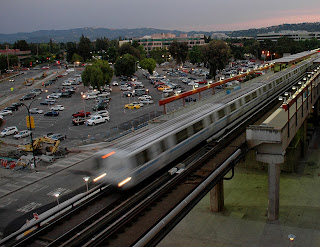


Photo courtesy of Wikimedia
Jon 'ShakataGaNai' Davis under CC-BY-SA license

BART is a heavy-rail system that works as commuter rail from points in the East Bay and the airport. It runs as a subway under Market Street. All lines converge here from Millbrae and the airport in the south and Fremont, Dublin/Pleasanton, Pittsburgh, and Richmond in the East Bay. The complete system and all stations are wheelchair accessible. Fares are distance based and vary, you can check this calculator to see how much your ride will cost. All BART fares are now paid via a Clipper Card, a one-time fee of $3 is required to buy one.

One word of concern about MUNI and BART – our experience with several of their station employees and drivers were the worst encounters we’ve ever had from transit employees that included being yelled at for a) asking a question, b) going the wrong way, and c) not knowing the name of the stop we wanted to get off at. Be prepared, they may get you where you’re going but not always with a smile.

CALTRAIN is a commuter rail line that runs along the West Bay peninsula from San Jose, and Gilroy just a little bit, to the San Francisco station just a few blocks south of Market Street. There are stations along the way in places like Santa Clara, Sunnyvale, Palo Alto, Mountain View, Redwood City, San Mateo, and South San Francisco. The passenger cars are double-deckers with wheelchairs riding on the bottom level. Each station has a wheelchair ramp built into the platform, chair users should wait on top to board the train…the conductor will deploy a ramp to get you in. Fares are distance based from a low of $3.75 one-way for one zone to a high of $15 for six zones. A day pass is available for twice the amount of a one-way ticket, disabled and senior riders pay a little less than half price.

FERRIES are operated by several companies and cruise into the city from Alameda, Oakland, Vallejo, Tiburon, and Sausalito. Fares start at $5.75 and disabled fares start at $2.75. All are wheelchair accessible.

AC Transit runs buses from Oakland and the East Bay and Golden Gate Transit from Marin County. All buses are wheelchair accessible.

A multitude of agencies run buses, trains, and ferries to other parts of the bay area that don’t come into San Francisco. For complete information about these agencies, plus the ferries and commuter buses, go to transit.511.org for complete transit information for the area.

San Francisco is one of the world’s premiere travel destinations and is very easy to see in a wheelchair. Have fun.


-Darryl
Copyright 2010 – Darryl Musick

Friday, April 23, 2021

Classic Trip: Seattle, Washington - Part 2


(Please read our Covid 19 Statement first - Ed) We'd saw some overpriced baseball, met some TV stars, watched big fish swimming underwater, and just missed having to be evacuated from a monorail.


The next morning, we decide to walk downtown. A bit of a mistake when we pass a rough section where drug deals are taking place out in the open and a couple of guys start to fight because one thinks the other shorted him out of a couple of rocks of crack. It’s just a short strip down the wrong street but next time we’ll get back on the bus instead.


At the ferry terminal, we buy our tickets and take a 30 minute trip across the sound to
Bainbridge Island. It’s about a half mile walk from the ferry terminal to the middle of town…there are also buses if you can’t walk that far…where we find a delightful little farmers market going on with some unusual fruit and vegetables. We buy some to make a picnic with later. Down at the waterfront, we find a boardwalk and dirt trail along the water that allows us to hike about half a mile up an inlet where we see some old ferries being mothballed, many blooming flowers, birds, and some beautiful houses.


Back in town, we buy some burgers to go with our fruit for a waterfront picnic.

After spending the morning in Bainbridge, it’s back on the boat. My wife wants some seafood, which curiously, we cannot find a whole lot of here. Some guides suggest Ivar’s, near the ferry terminal, so we head to an outdoor counter there where you can buy food to eat in a nearby dining area.


Ordering here is unique…basically there is no line, no system. Everybody crowds in and when the order taker is ready, everybody just kind of shouts their orders in at the same time. I’m told this is just the traditional way to do it here. We do eventually get our food but it is very chaotic and confusing…not really my cup of tea. The food is good, but it is heavy on the “deep fried” variety of seafood.


Earlier in the week, we walked through the Seattle Center where the Space Needle is located. We had learned that it would be $16 just to take a ride up in the elevator. That’s quite steep. I also learned there are a couple of alternatives.


The circa 1914 Smith tower (of Smith/Corona typewriter fame) near Pioneer Square is one of them. Just a bit shorter than the Space Needle (522 feet vs. 605 feet), the observation deck is actually 2 feet higher than the Space Needle, which has a deck at 520 feet. It’s only $7.50 to go up here to the famous Chinese room and to step out into the fresh air.


It’s very beautiful up there, and it’s not just the view. The owners have amassed a collection
of Chinese antiques and furnishings to enhance the surroundings. A chair up there is supposed to grant magical powers to single women that sit in it…they are to find their groom after doing so.


It is at this point where I’d usually say we went back, had another nice night in the hotel, and went back home but there is one more adventure that would await us. I called the same taxi company that brought us from the airport and reserved an accessible cab for noon the next day to take us back.


At noon, waiting in the rain in front of the hotel…nothing. At 12:20, I called the cab company and asked where the cab was. The man on the phone said, quote, “just because you reserved a cab doesn’t mean one will show up.” When I asked for an ETA, he hung up the phone somewhere between the letters T and A.


Where I come from a reservation means they will set aside the item to be reserved. Also, when a paying customer calls and…politely I might add…asks where the item to be reserved is and when it will be there, you don’t hang up on them.


We had a problem; the airport is 15 miles away on the other side of town. We had no idea when, or even if, our ride would get there. We had one slim chance to get out of town in time to make our 2:40 flight.


Grabbing our bags, we hoofed it to the busiest bus corner about two blocks away. When a bus pulled up, we ask the driver the quickest route to get to the airport. She said, “hop on.”

At Pioneer Square, she dropped us off at the Downtown Transit Tunnel and told us to catch a bus down there (the transit tunnel is like a subway, only used by buses instead). We find the bus, get on, and make it to the airport about an hour before departure. Indeed, Seattle transit workers are the nicest and most accommodating we’ve ever encountered…they really saved the day, and our vacation, by their actions.


As I’m waiting in the departure lounge, my cell phone rings. It’s the taxi driver. He’s in front of the hotel, wondering where the hell I am. I said to him “do you know what your dispatcher did to me when I called?” He said no. I pressed the disconnect button.


Darryl
Copyright 2009 - Darryl Musick
All Rights Reserved

Monday, April 19, 2021

Classic Trip: Seattle, Washington - Part 1


(Please read our Covid 19 Statement first - Ed) The scene on TV is scary. About half a dozen firetrucks…lights flashing, ladders extended…were under the track of the monorail. Frightened passengers were climbing down waiting for the safety of solid ground under them.


That could’ve been us...


The flight to Seattle was nice. Southwest Airlines has vaulted its way to the top of domestic carriers with a simple strategy; keep it simple and keep it consistent. As “passengers with special needs”, we were able to board first and snag the bulkhead seats. One knock on Southwest is that there are no reserved seats for most passengers. It’d be nice to know ahead of time where you’ll sit but this is one time being disabled comes in handy.


The flight left from Ontario, California right on time at 9:50am. The baggage handlers deftly handled Tim’s 350-pound power chair, using a special lift right outside the jetway door. A quick stop in San Jose, and we’re arriving at SEA-TAC airport at 12:30pm.


I had called a taxi service ahead of time to reserve an accessible cab but they said just to call when we arrived. I did and we had a ride within 30 minutes. Don’t cheer too much, though, as you’ll see later.


It was half an hour and $42 dollars later that we arrived at our hotel, the Homewood Suites in the Queen Anne District, just three blocks from the space needle and across the street from the late Post-Intelligencer newspaper building with its beautiful globe on top.


I had called about two weeks earlier to make reservations and talked to an Ed at the reservations office. All the accessible rooms were taken but he assured me he’d have a bath chair put in the room if we stayed there. At $215 dollars a night, this was the cheapest decent hotel I could find so with a little trepidation, I made the reservation.


At check in, who else would be manning the counter but Ed who not only remembered our phone conversation but also told me to check out the room and let him know if the chair he put in was OK. It was and provided a nice level of access in the bathroom…all we needed, really.


The room itself was a spacious two-room suite with a separate bedroom and a queen sized sofa bed. It also had a small kitchen, walk-through closet, robes, ironing board, and just a slight view of Puget Sound out the window.


There is an evening manager’s reception…with beer, wine, and appetizers…along with a hot buffet breakfast served each morning. One notable thing is that a nice, local microbrew is poured along with the usual bud and bud light. The bar is manned by Ed who greets us and tells us what appetizers he’s serving. While Ed is pouring the beer I comment to him that he sure seems to be everywhere. He tells me that the managers take turns running the reception by picking what appetizers will be served and manning the bar. It’s a very hands-on approach and I don’t know when I’ve had better service at a major chain hotel.


That evening, at Ed’s suggestion, we walk a little over a block to Buckley’s. This is a local pub that serves great microbrews for $3 during happy hour and served one heck of a macaroni and cheese dish for $13. Bubbling with cheese and infused with bacon, it’s the best dish we’ll have this week.


We continue on to the Seattle Center…the former World’s Fair site…and try to ride the monorail into town. I say “try to,” because it is not working at the moment. The workers have no idea when it will be running.


After a delicious breakfast in the hotel’s very nice dining room…with its floor to ceiling windows giving a view out to the sound…we head downtown. There are two major bus stops near the hotel with frequent bus service. Unfortunately, we are just outside of the downtown free fare zone, so we have to pay but it’s not much and 20 minutes later, we’re downtown.


Our first stop is the Mariners Team Store to buy tickets for a game. The main reason we’re in Seattle at all is that we’re trying to add another stadium to our list. Tim’s goal is to see every major league stadium. We get tickets at first base at the top of the field level for $60 each. This is a bit steep when the same tickets at our stadium…Angel Stadium in Anaheim, California…are $24. This is also for a team that will go on to finish with the less-than-stellar record of 61 wins and 101 losses to finish in last place 39 games behind the division champion Angels.


It’s not a long walk from there to the Pike Place Market, home to the world’s first Starbucks and the flying fish guys. It’s a very touristy place and also has a lot of traffic on the street out front but there is some great produce here. We buy some fruit to take back to the hotel, watch the guys throw some fish around, visit a few shops, and head back to the hotel to rest up for the game.


A couple of blocks away, we’re able to catch a bus that will take us all the way to Safeco Field, home of the Mariners. We get there early and the Pyramid brewery and bar are right across the street having happy hour but Letty and Tim aren’t interested. We get in and, as we do with any new stadium, take a lap around to see what’s there.


We find our seats and are shocked to find they are completely blocked by a TV camera platform. I can’t believe they charged us $180 dollars to sit here! I find an usher and complain. He says I have to wait for a manager who, when he shows up, allows us to move.

Mind you, this game is far from a sell-out. Less than half of the seats will be filled tonight…this is just unforgivable that the team would sell us such lousy seats at these prices when many better locations were available.


At our new seats…about fifty feet away from our original location…we settle in for the game. I get us some of the local specialty snack…Ichi Rolls from the Sushi stand…and watch at Ichiro, Arian Beltre, and company go down in flames again.


One very nice feature to the stadium is that in rainy Seattle (yes, it rained nearly every day, even in August) there is a roof over the park to keep it out. It is still an outdoor stadium; it’s just that the retractable roof rolls over like a giant umbrella when it starts to rain. That’s what makes it funny when I see during the next season that they had a rainout in Seattle. Really?
They couldn’t put the roof on?


After the game, we go outside to catch a bus going back. We find out that one bus comes by around every twenty minutes. One…for the several thousand fans that are exiting.

Luckily, the bus driver sees us and holds everybody else back so that Tim and his chair can board first. We also find out that we have to transfer to another bus at Pioneer Square to continue on to the hotel.


Now I have to note that there is a commuter rail station right next to the stadium but it doesn’t occur to anyone here…supposedly the greenest city in America…that it would alleviate so much traffic to the game to run trains? Only on certain weekend games to they run Sounder trains…not during the week. Only that lonely, solitary bus coming by every twenty minutes.


(Note: The new Link light rail, which opened up a year later, now serves the stadium)


I have to say at this point, however, that the bus drivers in Seattle are the best and nicest transit drivers we’ve ever come across. They always strapped down the chair, were friendly, and never hesitated to give us information about the town while we were there. They would also turn out to save our bacon in a major way later.


The next day, we walk over to the Seattle Center. The monorail is still broken. Inside one of the halls, we have a very good hot dog and go outside to see the fountains. They have this cool fountain set in a large bowl that the kids can go play in. It even has a wheelchair ramp that spirals down the side. After much coaxing, Tim finally goes down and has the time of his life dodging the spray.


I notice a monorail moving along the beam. We hurry to the station, buy tickets, and we’re off on the cheesiest transit you’re likely to come across. The driver dresses like he’s on Star Trek and sings Elvis songs during the one-mile journey. The train is old and, of course, looks like what people in 1962 thought trains would look like in the future.


At the other end in downtown, we explore the area, have some coffee, visit the Nordstrom’s flagship store before hopping back on board to the Seattle Center.


Next, we get some sandwiches from a nearby deli and catch a bus to Ballard. Another bus takes us the last mile to the Ballard Locks, a Corps of Engineers project that allows vessels in from the salt-water sound to the fresh water Lake Union and on to Lake Washington by lifting them in the twin locks.


It’s an interesting process to watch…you can go right to the edge, talk to the people on the boats as they wait to be raised or lowered. Afterward, you can go across the locks to the salmon ladders on the other side.


A ramp lets wheelchairs into the underground chamber where you can watch the massive fish swim upstream. Going out to sea, large pipes act as waterslides giving the fish the ride of their lives as they shoot into the ocean.


Back on the Ballard side of things is a nice park and pretty garden where we have a picnic of our sandwiches on top of a green hill looking down on the locks.


Instead of the bus, we decided to walk back to Ballard going by way of a few shops along the way to buy some smoked salmon to take home. We also see a couple of genuine TV stars…the Wizard and the Northwestern. These two boats are featured on the Discovery Channel’s Deadliest Catch and are based here in Ballard, as are a few other boats from the series. Didn’t see any of the Hansen brothers though.


Back on the bus, we get stuck in a massive traffic jam but finally make it back to the hotel. Some more light rail or even a few ferries would make this city much more bearable.


At the hotel that night, I’m watching the news where a scene of multiple fire trucks have their lights on and ladders extended. It seems that the monorail broke down again…just a few hours after our ride…and the passengers were being evacuated down those ladders. I don’t really want to know how they would have had to evacuate Tim.


Stay tuned for part 2...
 
Darryl
Copyright 2009 - Darryl Musick
All Rights Reserved

Wednesday, August 19, 2020

Riding Public Transit in Berlin and Munich, Germany With or Without a Wheelchair


(Please read our Covid 19 Statement first - Ed) T
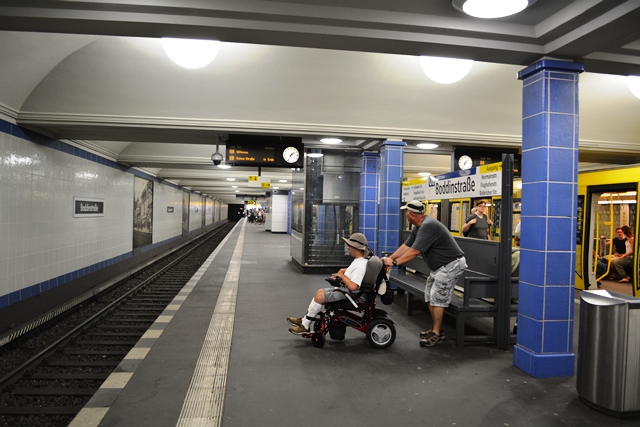
ransit in Berlin and Munich, at least, is very accessible. More so than in many U.S. ADA-covered cities like New York or Chicago even.

We like to use trains (such as the U-Bahn subway system) as much as we can but also know that the buses are accessible, too. While we'll get to the trains and trams below but first, the bus. 


Watch the Video!


Wave to flag the bus driver that you'll want to board the bus. You'll most likely enter via the rear door where a ramp can be deployed.  A wheelchair section will be at mid bus, the correct position is to sit rear-facing against the bracing board. Many buses also have a strap that you can request the driver put across you for added security.

You can tell the driver where you want to exit or press the button with the wheelchair symbol next to the wheelchair section. This will let the driver know that a wheelchair needs to exit at the next stop.


On buses, as with trams, you will most likely purchase your fare ticket on board (there are a few spots, like the airport or larger train stations where you can buy the ticket ahead of time). Please note that just purchasing the ticket does not make it valid...you must validate it on the bus or tram (or ahead of time, if you have access to a validator) with the machine that stamps it with the time and date.

This ticket must be shown to fare inspectors upon demand, who will check the time and date to see if it is expired or not (fare is good for two hours on a basic single ride ticket).

In larger German cities, the U-Bahn and S-Bahn are the backbone of the system. It's equivalent to the subways and commuter trains of larger American Cities.

For the U-Bahn and S-Bahn, you must buy and validate a ticket before getting on the train.  For all trains, buses, and trams, you can also buy multi-day passes.

Before riding on the U-Bahn or S-Bahn, it would be very helpful to check a subway system map to make sure the station you want to go to is wheelchair accessible. The system maps don't always show wheelchair symbols but they do have either an elevator icon, or a ramp icon indicating which type of access is available.

Berlin System Map
Munich System Map

If neither icon is showing, the station is not accessible to wheelchairs.


Most trams in both cities have either ramps or lifts into the vehicles. For any means of transit, the best place to wait is where the front of the train, tram, or bus will be so the driver can see you and deploy any ramps or lifts necessary.

All barrier-free (barrierefrie in German) stations have a folding ramp, so if you get a train with a gap that you cannot manage, the driver or station attendant is supposed to deploy that ramp for you.

For more information, please visit the respective websites below.

Berlin Public Transit
Munich Public Transit

Darryl Musick
Copyright 2016 - All Rights Reserved


Photos by Letty Musick
Copyright 2016 - All Rights Reserved


Wednesday, September 25, 2019

TRANSIT REPORT: Calgary, Alberta, Canada


Calgary is the 3rd largest city in Canada. It has a well-defined city core, which helps in transit planning.

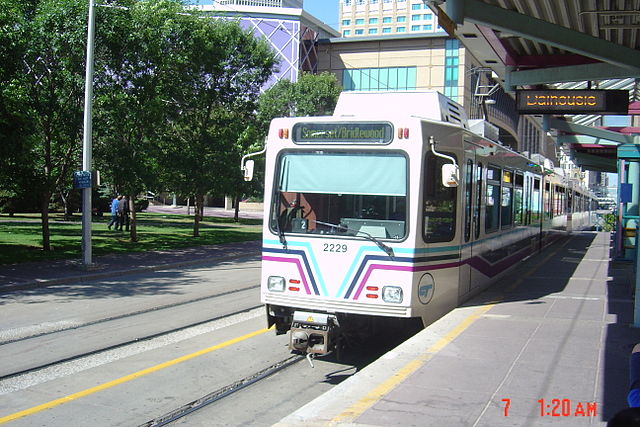
The transit system here is made up of three components. The C-Train is the system's light rail service. Bus Rapid Transit (BRT) serves future, planned light rail line routes, and local bus service makes up the rest.


The C-Train has two lines but acts like four lines converging on downtown...the Red and the Blue.

The Red Line reaches Tuscany in the northwest portion of the city, transits through downtown, then continues on to Somerset in the southeast section of the city. 

The Blue Line covers the other two points on the compass, coming from Saddletowne in the northeast to 69th Street in the southwest after going through downtown.

Each car on the C-Train has a dedicated door for wheelchairs/walkers/scooters. There is no designated spots on platforms where these doors line up with so you need to watch the train as it arrives to determine a) which door has the wheelchair symbol on it and b) where you need to go.

The accessible doors have a well-marked button that you press, which deploys a ramp so you can wheel in from the platform onto the train.

Both trains travel down 7th Avenue in downtown Calgary where they share eight stations from City Hall in the east to 8th Street in the west.


There are five BRT routes. BRT serves the airport but C-Train doesn't. Line 300 is the airport line, 301 comes in from North Pointe, 302 Comes from Cranston Avenue south of the city, 305 goes from Olympic Park in the west to Ellison Lake in the east, 306 travels from Westbrook Centre, just west of downtown, to Heritage Station south of town. All BRT lines, with the exception of 306, converge on the downtown corridor.


160 local bus lines reach the rest of the city.

All the buses are wheelchair accessible.

Local fare (in CDN) is $3.25.The airport line (300) is $10.00, which is basically a day pass since it is the same price and allows you access to all transit in Calgary. As stated, a day pass is $10.  The downtown zone on the C-Train between City Hall and Downtown West/Kerby is free.

Find more information here: Calgary Transit

Darryl Musick
Copyright 2017 - All Rights Reserved

Wednesday, August 14, 2019

TRANSIT REPORT: Houston, Texas


Metro is Houston's transit authority and it runs a system of three light rail lines and a web of bus lines through the region.

The light rail system serves the downtown area very well with frequent service to most points of interest. What it fails to do is serve either airport, George H.W. Bush International or Houston Hobby Airport.

Lines come in from the east (Green), south (purple and red) and north (red) and converge on the Main Street/ Fannin corridor downtown.


The system is 100% wheelchair accessible and you can get maps and more information at ridemetro.org.

That is pretty much the entire system, it works well for the city, especially well in the central city, but lacks commuter bus or rail for points farther out.


Fare is $1.25 and is good for three hours.  Disabled fare is $.60. A day pass is $3 but it's a weird way to pay...you must load at least that amount on a fare card (tappable at the station to validate the fare) and, after three taps, the card won't collect any fare past $3.

Find great gifts at WineoftheMonthClub.com!

Darryl Musick
Copyright 2017 - All Rights Reserved

Wednesday, July 24, 2019

TRANSIT REPORT: Dallas, Texas


While central Dallas has pretty good public transit, it gets a little bit harder to find the farther out you go. The main components of the Dallas Area Rapid Transit (DART) are buses and light rail. There is also limited trolley service, a commuter railroad (TRE and DCTA), and paratransit.

Light Rail consists of four lines that bring commuters in starting at nearby suburbs, converging on the Pacific Street corridor in downtown Dallas.The suburban terminals are Carrollton and Plano to the north; Rowlett to the east; Buckner to the south; and Westmoreland to the west. The Orange Line also serves Dallas-Fort Worth International Airport. There is no train service to Love Field, home of Southwest Airlines.


The train cars are split-level with wheelchair seating available in the middle of each car on the lower level. Low floor entry is available at the doors where the wheelchair seating is.


Farther out, you can catch the TRE from Fort Worth and the DCTA A-Train from Denton, north of Dallas.

Both of these commuter railroads operate Monday through Saturday.

Numerous bus lines, all accessible, cover most of the rest of the area with the exception of Arlington (home of the Cowboys and Rangers), which has very little in the way of public transportation.

The basic DART fare is $2.50, or $1.25 for reduced (disabled/senior) fare. This is good for two hours. A day pass is double those amounts.

TRE is $2.50 per zone (there are two, if you go beyond DFW airport, it's an additional zone) and half that for reduced fare. From 9:30am to 2:30pm, unlimited riding is available on the midday pass for $1.75.


Basic fares on the DCTA is a dollar more than TRE but reduced fares are 50 cents less.


There are numerous HOV (or carpool) lanes on the areas freeways. Be advised that they are not free and a bill will be mailed to you based on your vehicle's license plate. If it's a rental car, it will be added to your bill. A sign at the entrance to the lane tells you how much the current toll is.


Free Gift with Every Gift Membership!

Darryl Musick
Copyright 2017 - All Rights Reserved

Wednesday, June 12, 2019

FIELDS OF DREAMS: Oracle Park, San Francisco, California

We've reached number 2 on the list of Major League baseball stadium that we've visited. So close to the top, it's the home of the current (and 2010) world champions, it's Oracle Park in San Francisco...


Oracle Park (formerly PacBell Park, formerly SBC Park, formerly AT&T Park) is the home of the San Francisco Giants who moved here from cold, windy Candlestick Park when the 2000 season began. In 2002, three games of the World Series were played here when the Giants faced the Angels for the crown. They lost to the Halos in the 7th game of the series in Anaheim.

Finally, nine years later and an eternity away from the Barry Bonds drama, they picked up their first west coast world championship when they beat the Texas Rangers in the World Series.

Over the curse of the Barry, they came back on the back of the beard...Brian Wilson...the closer that helped lead them to another championship last fall.

This year, 2013, they've fallen into the cellar, lost their closer, and are almost 20 games back from the resurgent Dodgers, who now have Brian Wilson and a good shot at the pennant . Over the years, many legendary players have been on this, one of Major League Baseball’s oldest teams. In fact, since becoming a team in 1883, the Giants have won more games than any other team. Willie Mays, Bobby Thompson, Willie McCovey, Gaylord Perry, Juan Marichal, and Barry Bonds have all called this team home. In 1989, they played their cross-bay rivals – the Oakland A’s – in a World Series that was interrupted by the 6.9 Loma Prieta earthquake. After a ten day delay, they were swept by the A’s.

Here are the stats…

Year opened: 2000
Surface: Grass
Construction cost: $357 million
Capacity: 41,915
Field dimensions: Left field – 339 ft.; left center – 404 ft.; Center field – 399 ft.; right center – 421 ft.; Right field – 309 ft.
Home teams: San Francisco Giants (National League, MLB) 2000 –present; San Francisco Demons (XFL 2001; California Redwoods (UFL) 2009; California Golden Bears (NCAA) 2011
Events attended: one game


One of the most beautiful parks in baseball with gorgeous views of San Francisco bay. In the park, large sculptures of a baseball glove and a Coke bottle invite kids to come out and play. The bottle has slides that the kids can use – a ramp even lets wheelchair users go to the top of the slide but I don’t know what you’d do once you got there. In right field, big windows open up onto the cove where fans on the sidewalk can get a glimpse of the game being played inside. It’s also the only major league stadium that I know of that uses a woman as a public address announcer.

The playing field has one feature I personally do not like, onfield bullpens. I think it’s dangerous and unnecessary. Other than that, the field is immaculately maintained.

Yes, we were there to rub it in the next year!

The seats in the stadium are canted toward home plate, unless you’re in the wheelchair section where they just point straight ahead. Accessible seating is plentiful here and available on all levels. We sat in the upper deck where wheelchair users and their companions sit in the third row.

Ticketing can be difficult as most games are sold out. Over the phone, we did not have any problem except trying to actually speak to someone. It’s a voice-mail hell when you call the front office and the prompts lead you nowhere. Press “0” (not an option on the voice menu) and you’ll get an operator who can quickly transfer you to someone. Once we did that, we had a friendly ticket seller who promptly sold us the tickets we needed. Ticket prices are demand based and set like a stock market, they can rise and fall with the demand…the team’s website list the current prices on a chart. As of this writing, prices range from a low of $13 to a high of over $250. I don’t know if I like that system.

At the stadium, wheelchairs are ushered to the VIP entrance where disabled fans can use the park’s only public elevator to reach their level. Once we got to the top deck and the usher showed us our seats, no wheelchair locations were to be seen, however, the usher promptly took a wrench out of his pocket and removed a seat, revealing the wheelchair location.

The staff here is very friendly and efficient. One thing I like here is that the ushers do not let anyone take their seat during game play action. You must wait until the ball is dead before you can return to your seat so you don’t block someone else’s view. They are also very good at keeping standing fans out of the wheelchair areas, which is a big problem at a lot of other parks we’ve visited.

The food…simply the best in baseball as you’d expect in such a gourmet’s delight as San Francisco. Orlando’s Caribbean Barbecue in Center Field has delicious island inspired food such as the ChaCha Bowl, filled with jerk chicken, veggies, beans, and rice sprinkled with habanero sauce if you want it.. The basic hot dogs are among the best in the league. A plethora of different beers are on tap, along with a great selection of wines and cocktails. The park is famous for starting the garlic fries revolution among baseball, although I’ve had better in France and at the Date Festival in Indio, California. That East Coast guilty pleasure, fried dough, can be found here…a very good version covered in melted butter, powdered sugar, and cinnamon.

As can be ascertained by the description above, Oracle Park is among the minority of ballparks that serve Coke instead of that overly sweet Pepsi. Prices are on the high side.

The stadium is well served by transit. Muni’s trolleys run right to the stadium after they pick up passengers from the BART subway on Market Street. It’s all accessible but be warned that the meanest, rudest, and “could not care less” transit employees we’ve ever encountered work for these two transit agencies.

So it boils down to great views, good team, fantastic food and drink, good staff, good wheelchair seating, decent transit, challenging ticket policies and pricing. Still enough “pros” to outweight the “cons” and make Oracle our pick for the second best Major League stadium and the best ballpark west of the Mississippi.

(Note: We will be visiting and updating this park later this summer...2019...so stay tuned for an update - Ed)

Darryl
Copyright 2010 – Darryl Musick
Updated for 2013

Wednesday, May 1, 2019

FIELDS OF DREAMS - Great American Ballpark, Cincinnati, Ohio


The Great American Ballpark on the banks of the Ohio River in Cincinnati is home to the oldest professional baseball team in America, the Reds, dating back to 1869.  The team that is, not the stadium.  The ballpark opened in 2003 and replaced the cookie-cutter like Riverfront Stadium, a dual-purpose football and baseball facility.  Baseball legends such as Pete Rose, Frank Robinson, and Johnny Bench have worn the uniform but did not play in this park.  More modern players such as the recently retired Ken Griffey, Jr., Scot Rolen, Joey Votto, and Bronson Arroyo have.  Here are the stats:

Photo courtesy of Wikimedia
Eric Kilby under CC-BY-SA license

Opened: 2003
Surface: Perennial Ryegrass
Construction cost: $290 million
Capacity: 42,271
Field dimensions: Left field - 328 ft; Left center - 379 ft; center field - 404 ft; right center - 470 ft; right field - 325 ft.
Home team: Cincinnati Reds (National League - MLB) 2003 - present
Events attended: 1 game


Watch the Video!

Good access but it would be nice if there were an accessible entrance from the river side.  There are several places you can walk up to the entrance level but they all have stairs.  There is on lobby by the left field foul pole with an elevator but it is closed to the public on game days.  A large accessible plaza is at home plate where you can pick up tickets from the will call booths.  The concourse is open so you can still keep tabs on the game when you go for snacks.

Wheelchair locations are at the top of the field level, at the top of the club level, mid level on the upper deck, one spot in the front row behind the plate, mid level in the outfield bleachers, and a section halfway up the bottom level behind home plate...these are probably the best wheelchair spots in the stadium.

Ticketing is fairly easy, just call the box office at 877-647-REDS.  We had no problem getting seats for the wheelchair and two companions.  Ticket prices start at $6 and go up to over $300, not including the suites, due to dynamic pricing. 

There is not a lot of good public transit to the game.  There is a local shuttle, $1.50, that cruises around the stadium area every 20 minutes or so and connects with Covington/Newport across the river in Kentucky.  It is easy to walk across the bridge from Kentucky and the downtown location makes it convenient to hotels there.

Many lodging choices are available.  The most lively area is across the river in Kentucky where many hotels, restaurants, bars, and attractions are available.

Food choices are minimal here.  Hot dogs, burgers, pizza, popcorn, and nachos are the staples.  Very few alternative choices are here.  The beer selection on tap is vast and inexpensive.

If it had better food and transit options, this stadium would be in our top five.  It's still a very nice stadium, several notches above our home stadium in Anaheim.

Darryl
Copyright 2012 - Darryl Musick
All Rights Reserved
Updated for 2013