Tuesday, July 29, 2014

Not All Pests Are Animals or Insects...


Well, I want to start off the post with something pretty. The Dragonfruit, which go very quickly from bloom to ripe, are ready. I picked this one and another one this weekend. This particular variety has a deep, dark, hot-pink flesh inside its fruit.

I wish it would produce more. The plants, a cacti, have little thorns that keep the animal pests off so I don't have to worry about the squirrels or deer getting to them. They also are very drought tolerant, which would make them ideal if they produced more fruit.


Speaking of pests, this morning I saw a lady come down to our back wall and snatch a large cluster of flowers from our plumeria tree. As you can see above, it grows a bit over our back wall. There's a public jogging trail on the other side.

I guess, I don't mind them taking whatever grows over to the other side, I just hope they don't harm the plants or think they can reach over the wall and take whatever they want. 

How do you feel about parts of your plants that grow beyond your property?  Is is open season on whatever grows there?

In other parts of the garden, you might have heard that California is in the worst drought of our history. The state has announced fines of up to $500 per day for visible water wasting. That's in addition to a conservation rate of 20%...we must cut back 20% on our water use.

I wonder about that last one. I've been trying to cut back for years. In fact, I qualified for a lower sewer service rate because we cut back 20% years ago. Do I now need to cut back another 20%?  What about those around me who haven't cut back at all.  Do they get to waste more water than me?

I tell you, the more I think about it the deeper the confusion is. 


Here's our lawn, which I have on a timer. You can tell it's suffering from lack of water, I'm just trying to keep it alive enough to come back when the rains do. It gets 10 minutes of water very, very early in the morning so that all the water is soaked in before the sun comes up. 

This is typical of what the lawns in our neighborhood look like right now.

A couple of people have stopped watering altogether but that brings up a lot of dust. What to do?  I think I might swing by the city hall someday and see what they will allow me to grow there instead of grass but that also might cost quite a bit.

Darryl
Copyright 2014 - Darryl Musick
All Rights Reserved

Monday, July 28, 2014

CLASSIC TRIP - Monterey, California


Interstate 5 is generally acknowledged to be the quickest route from the southern half of California to the northern half. It’s a no-nonsense, straight arrow, 70 mile-per-hour stretch of freeway through the Central Valley. It’s also one of the more boring drives in the state.

I much prefer highway 99 through the valley or the 101 along the coast where scenery and small towns at least pique your interest now and again. But today, we’re trying to minimize our driving time so it’s up the 5 we go until we get to the pass over to Hollister and then along a busy country road to the coast. Our final destination is Fisherman’s Wharf in Monterey and our time to get there is 6 hours, including a gas stop and a Burger King stop in Kettleman City.


Home for the next two nights would be the Doubletree Hotel (now the Portola Hotel - Ed) adjacent to Fisherman’s Wharf in downtown Monterey. This would cost us the advertised $89 per night, plus tax and parking...not a bad deal for the location.

It does take some effort to find the driveway to the hotel. The highway dips into a tunnel under it and then offers no place for a U-turn for a mile. Once we double back, the one-way streets that make up the downtown area keep us circling the block until we can arrive at the proper place to turn in. Since the valet only costs an extra two dollars a day, we opt to pull up to the door and let someone else worry about the parking.

I ask, but no accessible rooms are available when we arrive...I was also told this when I made the reservation, but it couldn’t hurt to ask. What we did get was a beautifully decorated room with two double beds, a view of the courtyard, with plenty of room for the chair but none of the usual accessible features such as grab bars. Since it was roomy, we compensated fine. Also, at check in we receive those delicious Doubletree chocolate chip cookies.

The next morning we head over to Cannery Row and have breakfast at the Culinary Center of Monterey, a combination cooking school, kitchen gourmet store, and restaurant. Their all-you-can-eat gourmet breakfast buffet is $12.95 per person with kids paying one dollar per year of their age. The restaurant is on the second floor but the main entrance (in back) is nicely ramped.

The tables here have a spectacular, if drafty, view of the bay and the food is very delicious. A very subtle chorizo and egg dish (the chef has a secret source in Salinas for the sausage), salmon crepes, cornbread french toast, and a fresh-fruit parfait are just a few of the delectable offerings today. We load up on this great food and head out for our day with tummies full.

It’s a forty minute drive north to the beaches of Santa Cruz. The last classic boardwalk amusement park sits on the sand here (Pacific Park in Santa Monica is a new version of these old beachfront parks but doesn’t count as a classic...yet). Admission is free and crowds of people are taking advantage of it this morning.

Santa Cruz Boardwalk and the Giant Dipper
Photo courtesy of Wikimedia
Larry Pieniazek under CC-BY-SA license

Our goal today is the 1924 vintage, Arthur Looff built Giant Dipper roller coaster. This classic woody is lovingly maintained and is on many coaster fans top ten lists. It’s also appeared in such diverse movies as The Sting and The Lost Boys.

We buy our tickets and check the access. Wheelchair riders enter through the exit where a button can be pushed to summon a ride operator to let you in. You get your choice of seats...we take the front. As usual, you must bring your own help for transferring out of your chair and into the seat, but the seat was just a bit roomier than most modern coasters and therefore just a bit easier to get into.

On Board the Dipper

Although the ride is exciting, the speed and elements seem quaint and tame compared to today’s monsters but it has one element that’s a doozy. When your train leaves the station, it immediately drops into a pitch-black tunnel featuring two very quick u-turns before coming out into the daylight and engaging the lift chain. No other coaster I’ve yet been on gives you such a quick scare and thrill before even starting up the lift.

The rest of the ride is medium fast (top speed 55 mph), with lots of curves integrated into it’s drops. The head-chopper effects are kind of minimal compared to such coasters as Ghostrider, Scandia Screamer, and the Cyclone. It’s a solid minute and a half ride, with one really all-star element...that tunnel drop out of the station.

Afterward, we munch on a mundane order of garlic fries. Not nearly as good as the garlic fries we got at the Date Festival in Indio or at Cajun Way restaurant in Monrovia, but better than nothing.

That’s it for us and the Boardwalk. Classic amusement park ride fans may also want to check out the circa 1911 Looff Carousel here too where you can still grab for the brass ring and get a free ride.

Next, we head over the hills, inland to the little town of San Juan Bautista.

For California history, you need to start with two things. The Gold Rush had a huge impact on the state (see our gold country and Yosemite reports for more), but before that, the Spanish set up a string of missions that every good Californian must visit at some time or another. Missions are special places for us and our family has visited several of them. Heck, my wife and I even got married in one.

The missions were churches, of course, but since the church and state were pretty cozy in those days, they were also forts with garrisons of Spanish soldiers stationed at each one. Each mission was built one day’s horse ride apart from each other in a string up the coastal side of the state. This mission road is El Camino Real. The padres were there to convert the heathens while the soldiers kept the peace and protected Spain’s interests in California.

History lesson over.

Photo courtesy of Wikimedia
Robert A. Estremo under CC-BY-SA license

Here in San Juan Bautista, the mission still sits in a nice, rural setting across the lawn from the old stage coach stop, the livery, and of course the hotel. The hotel even boasts of such modern conveniences as a two story outhouse (what’s it like to be in the bottom one?).

The mission...still an active parish...is a beauty with wide aisles, an ornate altar, and a lovely garden. We wandered around the grounds and found some barn owls living in a palm tree and a young chicken attached itself to me and followed me around like a puppy until one of the nuns spotted us and put the bird away.  Apparently, it had escaped its coop and she wanted to put it back before it became a meal for the local wildlife.

One thing that always gets me when I visit these old missions is the Indian graveyards inside. Usually, a small plot of land will contain the remains of thousands of Native Americans. Here in San Juan Bautista, a plot about a hundred feet long by about fifty feet wide contains approximately 4,300 natives in the soil. It’s kind of a testament to the devastation wrought among the indigenous population via the European explorers and settlers.

Afterward, we have some ice cream over on the town’s main street while many Harley riders loudly start their machines as they leave town. On a side note, why do so many Harley riders take the mufflers off of their bikes? Why is it that they have to impose such a noisy thing upon everybody else? What is so cool about being so loud? Really, I want to know...if there is no reason, please do us all a favor and be quiet!
Back to Monterey...

Attached to the Doubletree Portola is Peter B’s, a brewpub and bar. It was four o’clock and the daily happy hour was starting. Peter B’s has a modern decor with a nice fireplace, a pool table, and many TV’s for the sports fan. We got a cozy table next to the fireplace and ordered some drinks.

The happy hour prices are just a nick lower than the regular prices. A 22 ounce beer was $4.50 compared to $5 regularly, so a screaming bargain this wasn’t. However, the popcorn was good and free and we could charge it to our room so we knocked back a few before dinner. For you whiskey drinkers, they specialize in the stuff along with the very good handcrafted brew.

It’s a very short walk to Fisherman’s Wharf from the hotel. In fact, you don’t have to even cross a street as the hotel sits on a viaduct connecting to the wharf while the highway goes under in a tunnel.

There are several restaurants here and all were gladly giving samples of their food. My wife chose tonight’s place, Rappa’s Seafood, I think mainly because it sat on the end of the wharf offering spectacular views.

Murphy’s rule on restaurants with a view: The better the view, the worse the food. In this case the seafood, at least, was very good with my wife ordering a seafood sampler with many kinds of ocean denizens on her plate. So Rappa’s breaks this rule

Murphy’s rule on seafood restaurants: Other than seafood, everything else will be less than par.

Unfortunately, Rappa’s keeps this rule with a New York steak that needed a healthy dose of A-1 to have any taste at all...a good steak should need nothing else to prop up its flavor. My son’s burger was also a bit less than overwhelming.

After our dinner, we come out to a wharf filled with fire trucks. It appears that the giant trash compactor that serves the wharf has a slow-burning fire deep within. I talk to one of Monterey’s firemen who tells me they will try to get it out but it’s looking doubtful. He’s not looking forward to what comes next: hauling the whole compactor off of the pier and dumping its foul-smelling contents in the parking lot to find the blaze.

Meanwhile, on the other side of the truck, the battalion chief has arrived and is handing out stickers to all the kids wandering by in a bit of impromptu PR.

We walk around the wharf a bit after dinner, checking out the sea lions on the buoys and rocks, a family of otters floating on their backs, and the usual tacky souvenirs on sale at the wharf’s general store.

All those tacky souvenirs makes my head spin!

We contemplate visiting the hotel’s pool and spa but nix that idea when we find it’s in a separate building and we’d have to do quite a bit of walking in the chilly outdoors in our swimsuits to get there. Instead, we visit a jewelry shop where my wife purchases some earrings as a souvenir.

The next morning, we head across the street to the Marriott to have breakfast in their cafe. Due to a quirk in the layout of the land, the Marriott’s coffee shop is actually closer to our room than the Doubletree’s Portola's. After a very nice last meal, we pack it back up and head home down the very scenic highway 101.

Funny, it only took us five hours to drive home on the scenic route when the quick route took longer...

-Darryl
Copyright 2003 - Darryl Musick

Tuesday, July 22, 2014

An Early Harvest


This will probably be my biggest harvest this summer. 

While the squirrels decimated my zucchini...I will not get so much as one squash this season...at least the tomatoes and grapes pulled through.

The grapes are usually end-of-summer but this hot, drought parched year made them come in early. Very early. But we did get a good crop. The bunches above represent the last of this year's.


The tomatoes are just starting to come into their own. The rodents attacked them early in the season, even uprooted the vines I have now, but I guess tomatoes aren't to their tastes after all because they've pretty much left them alone since then. 

Now the plants are recovering and producing fruit.


Luckily, the dragon fruit grow on spiny cactus stocks, so we can count on a few fruit from time to time from that.


It won't be long til we're picking Meyer lemons too.

Darryl
Copyright 2014 -Darryl Musick
All Rights Reserved

Wednesday, July 9, 2014

Hundreds of Free Videos!


That's right, we can now officially add the "s" to make it plural. Our Blue Agave Cocktail Hour video was our 200th video added to our video page.


With our latest video, "R&R in the Motherlode," our total is now up to 201.


Watch the Video - Morro Bay!


If you haven't taken a look at our video channel, please take advantage of the link below to browse the over 200, all-original content, videos waiting for you at no charge.


Watch the Video - French Riviera!


From 2009, our first videos of the French Riviera, Bavaria, and the deserts and beaches of Southern California to our latest forays in to Gold Country and beyond, they're all waiting for you.


Watch the Video - St. Croix!


So don't waste anymore time, head over to our video channel now to find your favorite.


Watch the Video - Southern California's Top 3 Margaritas!


Darryl

Monday, July 7, 2014

Battling Back for a Harvest


So far, my harvests this year have been pitiful. The drought's taking it's toll...not on the plants directly...but driving animals down from the dry, cooked mountains behind our house.

Deer have been using my rose garden as a diner, picking up dinner whenever the flowers are in bloom. Squirrels have invaded, some even trying to burrow under our water heater, and have decimated my zucchini. Although they can't stand the hot chiles, the leaves are to their taste and our pepper harvest is very minimal.

The pest control guy says to just block their access so we try to fill every rodent-sized hole with bricks. Just when I think I'm making progress, I look out and see another squash or pepper plant laid waste.

We have had limited success with our tomatoes, especially the cherry tomatoes I grow in a hanging basket.


The grapes have been my most successful battleground. Years ago, I put up a rodent-deterring cage around the bottom of the vine. That works for the mammals but the birds still have access to the top.

I've tried netting and, while that worked, the fruit was tiny. My wife thinks it constricted the plant too much.

This year I applied holographic tape to scare the birds away. My wife says she still see mockingbirds eating the fruit but even so, some clusters have made it through (I put fruit nets around some of the clusters but not most of them).


The heat and drought have also had another effect. Our grapes usually ripen at the beginning of September. We're harvesting now...the first week of July...and expect to get around 10 pounds.

At least I've had one success this year. Now, if I can just sneak some veggies past the squirrels, I'd be a happy gardener again.

Darryl
Copyright 2014 - Darryl Musick
All Rights Reserved

Tuesday, July 1, 2014

Recipes for a Cheapskate: Stuffed Chiles


Sunday's are barbecue days at the Cheapskate's house. Probably 40 out of the 52 weeks in a year will find me out on the patio grilling some poor, dead creature over flame.  The garden often provides the side dish.

This week, along with some roasted potatoes, it's an extremely simple stuffed chile dish.


These three Anaheim chiles are from our plant. They have somehow made it through the relentless squirrel attacks we've had this year.


Anaheim chiles are very tasty and have just a hint of heat.


After washing, I just score them. The chiles off of this particular plant have hardly any skin on them so I don't bother peeling them.


Not a lot of seeds inside either, so it's just insert a sliver of cream cheese, sprinkle on a shredded jack and cheddar mix, wrap in foil, and cook on indirect heat on the grill along with our main dish.

Darryl
Copyright 2014 - Darryl Musick
All Rights Reserved

Thursday, June 26, 2014

Orchids of the Earth


It's time to repot some cymbidiums.  As my mother-in-law would tell you, it's a chore I should do more often.

In general, cyms should be repotted every 2-3 years. It's not a tricky process but it is hard work and messy at times.

First, to determine which plants need to be repotted, look for plants that have filled up the entire pot. Maybe they look more dead than alive and the mix is broken down, that would be another sign that they need to be repotted.


You'll need the plant, a pot (usually I put them back in the same one, on very vigorous plants I might increase the pots size a bit), mix, trowel, hammer, and pruning seal (not shown above).


Knock the pot off. You can see this plant is more root that soil, indicating it needs repotting. With your fingers, reach in and break up the root ball. Remove as much soil as you can, along with dead roots.  I also remove the dead-looking back bulbs and maybe even some green growths to make a more centrally-shaped plant.


You can also pot the dead looking bulbs, as long as they feel very hard and firm to the touch, and new plants will grow from them.

Cymbidiums are terrestrial orchids, meaning that they grow in the ground in the wild unlike epiphytic orchids (like cattleyas, dendrobiums, and phaleanopsis), which grow on the side of trees.


This means you can't use straight bark chips on them like the other orchids. I buy a pre-made mix from an orchid nursery but you can also make your own using 50% small to medium bark chips, 25% perlite, and 25% peat moss.


You can see that there's a hole in my bag. Want to know where the Cheapskate is? Just follow the trail of cymbidium mix.


Put an inch or two of mix in the bottom of the pot. Spray pruning seal on any wounds left by tearing off old bulbs. Find the leading growing edge of the plant. Cymbidiums don't grow out in all directions, the green point at the bottom of the bulb above is the new growth. The plant will grow in this direction.


Put the none-growing edge up against the edge of the pot and the new growth facing the center.  Fill with mix all the way to the edge of the pot. Use a hammer handle to pound the mix down as tight as you can.


If you've pounded the mix tight enough, you should be able to lift the plant by the leaves and the pot will not fall off.


Once done, it should look something like this with the growing edge given room to grow across the pot for the next two or three years.  Water it in and put back on your orchid bench.

Darryl
Copyright 2014 - Darryl Musick
All Rights Reserved

Tuesday, June 24, 2014

The Collapse of the Rainbow Coalition


Ok, so my last attempt at mockingbird dissuasion failed.  I put holographic tape on the grapevine. It's supposed to give them vertigo and headaches and leave the plants alone.

Not here, these mockingbirds just see it as decorations for a free grape buffet.


One last try...I'm using the netting that you find on some fruit you get at the grocery store on each cluster as a barrier. Unfortunately, I only have two of them.  If it works, we'll be saving more of the fruit netting for the next crop.

Darryl
Copyright 2014 - Darryl Musick
All Rights Reserved

Monday, June 23, 2014

CLASSIC TRIP - Amador County and Gold Country, California 1998 - Part 2

For those of you who are tired of all the "Napa Valley" theatrics of the wineries...i.e. overcharging for tasting, castles, gondolas, etc...California offers many other wine countries.  From the almost completely unknown Cucamonga Valley by L.A., Temecula even farther south, Monterey, Mendocino, Lodi and more.  My favorite of them all is little Amador County, about halfway between Lake Tahoe and Sacramento.  Still mainly undiscovered, this is California's oldest continuing wine producing area.  It's unpretentious, has great wine (especially reds like Zinfandel), and you can still find free and cheap tastes there.  We go there as often as we can...we were there last in June of '09.

Here's part 2 of our Amador Country trip from 1998 where we go from possibly the most historic site in California (part 1) and delve deeper into the wineries and tasting rooms of the region...

After a few hours in Coloma, we start to head south on highway 49 towards our lodging in Ione. Along the way, we decide to have lunch in Plymouth-one of the many Gold Rush era towns dotting the hills here. Driving down Plymouth’s small main street we do not see a single restaurant though we do see many saloons. Back out on the edge of town is Marlene & Greg’s Diner which serves a very nice and reasonable lunch.

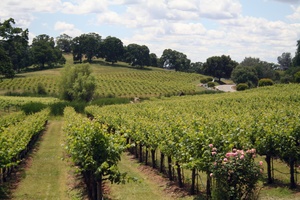
Still with a couple of hours to kill before check-in time at the Heirloom, we head over to our main weekend destination, the Shanandoah Valley just outside of Plymouth. This is California’s oldest wine region. There are still vines growing-and producing-in this area that date back over 125 years.
Picture courtesy of Wikimedia and Steve Howe at www.cheers2wine.com
Under CC-BY license
There are over a dozen wineries here so we just hit a few today with plans to return tomorrow. First is the Montevina Winery, recommended by our local wine merchant. In the modern mission-style tasting room we try several good wines. Our favorites are the superb refosco (which is my number one pick of the entire weekend) and the sangiovese.

Next, we head over the Shanandoah Vineyards. Shanandoah is owned by the oldest winery in the state, the nearby Sobon Estate. The wines here are okay, but I guess being the oldest is not necessarily the best. Nothing to knock your socks off here.

We finish off this afternoon’s tasting at Renwood Winery. Several wines here really, really blew us away. The barbera was like drinking velvet, but at $35 was a bit out of reach today. Their old-growth zinfandel was superb and a drink of living history made from vines that were alive with the 49'ers. The sangiovese bested even Atlas Peak’s stunning entry. We take a couple of bottles of the sangiovese and some delicious muscat for later and head over to Ione to check-in to our room.
Driving into Ione is much like any of the other Gold Rush era towns here except Ione is not a gold town...it’s a brick town. Ione, while contemporary with the other mining towns here such as Sutter Creek, Jackson, and Amador City, was not a gold-harboring site. Rather, it made it’s living making bricks from its abundant clay that the other more famous nearby towns were built out of.

Coming in the first thing you notice is an imposing, castle-like building on the north end of town that dominates the landscape. It turns out that the “castle” is the main administration building of the local juvenile hall.

Today, Ione’s main industries are inmates (the facility has since been closed-ed) and fireworks. The local pyrotechnics factory supplies Disney with it’s spectacular shells that light up the magic kingdom. Due to this, Ione proudly puts on the Sierra’s biggest and brightest fireworks show...for free! Only, the skip the fourth (the company’s biggest business day) and celebrate on the fifth when more of the employees can put on and enjoy the show.

The Heirloom is located at the end of a 1/4 mile drive just off of the main highway through town. Separated from a nearby strip mall and the rest of the town by a barrier of big old trees, it retains a seclusion and tranquility that really help recharge your batteries.

The owners, Millicent and Pat, go out of their way to make you comfortable at the 6 room inn. 4 rooms, including ours, are located on the second floor of the circa 1863 main building and 2 more are located in an adobe walled cottage nearby.

Our room included a fireplace, private bathroom, queen size bed and balcony. After a day of touring & wine tasting we quickly settle for a nap after checking in.

Dinner that evening was at the Palace Hotel and Saloon in nearby Sutter Creek. While looking a little tacky from the outside, we were pleasantly surprised by the quality and value of the food. The service and atmosphere were also top notch. The owners of the inn and other guests were surprised at this because the Palace is kind of considered the “low rent” dining establishment of the area.

Breakfast the next morning, July 4th, was served out in the garden with a quiche, fruit, and a special patriotic shortcake with an America flag sticking out of it. Despite Millicent and Pat’s efforts to include at least two parties at each table, most guests stuck to themselves on this first day, which is too bad because a big part of the B & B experience is to meet new people. The next day would be different though.

Now we had a full day to tour the local wine country. First stop: California’s oldest continuously operating winery...the Sobon Estate.

If you’re a wine lover, you know that California is one of the top wine producers in the world. What most don’t know is that Napa Valley is not where the state’s wine industry started. That honor goes to Amador County and the Sierra Foothill area known as the Shanandoah Valley.

To see where it all started, I recommend that all wine lovers make the pilgrimage to the humble little cellar...dating back to before the Civil War...here at the Sobon Estate. The estate has a historical museum...admission free...with artifacts of 19th century life and wine making. The museums goes through 5 areas, each one a little older, until you end up in the original wine cellar dug into the hill those many years ago.

It’s a small room actually, no larger that many living rooms, that is still used by the winery to age the wine in oak barrels. Nothing has changed, except the addition of electric light, in all those years. It’s an awesome sight.

For all that, however, the wines produced by Sobon are rather pedestrian but it is worth it to buy a bottle as a souvenir of California wine history.

Next, we head over to the Deaver Vineyards. The Deavers not only run a winery, but also run the Amador Harvest Bed & Breakfast (on the grounds of the winery) and the Amador Flower Nursery nearby, which is world-renowned for its day lillies.

Being July 4th, there are numerous red, white and blue banners and baloons. Tables and a big barbecue are set up on the grounds. A 2 man band is preparing to play. Is it a private party? We don’t know but a sign out front says the tasting room is open so we head on in.

Mike Deaver, his family, and employees are busy manning the tasting counter. We quickly line up for some samples and taste some fine wine. The Deavers best, however, are their port wines which just tickles the palate and goes down ever so smoothly. Mike then asks us “are you staying for the barbecue?”.

We don’t know, we reply. “It’s free”, he says. Well, in that case...
We feasted on barbecued bratwurst and burgers. Washed down with free sodas and water. To ease our guilty conscience, we buy a bottle of Deaver’s sauvignon blanc to drink with our meal. This was all while we sat on the beautiful green lawn on the banks of their little lake and listening to the surprisingly good music put out by the band...easily the biggest bargain of the weekend.

After lunch, we took a walk around the lake, watching the local birds and getting a close-up look at the vineyards.
After the great lunch break at the Deaver place, we continued over to Story Winery with its tasting room in the ancient miner’s cabin. The wine at Story is good, very good, especially the whites. What really sets them apart from the rest is the view over the Consumnes River canyon from their tasting area. We saw several eagles while relaxing here. Story also has an old growth zinfandel (like many here do) on ancient vines...but with a difference. These vines recieve only rain water, no irrigation. The result is an intensely flavored fruit that passes that excellent quality on to the wine.

That was it for the wine tasting, although there are many other wineries in the area we’ll have to get to next time. For now, it was back to the inn with our trunk load of wine to wind down, relax, and get ready for dinner.

After a nap and a very pleasant stroll along the banks of Sutter creek, we head over for dinner at the nearby, historic Ione Hotel.

Here you can have some very good food served by candle light right off of the old western-style saloon. Service is also excellent here and prices, while not cheap, were still reasonable. We walked around the small downtown area of Ione and then headed back to the inn.

Another restful night, another great breakfast (this time with some other guests to share our table) and then it was time to head back home. That evening they tell us Ione had a great fireworks show, oh well, maybe next time we’ll get to see it.

-Darryl

Friday, June 20, 2014

CLASSIC TRIP - Amador County and Gold Country, California 1998 - Part 1

Please indulge us for another classic trip, a new trip will be up next week.  For now, it's time for another trip in the WayBack Machine.  This time, way back to 1998.  One caveat is that our lodging in this report no longer appears to operate as a bed and breakfast.  It is now just a place to hold weddings and receptions, which is too bad because it was a very nice place to stay.  Kind of like a Tom Sawyer house along the banks of a nice little creek.  Oh well, time marches on...


After driving 300 miles and getting lost on some country back roads, it was amazing looking at this humble little stretch of sand that is the epicenter of California history. For it was here, on a January day 150 years ago that a sawmill manager bent over to pick up a shiny fleck in the outflow of the mill. From that moment on, things were never to be the same in California again.

Our latest getaway was taken over the July 4th weekend. Again, we find ourselves drawn to the Gold Country, this time to the area south of Placerville and east of Sacramento.

In planning this trip, we originally were thinking of seeing the star wine country of the state, Napa Valley. We were soon discouraged over the high lodging prices and the long drive. Looking over the appellations of the wine bottles at our local shop, the name Amador County popped up again and again. A little research into this area showed that it is a great area for wine and travel value so Amador County is was.


We settled on the great little Heirloom Inn in Ione, CA for our lodging. This antebellum style inn, built 135 years ago, sits on the banks of Sutter Creek and provides a secluded, private base to explore all this area has to offer.

As stated above, our first day in the area started with us taking a wrong turn near Placerville and getting lost trying to find Coloma. Unfortunately, our AAA map of California was missing some key roads in the area and was of no use. Knowing that Coloma should be somewhere northwest of Placerville, we stumbled along until we found a sign pointing in the proper direction.

The town of Coloma...really more of a village these days...is a state historic park. Coloma is the spot where James Sutter built his sawmill to process the logs from the nearby mountains. John Marshall was Sutter’s manager at the mill.

On that fateful day in January of 1848, the tailrace of the mill (where the water that powered it flowed through) was clogged with debris. The waterwheel that powered the mill would not turn. Marshall supervised the dynamiting of the tailrace. The blasting was successful and the water again flowed freely.

Marshall then went to inspect the exit of the tailrace to make sure there was no more clogging debris when he noticed something shiny in the water. There, at the spot pictured above, he bent over and picked up the gold nugget that started the California Gold Rush.

150 years later, we find ourselves looking for another kind of gold. We are frantically looking through our car for loose change because of the $5 park admission fee. We have a $20 bill, but the toll booth is unmanned and no one is available to make change. Finally, we find our $5 worth of change and somehow manage to cram it through the narrow slot of the toll booth and park our car.


From the lot it is about 100 yards to the replica of Sutter’s Mill. It’s about another 200 yards from that spot to where the mill was originally located, marked by a monument (the American River has changed course since 1848 and inundated the original site). Next to the replica is a shed containing some original wood from the real mill.

It’s what lies down river that intrigues me even more. First is that spot where the mill was actually located. As you stand on the banks of the river watching the rafters go by, all it takes is the thought that 2 of the most important men in the state’s history stood on this spot. Indeed, they worked and lived here.

Further downstream as you come upon that humble little beach (see the picture up above), again the thought comes into your mind...this is where John Marshall actually bent over and picked up that nugget. My son kids me sometimes about my getting thrilled over history, but it’s the same feeling I get when I’m in Washington, D.C. and standing behind the balcony in Ford’s theater thinking about the assassination that took place right in front of the spot I’m standing in.

Later on we visited the park’s museum and wandered around what’s left of the town...many of the old buildings were torn down as prospectors looked through the ground underneath them for gold. Of interest here is the old jail and the many pits left from those early diggings.


Up the hill is John Marshall’s grave which is marked with a prominent monument pointing down to the discovery site. It’s sad when you learn that he died broke and dejected...only after his death was his place in history noted with this monument.

Just below his grave is his old cabin. Still standing, complete with the outhouse. Adjacent is the old cemetery and an old canal, still carrying water, left over from those gold rush days.

Stay tuned for Part 2...

-Darryl
Copyright 1998 - Darryl Musick
All Rights Reserved