Showing posts with label gold country. Show all posts

Monday, February 21, 2022

CALIFORNIA GOLD RUSH TOWNS: Ione


Ione...formerly Bedbug or Freeze Out...is another of those Gold Rush era towns that didn't dig for gold. The city existed to be a supply and transportation center for those other towns up the hill that did the mining. It's gold came from the pockets of those miners buying supplies at precious prices from the town's merchants.


Founded on the banks of Sutter Creek down the hill from the city of Sutter Creek, the modern town of Ione got its name in 1848 and its configuration in 1853 when Thomas Rickey subdivided his land into lots around the creek.


After a few fires, the original wooden buildings were reconstructed with brick, which conveniently was mined and fired right here in town. One of the products that the town supplied was the eponymous Ione brick which rebuilt many a burned-out Gold Rush town.

While the city didn't engage in large-scale gold mining, other minerals were abundantly mined here. Copper, coal, sand, clay, aggreagates, and silica provided a big boost to the local economy. In fact, the only real large scale mining done in Amador County today is in Ione.


Cattle ranching took hold in the area and thousands of head still graze in the hills and ranches around town.
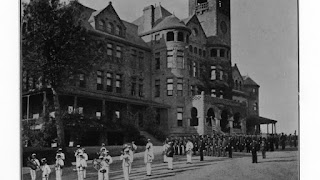

In the late 1800's, the city embarked on a new industry, corrections. A large reform school was built here in 1894 on 230 acres. The school, envisioned to be a place of reform for errant boys, would take the juvenile offenders from state prisons and teach them new careers to steer them from a life of crime.


Proposed by State Senator Edward Preston, the new school was named after him...the Preston School of Industry. 


A massive, gothic redstone building was built on top of the hill with supporting structures and houses for the staff below. This imposing structure was nicknamed "Preston Castle." 

Abandoned in 1960, it sat deteriorating for several years until a foundation created to preserve it was formed. They bought the castle and a few acres around it.


The foundation now gives tours on Saturdays during spring and summer. Reservations are required and can be booked online at Prestoncastle.org.


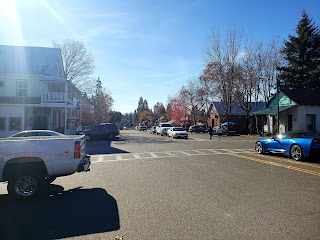
While not a gold mining town, Ione has a classic Gold Rush era downtown with several buildings dating back to the 1850's. Daniel Stewart built what is considered the oldest building in town for his general store in 1854. It now houses Salon Envy across the street from the Native Sons of the Golden West hall and the IOOF which both date from the same time.

A quick walk down the three blocks of Main Street yield more nuggets of history. It's also nice that Ione is the most wheelchair friendly downtown we've found in California's Gold Country.


The old Commercial Hotel, built in 1964, is now the City Hall. Still serving as a hotel, the Ione Hotel (no accessible rooms) has been in business since the 1850s but the current building dates to 1910. Another fire almost destroyed it in 1988 but it has been fully restored with a nice restaurant on the first floor (ask to see the haunted well that still exists in the middle of the dining room).


The old 1850s flour mill now serves as a charter school at the west end of Main Street. The original cabin from the 1840s has been expanded into a building shared by a real estate office and hair salon. You can still make out the diagonal swinging doors on the old saloon on the corner of Buena Vista Street but it is now a very fine butcher shop. A modern saloon, Tilly's, sits two doors down if you fancy a drink.


The old movie theater now houses another beauty salon and the town's ice cream parlor and candy shop. Another pub, Grumpy Jeff's, rounds out the block on the next corner (check our our Ione Pub Crawl). 


Look behind City Hall and you'll see Iron Ivan, the last steam locomotive of the old Amador Central Railrod. A couple of blocks away sits the old derelict train depot, along with the last locomotive of what was then called Amador Foothills Railroad, an old switching engine, next to the junior high.


That junior high was the original high school of the county with the oldest building dating to 1903. Around the corner, the tall brick spire of the United Methodist Church tops a building that dates back to 1864.


On the hill behind sits the original Catholic Church in the midst of its cemetery. Across the street, the Public Cemetery dates to 1850. Behind that, Howard park...formerly the racetrack of Charles Howard, owner of Seabiscuit...provides ample room for recreation.


The park is also the center of a three-day party and festival held each May called Homecoming.


Ione is not easy to find. It's not on the major highways...49, 88, or 16...of Amador County (you have to detour a few miles off of 88 on 104 or 124) and does not attract the crowds of tourists that other towns in the region do but it is truly an underrated and undiscovered historic gem.

Definitely worth it to spend a day or more on your Gold Country explorations.

Darryl Musick
Copyright 2022 - All Rights Reserved

Friday, February 18, 2022

CALIFORNIA GOLD RUSH TOWNS: San Andreas


The outlaw names of Joaquin Murrietta and Black Bart loom large in California lore. Those two names intersect in the historic Calaveras County town of San Andreas, where Murrietta was said to operate and gentleman stagecoach robber Black Bart (Charles Boles) was convicted and sent to San Quentin prison.


Founded in 1848 by Mexican miners and named after Saint Andrew, easy to find placer gold soon ran out. By 1859, amounts of gold large enough to pay for mining it was running out. Chinese miners took over in 1860, going through the tailings left by previous miners.

Although never incorporated as a city, San Andreas became the county seat of Calaveras County in 1866 and remains so today. It's an overlooked town with most tourists passing through on the way to more popular towns such as Sonora, Murphys, and Sutter Creek. If they stop, it's mostly for some of the cheapest gas prices in the Motherlode.

And, while it shares a name with California's most infamous earthquake fault, the town has nothing to do with California's temblors. The fault is located a hundred miles or more to the west.


This is not to say that San Andreas is not worth your time. The old downtown on Main Street has some very nice Gold Rush era buildings. Gooney's, a dive bar located at the corner of Main Street and highway 49, is a fun, friendly place that also serves up a tasty menu.

The bar is named after Gooner Everson who acquired the 1858 building for $18.60 in back taxes in 1863. It's been run as a saloon and restaurant ever since, the current iteration opened in 2019.

A few other shops, the Black Bart Hotel and Restaurant, lead to the Metropolitan...another bar and nightclub...at the other end of Main Street. We like to explore the residential neighborhoods beyond where we'll loop back and end up at Turner Park.


Here in the summer, you may be able to catch a free concert on Wednesday evenings.


At the south end of town, you'll find the abandoned Calaveras County Airport.


My wife likes to shop at the outlet store located here called This and That while Tim and I will hike up and down the old runway.


At the other north end of town, we like to enjoy a lunch at the Pickle Patch Deli, where they make some of the best smoked tri tip anywhere. 


They're only open a few hours a day, Monday through Friday, but if you find yourself there at the right time, a meal in the beautiful garden is well worth while.

Being the county seat, you'll find a lot of government and health care facilities here. The DMV, highway patrol, courthouse, hospital, and more are located here to serve Calaveras County and helps to cement the image of the town as a working and "getting down to business" town rather than a tourist destination.

Still, it's a pretty town with a nice Gold Rush history behind it and makes a great place to explore for a few hours.

Darryl Musick
Copyright 2022 - All Rights Reserved

Monday, February 14, 2022

CALIFORNIA GOLD RUSH TOWNS: Knights Ferry


There are two types of Gold Rush towns in California...those there gold was actively mined and pulled out of the ground, then there were those that sprung up to provide goods and services to the miners in those towns...and, although gold was not found in all of them...they can be just as historic and interesting to visit.

Knights Ferry is an example of the latter. As the name suggests, it grew up during the Gold Rush not as a mining town but a convenient spot to cross the Stanislaus River where gold and the supplies needed for mining it to be shipped back and forth.

William Knight was a physician and fur trader. Seeing all the gold being pulled out of the ground in the foothills to the east, and a bottleneck of transportation down below, the doctor and his partner James Vantine found a good spot on the river that would be ideal for a ferry crossing.

An old whaling boat was procured and the business venture was a big hit, raking in over $500 a day ($12,000 in today's money). The success would be short-lived for Dr. Knight, however. He was murdered within a year.

Vantine continued the business with new partners, John and Lewis Dent. The Dents took over Dr. Knight's house and property. It is said that Dr. Knight is buried near the front gate of the Dent house.


Within a short, few years, a toll bridge was built by David Locke. Locke built a flour mill in town (ruins are still there to explore) and his bridge opened in 1857. It wasn't too long before the bridge was destroyed in a flood. 

A year later, a new bridge was built higher above the waterline. A 330 foot, covered wooden bridge. 

Until 1985, you could still drive across that wooden bridge. Today, you can still walk over it. It's the longest wooden bridge west of the Mississippi.

Knights Ferry is located east of Modesto, just across the Stanislaus River from highway 108, about halfway between Oakdale and Sonora. A modern replacement bridge now provides car access to the town from the highway.


In town, you find a couple of restaurants and bars. 


The food is good and the river view outstanding at The River's Edge restaurant, which also has accessible restrooms.

  
Once fed, you'll want to explore the history here. A couple of doors down from the restaurant is the old fire station, the Knights Ferry Hook and Ladder Company, dating from 1871. The general store and saloon across the street has been open over 100 years.

On the street behind the general store, at 17679 Ellen Street, you can find the Dent house. It's now a private residence, so no tours, but you can stand at the front gate and try to guess where Dr. Knight might be buried.

At the other end of town, you find the ruins of David Locke's flour mill. The area around them, managed by the U.S. Bureau of Land Management, is mostly wheelchair accessible. 


When electricity came to the region in the late 1800s, the penstocks that turned the mill's wheels were converted to turn turbines instead. The mill became a power plant that powered the area for the next three decades.

The star of the show, however, is the 379 foot long wooden bridge just beyond. Wheelchair users will want to go to the other side of the river and navigate across it from there as the north end is just too chewed up to be of any use to wheelers.


Closed to traffic, the bridge still hosts pedestrians.

Halfway between the cities of the Central Valley and the gold mines of the foothills, Knight's Ferry is a great stop to spend a few hours in between.

Darryl Musick
Copyright 2022 - All Rights Reserved

Friday, February 11, 2022

CALIFORNIA GOLD RUSH TOWNS: Georgetown


If you're visiting the gold country of California's Motherlode, chances are you're going to go to Coloma where the first nugget was found at John Sutter's mill, sparking the Gold Rush. While you're in the neighborhood, you might as well visit Georgetown, another little historic Gold Rush town located less than 10 miles north of Coloma. 

Coloma is mostly a state historic park (and well worth spending a day in) but Georgetown is still a regular town which, while the home of a lot of history, is home to regular people like you and me and not such a tourist magnet.

That's not to say it's not worth a visit. 


Georgetown was founded by a group of miners headed by George Phipps. It may or may not be named after him, the documentation is fuzzy in that regard.

The original townsite was just south of the current one. After founding in 1849, like most of these towns, a big fire roared through and it was decided that it would be prudent to move the town up the hill to its current location.

One thing you'll notice is that Main Street is wide. Very wide. It was thought that making the main street one hundred feet wide, with sixty foot wide sidestreets, that fires would have a harder time jumping over that divide. It seems to have worked.

A nice, solid vein of gold was located here and over $10 million worth of the metal was pulled out of the mines here during the first twenty years of the Gold Rush. Mining continued here into the 20th century.


Timber was also a big industry here and a tram was built to ferry the lumber across a steep canyon nearby at the turn of the 20th century. After a few of the suspended cages fell into the river below, the tramway was abandoned and trucks were used instead.

Visiting today, you'll find a nice, tidy town with a two block long Main Street. At one end of the downtown is the historic former American Hotel, originally built in 1863 and burned by a few fires, the current building dates to 1899. It is now the American River Inn Bed and Breakfast.


Almost like a bookend at the other end of the street, the Georgetown Hotel and Saloon (established in 1856, the current building was built in 1896) has a nice wheelchair accessible saloon with better than average food. 


It's a great place to have lunch and whet your whistle and a lot friendlier than the dive bar at the other end of town.


Across the street is a cafe that is not wheelchair accessible next to a gift shop in a Civil War armory that is.


We also walked around the corner to the large, Gold Rush era cemetery and explored the tombstones.

Unfortunately, we could not find any accessible accomodations in town but you can find them in nearby Auburn or Placerville.

A couple of boutiques and the town's general store and deli round out the offerings. It's a nice place to visit for a few hours when you in the vicinity of Coloma's gold discovery site.

Darryl Musick
Copyright 2022 - All Rights Reserved

Monday, February 7, 2022

CALIFORNIA GOLD RUSH TOWNS: Jackson


About 50 miles southeast of Sacramento, Jackson sits in the heart of California's Motherlode. Founded in 1848 by miners panning the numerous creeks in the area, the town is named after Colonel Alden Jackson. The town became the county seat of Amador County in 1853, an honor it still holds today.

Coming over the Argonaut Grade on Highway 49, you'll see a tall headframe to your left. It's the remains of a famed mine.


Reaching over a mile underground...and over 4,000 feet below sea level...the deepest mine shaft in the United States belonged to the Kennedy Mine. The mine closed early in World War II, the pumps were shut off, and...while the tunnels are still there...the shafts flooded.

Nextdoor, the Argonaut Mine's shaft reaches nearly 5,000 feet down. In 1922, 47 miners were trapped deep in the mine. A tunnel was dug from the Kennedy's shaft to try to rescue them but for naught...they all perished.

It was California's worst mine disaster.

While the Argonaut is now a Superfund site and off-limits, on weekends you can take a surface tour of the Kennedy Mine and see the giant tailing wheels that swept mining debris into a canyon over the hill.

Placerville and Sutter Creek to the north and Muphys, Sonora, and Columbia to the south attract more tourists but there's still a lot of history to see and experience here at the crossroads of highways 49 and 88.


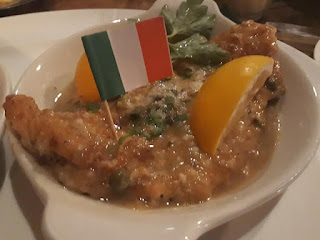
If you're hungry, you can get a nice Italian meal at the city's oldest restaurant, Teresa's Place, which has been operating on Jackson Gate Road a couple miles west of downtown for over 100 years. 


Wander to the back of the parking lot to the creek and notice the rock outcropping on each side. This is the historic Jackson Gate where so many miners descended on the creek that water sold for a dollar an inch...back in 1850.


Today, the reward is a dinner fit for a king in Teresa's homey dining room or bar.

Follow Jackson Gate Road east where you can take a break at the Tailing Wheels Park where you can see a couple of the giant wheels that would take the waste rock from Kennedy Mine up over the hill the the basin where it was dumped. One wheel is preserved in a weather-proof enclosure while another is laying on its side, deteriorating in the elements.

Continuing on, past the Serbian and Public Cemeteries, Jackson Gate turns into Main Street and you'll find yourself in the heart of Jackson's old downtown. Sitting proudly at the other end of Main Street is the National Hotel, founded in 1852, where the current building dates back to 1860.


The hotel was brought up to modern standards a few years ago by former owner Stanley Lukowicz, including an elevator and accessible rooms so that wheelchairs have access to the entire building.

The area was settled in large part by many Serbian immigrants. In celebration of Serbian Christmas each January, many of their descendants gather in front of the hotel, firing shotguns (loaded with blanks) into the sky. It's loud and racous but one of the many local traditional celebrations here.

Across from the hotel, between the excellent Serbian Blue Door bakery (try the sourdough and morning rolls) and Rosebud's Cafe, look for the historic plaque in the sidewalk noting the former location of the hanging tree.


Like many Gold Rush towns, Jackson was home to not only many saloons and taverns but hosted many brothels and gambling halls. In fact, those vices clung stubbornly here with casinos and "houses of comfort" operating pretty openly with the blessings of the business and political communities until well into the 1950's  when the laws of the state finally caught up to the city and shut them down.

Most of those buildings still adorn Main Street. That quaint little antique shop may have hosted a roulette wheel or that jewelry store might of hosted some ladies of the night less that 70 years ago.

Some gambling continued, including a legendary game of poker featuring John Wayne that ended up with the western star down tens of thousands of dollars at the National Hotel in 1963. It's also rumored that the actor settled up with a check that bounced...although some say he eventually made good.


Now, gambling is legal again...at least on tribal lands...and the Jackson Rancheria Band of Miwuk Indians runs the Jackson Rancheria Casino and Resort just north of town off of highway 88.

Other pastimes here are sampling wines from the several dozen wineries in the area, particularly in Shenandoah Valley to the north (although Avio Winery is located on the north edge of town on Ridge Road), skiing at the world-class mountains of Kirkwood 60 miles east on highway 88, playing and fishing along the Mokulomne River which delineates the separation of the counties to the south of town, or fishing and boating on local lakes such as Pardee, Camanche, and Tabaud.

Lake Tahoe is only 90 minutes away.


One good place to get your bearings and see what the area has to offer is the gas station at the intersection of highways 88 and 49...where 88 splits off on its journey over the mountains to Nevada. Tresslers offers some of the lowest gas prices in the county and also is home to a giant mural by artist Rand Huggett, which is a giant map of Amador County highlighting points of interest and history of the region.

Jackson is a great place to spend the day, maybe even longer. It makes a great base to explore Amador County and the Gold Country beyond. The aforementioned National Hotel has plush, accessible accomodations for the travel while the Jackson Rancheria Casino and Resort offers excellent affordable rooms with resort amenities making this a very comfortable place to call home while you explore the area.

Darryl Musick
Copyright 2022 - All Rights Reserved

Monday, November 1, 2021

CALIFORNIA GOLD RUSH TOWNS: Angels Camp


Henry Angell set up a tent camp along the creek that sort of carries his name today back in 1848, selling supplies to miners along the creek. The placer deposits gave out in a few years but hard rock mining of the gold bearing quartz commenced after that.

The town was named for Henry but dropped the second "L" becoming Angels. It was incorporated in 1912 and eventually had the word "Camp" added to it.

Angels Camp is the only incorporated city in Calaveras County.

While nearby San Andreas is the official county seat, Angels Camp is the real hub of the county. It's arguably the most famous of the Gold Rush towns of California. It was here that a young Samuel Clemens...Mark Twain...heard a story of a frog trained to jump over drinks at a local tavern. Of course, that story became "The Celebrated Jumping Frog of Calaveras County," which was published in The New York Saturday Press in 1865 launching him onto a legendary writing career and starting a local legend of its own.


That tavern is gone but the building remains.

Each May, this is celebrated at the county fair with several days of frog jumping competition at the central stage of the Frogtown fairgrounds on the south end of town.

If you're there at the proper time, you can experience this small county fair in person. The grounds are not as crowded as you'd imagine but it is spread out over a lot of hilly acres. Paved paths will get you to wherever you want to go but there will be some climbing to do.


At the frog jumping stage itself, accessible spots for wheelchairs are down in the front row. There is precious little shade to sit under while watching so a hat or umbrella would come in handy. There are a couple of trees on the hillside, above, where you can watch in the shade but it would take some hard work to get your wheelchair over the grassy elevation to get there.


Other than the frog jumping, it's your typical county fair with exhibit halls, wildly unhealty food, animals, and carnival rides. Something we love to do and it's a nice, inexpensive day out.


During the fair, locals compete to see who can come up with the most interesting lines of laundry and hang them across Main Street as a display.

Outside of the fair, the small and quiet downtown makes for a nice stroll. Numerous trees provide welcome shade and, unlike many other old towns around here, wheelchairs have access to all parts of the sidewalk.


Vendors cater to tourists with many frog related items but most visitors bypass Angels Camp for the more geared-for-tourists Murphys up the road.


Plaques on the sidewalk honor frogs and their "jockeys" with a frog jump walk of fame. 
Posters in the windows of vacant shops tell the story of the history of the town.

One of our favorite places to eat, the Pickle Porch, slings out some of the best tri tip you'll find but in deli style sandwiches, not hot plates.


My Bar is a fine example of a Gold Country dive bar and a friendly place to get a drink.


The old movie theater has been turned into a multiplex and screens the latest films.


Beyond that, you'll find the usual assortment of antique shops and boutiques and Utica Park at the north end of downtown is a great place to have a picnic. On Fridays during the summer, you can find a farmer's market here.

Outside of the downtown section, you find more modern shopping conveniences like McDonalds, pizza parlors, supermarket, hardware stores and more. It's also a crossroads where you can turn off and cross the Sierras on Ebbetts Pass (highway 4) in the warmer months...the road closes during winter.


Spend a few hours or even overnight in one of the several motels here and you can get a glimpse of what life was like for those early miners and Mark Twain.

Darryl Musick
Copyright 2021 - All Rights Reserved