Sunday, October 10, 2010

HAPPY COLUMBUS DAY: Italian Memories

Tomorrow marks the 613th anniversary of the day Italian explorer Christopher Columbus landed  in the Bahamas, setting off the European dominance and colonization of America.  This gives us a good time to look back at our limited adventures in Italy.


We have yet to really get into Italy, so far we've just nibbled around the northern corners of the country.  Here are some of those highlights.


2006 - Day trip from Cannes to San Remo, Italy.


The car is ours for one more day so we run for the border. It’s not a long drive to Italy so we decide to head to San Remo for the day and to have a nice Italian lunch.

The autostrada is way up the hill, San Remo is at the bottom and it’s a steep, windy, and narrow road down. We make it and even find a free parking lot on the beach where we find this old Fiat 500. The old Italian men nearby tell us that there are still a lot of the old versions of this car running around Italy, we soon find out they’re right.

There’s a nice, but rocky, private beach here and we walk along the beachfront until we find a ramp up into the town. There’s a lot of traffic and about five blocks of shops and restaurants. San Remo looks like an Italian town that’s seen its best days pass by. A little ragged around the edges…still a nice place…but not one that tourists will flock to.

A small trattoria with tables on the sidewalk provided the lunch of a simple pasta with cheese and olive oil sauce. It was delicious and just right in the amount, not the gut-busting plates of pasta we get back home.

2009 - Day trip from Munich to Bolzano, Italy


Here's a short out take from our European video of Bolzano that we didn't use in the final edit.
Since we have the car till the end of the trip, the next day is another day trip, this time to the northern Italian town of Bolzano for lunch and to see Otzi.

It’s around a two hour drive on the autobahn...which turns into the autostrada in Italy...over the Brenner pass through the alps. Into the center of Bolzano, we turn into an underground car park and make our way to the central plaza where we dine on pasta, pizza, and shrimp.

A couple of blocks away is the Archaeological Museum and the home of Otzi. Back in 1991, a couple were hiking in the nearby mountains and saw a body at the edge of a melting glacier. The authorities were called, because it looked like an avalanche victim was uncovered by the spring thaw. The body was taken to the local examiner where it was discovered that this was actually a 5,300 year old body. 

Today, the museum focuses on different types of mummies, with its main attraction being that 5,300 year old found in the mountains...Otzi.

There are many human and animal remains on display here with various types of mummification methods. It is completely wheelchair accessible and there is even an in-floor lift that raises you and your chair up so you can see into the vault where Otzi’s body is stored. If this all sounds a bit morbid, it’s not. It’s just another very interesting museum that lacks any sense of the macabre at all.


-Darryl
Copyright 2006 & 2009 - Darryl Musick
All Rights Reserved

Sunday, September 12, 2010

THE COCKTAIL HOUR: Weekend Barbecue Tips

Today on The Cocktail Hour, we come back from our little summer hiatus with something a little different. Instead of a drink recipe or a drinking field trip, we’ll be talking about that great summer drinking activity, barbecuing, so put a couple of cold, refreshing brews on ice and join us on the patio (see the video for an example of the brews we’re having).
Watch the Video!


For our barbecue, we like to use a kettle grill such as a Weber because of the even heat distribution. And, yes, I’m going to call it barbecuing even though it’s kind of a mix of grilling and barbecuing that we do.


To start, I like to use a chimney charcoal starter. First, because it eliminated any flavor from lighter fluid; second, it’s better for the air especially in a place like here in the smoggy L.A. basin; and third, because it lets me play with fire. Take some old paper like newsprint, wrapping paper, or old utility bills and crinkle them up loosely in the bottom of the chimney. Fill the top with charcoal and light the paper.


When the charcoal is ready, pour into one side of your barbecue. Spread it out evenly but keep it to one half of the grill only. Put the grilling grate on and let heat up for a few minutes.


Once the grate has had a few minutes to heat up, clean it by scraping with a wire barbecue cleaning brush.


Season your meat to your liking and put on the side of the grill with the coals. Sear for 2-3 minutes a side and then move the meat to the other side of the grill. Cover with the lid…make sure the vent holes are open…and cook on each side. A one inch thick steak would go for about 6 minutes per side; thick pork about 10-12 minutes per side; chicken about 8 minutes per side. Thin steaks, like flank steak, about 3-4 minutes per side.


For a side dish, cut up some veggies. Salt them and wrap up loosely in foil. Put them on the non-coal side of the grate for the entire time you cook. Corn on the cob can just be laid as-is on the same non-coal side for the entire cooking time as well.


That’s it! Have fun, be careful, and enjoy the food and drink.


-Darryl
Copyright 2010 – Darryl Musick

Sunday, August 29, 2010

BLOG STATUS REPORT: Where's The Cocktail Hour?


You might have noticed that The Cocktail Hour has been on a bit of a hiatus.  This is because of two reasons:  a) Letty and I have been trying to get into better shape this summer and get our weight back where it belongs, especially me, so we've been cutting back on cocktails and drinking mostly wine instead - which doesn't make for  good Cocktail Hour recipe videos -  and b) I've been trying to get as many stadiums posted as possible for The Fields of Dreams series while it is still baseball season.


Don't worry, though.  We'll be making more Cocktail Hour videos (which usually are posted on Sundays, the day of rest) and you can click on the link in the first paragraph to see the reports we've already done - you can bet you haven't seen them all.  Next weekend we'll be having a special Labor Day themed Cocktail Hour.  We've also been experimenting with new cocktails with lower calorie counts and will be sharing those recipes with you in the future.


Thanks for your support and we hope you continue to visit our little corner of the web.


-Darryl

Wednesday, August 25, 2010

TRANSIT REPORT: Munich, Germany


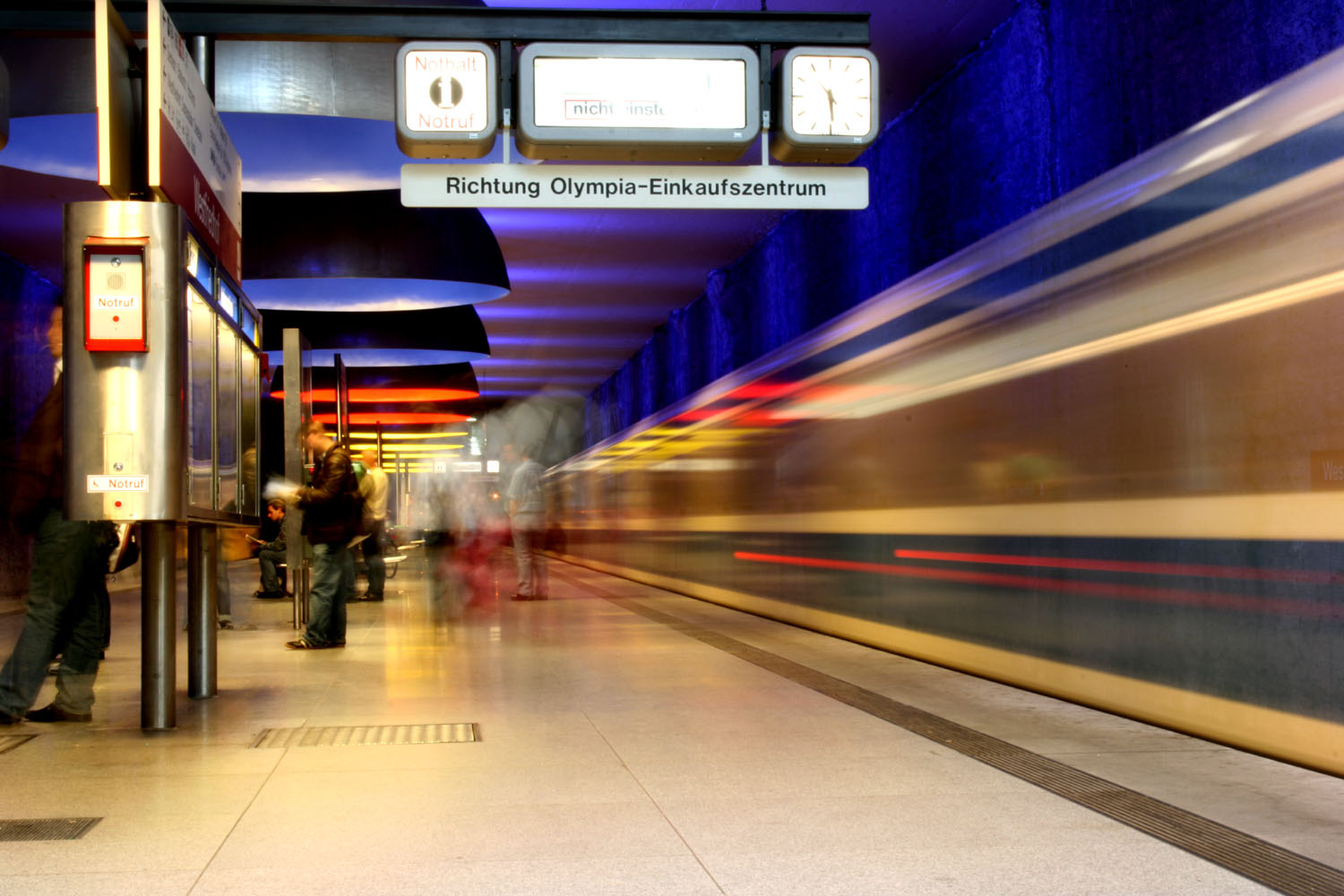
The main transit agency in Munich is the Munchen Verkehrsgesellschaft (MVG), which translates to Munich Transport Company. They run a three-tiered system of trains and a bus system. This all connects to the German Duetsche Bahn (D-Bahn), the nation’s train company. Most of the trains run below ground in the city, coming above ground for the suburbs. The only trains running above ground in the city are the trams.

As far as wheelchair accessibility is concerned, Munich is the most barrier-free European city we have ever visited. No need to feel apprehensive about bringing your chair here.

BUSES

Buses in Munich are mostly a secondary form of transportation. Used for the portions of the city that doesn’t have quick access to one of the train systems. As a visitor, you would have little, if any, need of the buses here. The only bus we rode was the bus to Dachau from the train station there. All of the city’s buses are accessible in the usual European way…the back door has a ramp that is deployed only when the door in closed. Once the ramp is deployed, the driver will open the door. There is a wheelchair spot in the middle of the bus with a padded vertical board .You are to back your chair up against this board. Usually, there are no tie-downs so make sure your brakes are in working order.

The U-Bahn and S-Bahn (click on link for a PDF system map)

The U-Bahn is the city’s subway. Think “Urban” for the U, not necessarily underground. Think “Suburban” for the S in S-Bahn. The two systems work in pretty much seamless order, a visitor would be hard pressed to see any difference in them except that the S-Bahn goes to destinations out of the city and the U-Bahn does not. Stations are identified by the signs with the white letter U on a square blue background for the U-Bahn, or the white letter S on a round green background for the S-Bahn.

As you can see from this barrier-free system map, almost all of the system is wheelchair accessible. You’ll look long and hard to find the very few stations that are not. A few stations, like the Haupbahnhof (the main train station), are huge and it might take a little effort to find a lift or ramp. Look for the different colored floor tiles that mark the accessible route.
Photo courtesy of Wikimedia
MaxM under CC-BY-SA license

Trams

Trams take the place of buses in most parts of the inner city. Click on the following link for a tram system map. Most trams are wheelchair accessible via a ramp deployed from the front door. Wheelchairs can sit in a space behind the driver’s cab. Some older trams are still running throughout the city which are not accessible. Don’t worry, when this happens the next tram will be accessible and they run on short intervals (like 5 minutes). Because it’s the train itself that’s accessible, all tram stops can be used by wheelchairs.

All bus stops, tram stops, U-bahn platforms, and S-bahn platforms have electronic signs letting you know when the next train or bus will arrive.

FARES

The basic fare is €2.30. There is also a €1.20 fare for short trips. The biggest deal in Europe is the partner fare. This allows up to 5 adults to travel on a single one-day pass (alternatively, 2 children count as one adult on this pass) for only €9.40 for the inner district zone. A Munchen XXL partner day pass…which covers one more zone out of the inner district…is €12.40. You’ll need the latter fare if you plan to visit Dachau, which is just outside of the inner district zone.

The fare to ride the S-Bahn from the airport into town is €9.60 or €18.80 for a partner pass. If there are two or more of you, use the partner pass because it’s cheaper than the normal fare and it is also good on the rest of the transit network for the remainder of the day.

Always remember to validate your ticket before entering the U-Bahn or S-Bahn (tram and bus tickets are already validated when you buy them). There are validation machines at each station. For wheelchair users, the machine is usually right next to the lift or ramp to the platform. A day pass only needs to be validated the first time you use it.

D-Bahn

The Duetsche Bahn is Germany’s national railway system. Like the rest of Western Europe, trains visit just about every town. The main station in Munich is called the Hauptbahnhof but the trains also stop at other stations in the city. You’ll want to take advantage of the D-Bahn for day trips out of the city such as Salzburg, Austria and maybe even Neuschwanstein Castle which can be accessed via bus from the Füssen Station.

German trains usually have an accessible car but you need to let the station employees know you’ll need assistance so they can arrange a lift from the platform to the train.

Fares are variable and several discounts can be employed. Usually, it will be less than renting a car and more convenient too.

Munich is a great city and Bavaria is an exciting region to explore. It is also one of Europe’s most progressive cities as far as barrier-free access goes. Have fun!

-Darryl
Copyright 2010 – Darryl Musick

Wednesday, August 18, 2010

TRAVEL GEAR: Summer 2010

Here are some items we find very useful while traveling.  Some will be more useful for disabled travelers, other items are good for everybody.  Links go to Amazon pages to help support Tim and the site.  Thank you for your support...

Doing laundry is one of those chores we hate to do while traveling but having to shell out for detergent, fabric softener, and dryer sheets is just one more hassle and expense we don't need.  These sheets are great for alleviating that.  One sheet in the wash serves as detergent and fabric softener.  Leave it in for the dryer and it becomes a dryer sheet.  They are also very easy to pack.  We take 2 or 3 in a Ziploc bag and use along the way.


OK, I'm ready to name the Kodak Zi8 the best pocket sized HD video camera on the market.  We've now lived with this camera and the Flip Ultra HD for close to a year now.  The Flip is a great camera but makes very large files and the format, MP4, does not play well with Windows.  The Flip editing software is not user friendly either.  The Kodak makes HD files about a third smaller than the Flip.  It also has a jack for an external mic.  You an buy extra memory cards and add capacity to your camera...the Flip is limited to the 2 gigs that are already installed.  The files work seamlessly in the Window Live Movie Maker editing software. It's also slimmer.   I love this camera for its size, quality of video, ease of use and editing, and capacity.  You can see the results on our most recent videos such as our trip to Morro Bay.


When you travel to a destination that does not have great accessibility, a power chair can be a liability.  Transport chairs don't cut it for user comfort on long trips.  This manual has been a Godsend to us.  Rugged construction, large pushable wheels, and a very comfortable, folding cushion make this a great travel chair at a great price of under $350.  Another neat feature is that the armrests are designed to fit a dining table.
Great for your GPS or cell phone but we use it to hold the video camera to get those driver point-of-view shots you see in our videos.

-Darryl

Friday, August 13, 2010

ROUTE 66 on The World on Wheels

The View from Route 66
Mt. Baldy with Azusa Canyon and the San Gabriel River in Front
March 9, 2010

We're Route 66 locals...we live just off of the road...so it's natural that there'd be some reports on the road here at The World on Wheels.  Check below for a couple of new videos along with links to all our Route 66 content.


Summer road trip season is in full swing and what better road to trip on than Route 66.  Below are our reports from our section of the Mother Road and above is a new video of a quick little cruise around the Glendora/Azusa section of the road.  It's a companion piece to the video below, which is a demonstration of how we get around while on vacation when we have no accessible vehicle or public transit available.


Route 66 Trip report -
    
Part 1

    
Part 2


Route 66 Roadhouses

Route 66 Travel Tunes - Route 66

Route 66 Landmarks

Route 66 Links

Wednesday, July 28, 2010

TRANSIT REPORT: Cleveland, Ohio

Picture Courtesy of Wikimedia
Hillrhpc under CC-BY-SA license

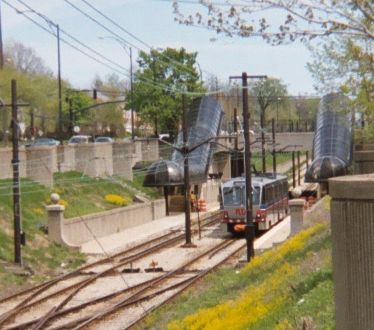
The main transit agency in Cleveland is the Greater Cleveland Regional Transit Authority (RTA). They run a system of buses, heavy rail, and light rail (trolley).
BUSES

Cleveland now runs a 100% wheelchair accessible bus system. The bus system covers most of the area. There is also a Bus Rapid Transit (BRT) that runs in its own dedicated lane from Windemere to Tower City called the HealthLine. This is similar to Kansas City’s MAX service.  You can get a route map here.
Picture courtesy of Wikimedia
Hillrhpc under CC-BY-SA license

The Red Line

The Red Line is Cleveland’s heavy rail system, think like a subway. It runs from the airport to Windemere, northeast of downtown. Only 12 of the line’s 18 stations are barrier free. Most of the inaccessible stations are located in the central part of the city. You can access Indians and Cavalier games from the Tower City station via an accessible walkway.
Picture courtesy of Wikimedia
Hillrhpc under CC-BY-SA license

Blue and Green Lines

Cleveland’s light rail system runs along the waterfront and can be used to visit the Browns’ stadium, the Flats (lots of dining options), and the Rock and Roll Hall of Fame. Both lines serve this area and, with the exception of the Amtrak stop, all waterfront stations are accessible. The Blue Line extends to Warrensville. Only the Shaker Square and Warrensville stations are accessible once the line goes east of Tower City. The Red Line culminates at the Green Station. Only that station and Shaker Square are accessible east of Tower City.

You can get a map of the rail system here.

Downtown Trolley

Two wheelchair accessible bus shuttle services serve the downtown area at 10 minute intervals between 7am and 7pm Monday through Friday. The service is free.

The fare for Cleveland’s transit options is $2.25 for the base fare. Disabled and seniors ride for a dollar.

-Darryl
Copyright 2010 - Darryl Musick

Sunday, July 18, 2010

ROAD FOOD: Ice Cream!

Update:  It's National Ice Cream Day...I didn't know that..
That was the temperature on our back patio on Friday afternoon at 4:00pm.  It's time to think of something cool.  Cold even.  Here are some of the most memorable ice cream parlors we've been to on our travels.
Picture courtesy of Flickr
rellim under CC-BY-SA license
The Sugar Bowl in Scottsdale, Arizona is a true family place.  So much so, it was Bill Keane's favorite place.  You may know him better as the dad who drew The Family Circus comic strip based on his real family.  Not only are there delicious ice cream and treats here, but many original drawings on the walls that Mr. Keane contributed to the restaurant.
Picture courtesy of Flickr
MonicaD under CC-BY-SA license
Superior Dairy in Hanford, California is a sight for sore eyes on one of those blisteringly hot Central Valley days.  The flavors are a bit on the basic side but can be jazzed up with many toppings.  The scoops are huge.  A single scoop here would beat a triple at many places.  It's located on Hanford's main plaza, which is also a jewel.
Dewar's is a 101 year old company located on the corner of California and Eye Streets in Bakersfield, California.  There's also another location on Hageman and Coffee Roads in the northern part of town.  Not only do they make delicious ice cream, but many hand-made candies too.  I'm particularly fond of the caramel chews.  Letty says they make the best pink peppermint and chocolate chip ice cream she's ever had...
...except for the version she made at home (see picture above).
Thrifty Ice Cream is available at most Rite Aid stores along the West Coast.  Many a California adult remembers as a kid visiting Thrifty Drug Stores (now Rite Aid) and buy ice cream cones for a nickel a scoop.  Now around a dollar, it's still suprisingly good for a low priced ice cream.  This basic frozen treat has a lot of fans.
Picture courtesy of Flickr
LadyDucayne under CC-BY license
The west San Gabriel Valley...just east of downtown Los Angeles...is known these days as a very large Asian community.  Great Chinese, Thai, Vietnamese, and other Asian tinged restaurants abound.  One thing that has stayed constant over the years is Fosselman's Ice Cream Parlor on Main Street in Alhambra.  The small shop is overwhelmed with crowds some days, but seek it out if you're in the neighborhood...and if they have white chocolate listed as one of their daily flavors, don't pass it up!

Try some of these great ice cream treats next time you're in the neighborhood.  Have an ice cream place you think is the best?  Tell us in the comments below.

-Darryl
Copyright 2010 - Darryl Musick

Wednesday, July 14, 2010

TRANSIT REPORT - Toronto, Ontario, Canada


The Toronto Transit Commission - TTC - serves the city of Toronto with bus, subway, streetcar, and paratransit.  GO Transit provides commuter rail service from the suburbs to the city. 


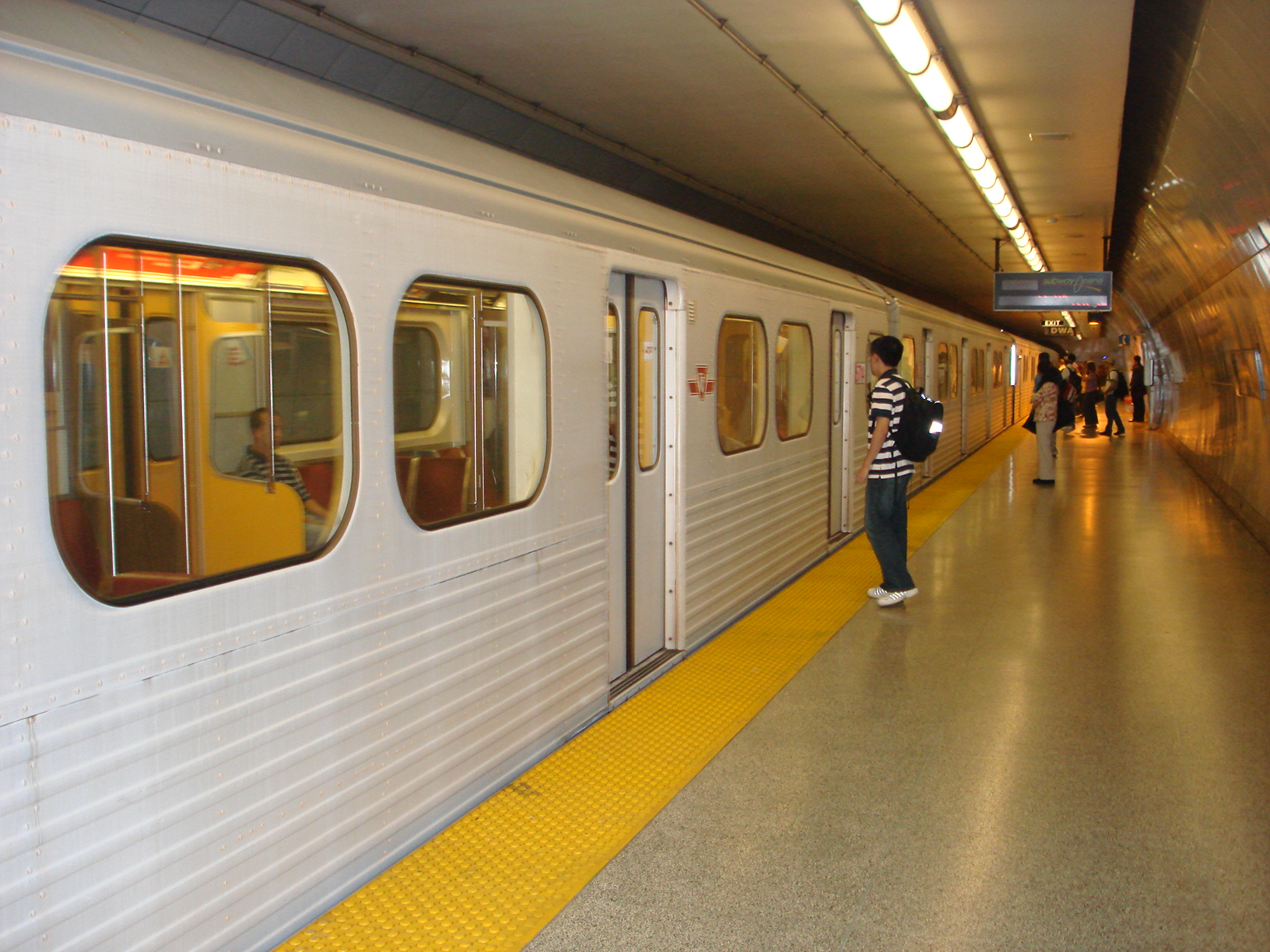
TTC Subway - Right now, there are 29 stations that provide barrier-free access to subway trains.  That is a little less than half of the stations.  On the TTC website, you can get a list of those stations.  Another 14 stations are planned to be accessible within the next 4 years. 
Picture courtesy of Wikimedia
Ivan Hernandez under CC-BY license

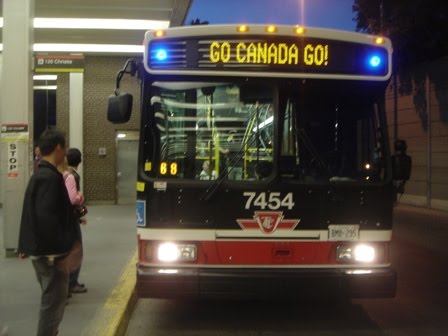
TTC Bus - 92% of the vehicles in the bus fleet are accessible.  By the end of 2011, it is expected that 100% of the fleet will be wheelchair accessible.  Three all-night routes (301, 306, and 352) and one downtown express route (141) are not listed as accessible, the rest are.  You can go to the TTC website to get a list and map of all the bus routes

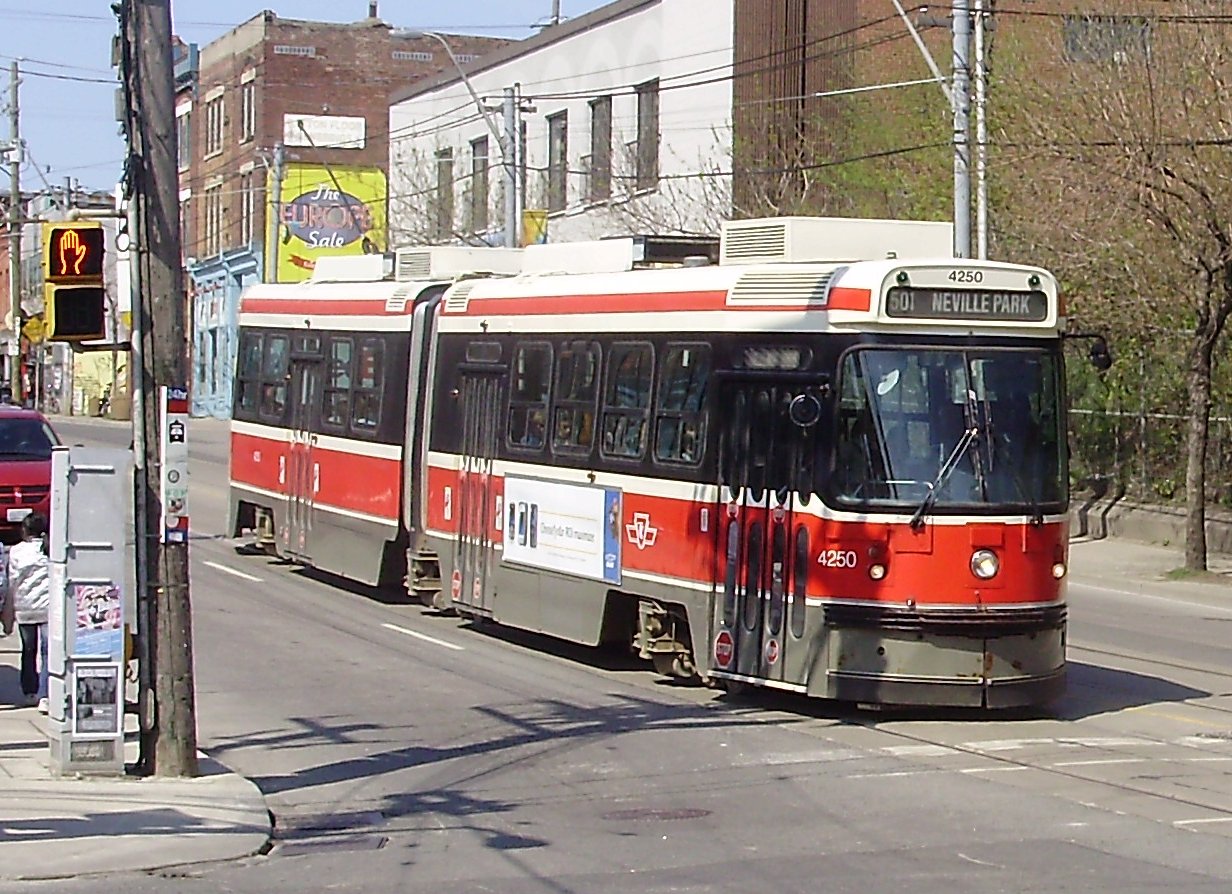
TTC Streetcar - The Toronto Streetcars are not wheelchair accessible.  The TTC plans to start introducing low-floor accessible streetcars in 2012 with the entire fleet done by 2018.
TTC Wheel-Trans - The TTC's version of paratransit requires an in person interview before approval to ride making it inconvenient for travelers.  Here are the procedures for approval.

The current base fare for all TTC services is $3 (CDN) and a day pass is $10. Seniors 65 or older get a one dollar discount on the base fare, there is no discount for disabled riders.

GO Transit - The commuter rail service provides double-decker trains into downtown Toronto's Union Station from Niagara Falls/Kitchner-Waterloo in the west; Orangeville, Barrie, and Beaverton to the north; Stouffville, Uxbridge, and Peterborough to the northeast; and Oshawa/Newcastle to the east.  All but 10 of the 59 stations in the system are accessible and 6 more are slated to be accessible by the end of 2010.   Fares run from about $4 one way to around $18 one way.  Their website has a fare calculator.

Many nearby towns have their own bus systems that connect with the outer reaches of the TTC or GO systems.  You can find a list with links here.

-Darryl

Wednesday, July 7, 2010

Travel Tunes - Week 33

On our trip to Yellowstone a few years ago, we went to the Gallatin County Fair in Bozeman, Montana.  While we were there, we took in a show by a husband and wife country duo who put on a great show.  At one point, the husband said they got a lot of requests to sing El Paso but complained that the song was too long so he was able to get the complete song into a 30 second version.  They started playing and he sang these lyrics: "Down in the West Texas town of El Paso, I fell in love, I got shot, and I died..." 

End of song.

Funny bit, and yes, it does give you pretty much the whole story in one line but the original version is worth listening to, all 5 minutes and 2 seconds of it.

Marty Robbins was born in Glendale, Arizona in 1925.  This is a suburb to the west of Phoenix, better known as the location of the Cardinals new football stadium that's shaped like a rattlesnake.  A product of a broken and disfunctional family, Robbins found comfort hanging with his grandfather and listening to his stories of the old west. 

He went into the navy in World War II and was stationed in the Pacific where he learned to play the guitar and loved Hawaiian music.  After the war, he played gigs around Phoenix which netted him a local TV show.  Success soon followed and he went on to the Grand Ole Opry and a long career in country music.

Robbins also raced and drove in 35 NASCAR races, including 6 top ten finishes, one of which was the 1973 Daytona 500.  He also dabbled in acting and his last film appearance was in Clint Eastwood's Honkytonk Man.  He died of cardiac arrest in December of 1982 at the age of 57.

In the tradition of Sons of the Pioneers, Robbins was one of the best balladeers to come along.  He covered other writers tunes, such as the classic cowboy ballad Cool Water and A Hundred And Sixty Acres, but wrote a few classics of his own such as Big Iron and, of course, El Paso, which he recorded for his 1959 album Gunfighter Ballads And Trail Songs.

El Paso is the story of the cowboy who comes into a cantina in the title town and falls in love with a Mexican girl...I certainly can relate to that.  When another man makes move on his beloved Felina, the cowboy shoots him dead and flees the law.  Hiding out in New Mexico, the cowboy realizes his heartache is worse than death so he heads back to El Paso to find his Felina.  He is spotted and a posse goes out to stop him.  He is shot and dies in Felina's arms.

What makes the song so good is the Spanish guitar work and Robbins lyrics: "I Challenged his right for the love of this maiden.  Down went his hand for the gun that he wore. My challenge was answered in less than a heart-beat; The handsome young stranger lay dead on the floor.  Just for a moment I stood there in silence, Shocked by the foul evil deed I had done," "I see the white puff of smoke from the rifle, I feel the bullet go deep in my chest," "from out of nowhere, Felina has found me...cradled in two loving arms that I'll die for, one little kiss and Felina good bye."

You're going to find yourself driving across a desert someday and this, along with Cool Water, Riders In The Sky, and Desert Skies should be mandatory on your playlist.  Give it a whirl and see if you don't get caught up in the cowboy's sad story.

Below is a video, I think from the 1967 film Road to Nashville but I'm not sure, where Robbins ends the movie with a full rendition of the song.  Enjoy!
-Darryl