Thursday, May 9, 2019

DINNER TIME! Dutch Oven Beef Stew


It can still get a little chilly at night here in Northern California. A hearty stew is just the thing to take the chill off.

This recipe used a cast iron Dutch oven inside of a conventional oven. It takes several hours to finish but most of that time, it's "set and forget." Just a little bit of preparation at the beginning and two stirrings during cook time.


INGREDIENTS
2 lbs. - beef stew chunks
2 strips - bacon
1/2 med. onion
4 med carrots
10 small yellow potatoes
4 oz. - sliced mushrooms
10 oz. - frozen peas
1 med. tomato
1 can - beef broth
1/4 cup - sherry
2 tablespoons - mince garlic
1 teaspoon Kosher salt
1/2 teaspoon black pepper
1/2 teaspoon - thyme
1 bay leaves
1/4 cup - cornstarch
2 tablespoons - olive oil


My wife and son don't like chunks of onion so, instead of dicing, I put the onion in the blender on a medium speed with 2 tablespoons of water for 5 seconds (you can dice if you like). Then, it's peel the carrots and slice into quarter inch chunks.


I quarter the potatoes and set aside in a bowl with the carrots.


Dice the tomato and set aside in a separate bowl.

Preheat the oven to 285 degrees.


Cut up the bacon into small chunks. Heat the olive oil in the Dutch oven on the stovetop at medium-high heat. Cook the bacon until just done in the oil.


Add the onion and cook another 5 minutes.


Add the beef, salt and pepper. Stir occasionally and cook another 5 minutes.

Add half the sherry, stir and scrape the bottom with a wooden spoon or spatula.


Turn off the heat and add the vegetables, bay leaves, garlic, thyme, mushrooms, and cornstarch.


Pour in the broth and the rest of the sherry.


Oops! I forgot the tomatoes so I add them (you can add with the rest of the vegetables).


Cover and put in oven for 2 hours. At that time, remove cover and stir. Cover it back up and cook another two hours. Stir again and cover. Cook one more hour and serve.

Darryl Musick
Copyright 2019 - All Rights Reserved

Wednesday, May 8, 2019

FIELDS OF DREAMS - Kauffman Stadium, Kansas City, Missouri


Moving into the top three of our accessible baseball stadium reviews.  Starting with this week's entry, the top three stadiums are so close to each other that there's just very minor reasons why one is rated above the other. They are also pretty well ahead of the rest of the stadiums on our list as far as comfort, food, and game experience.  We kick off our esteemed top three with...

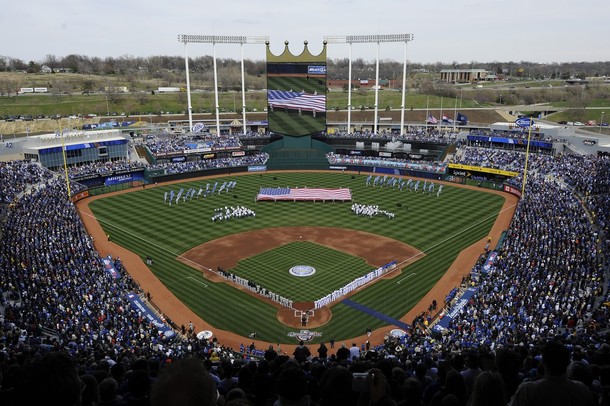
Kauffman Stadium, on the eastern edge of Kansas City, is home to the American League's Royals.  Built in 1973, it is the sixth oldest stadium in Major League Baseball behind Boston, Chicago (Wrigley), Los Angeles, Anaheim, and Oakland.  The Royals are owned by David Glass, a former president and CEO of Wal Mart.  The stadium hosted the All Star game for 2012.

Sitting 10.5 games behind a red-hot Detroit for 2013 puts the Royals in third place. Once home to one of the best hitters to ever play the game, the roster now consists of decent but lower-priced journeymen and youngsters. One of the nuttier people to ever sit in a broadcast booth, Rex Hudler, now provides color to the bland Steve Physioc on the teams TV broadcasts.

The stadium was given a renovation in 2007 and is one of the minority of professional sports facilities not to have a corporate name...Ewing Kauffman was the former owner of the team.

It has a signature feature, large fountains in the outfield.  Kansas City is said to have more fountains than any city other that Rome, so this is the architect's tribute to the city (funny, in driving all over the city I only saw one fountain).  It also has the third largest video screen in baseball, a high def, portrait-oriented screen with a crown on top that shoots fireworks at various points in the game like team introductions and home runs.

Click on the link to see a video from the game we attended.

Here are the stats:

Opened: 1973
Surface: Grass , bluegrass and rye, 1995 - present
             Astroturf 1973 - 1994
Construction cost: $70 million ($250 million for 2007 renovation)
Capacity: 39,000 (present)
               40,625 (1973)
               38,177 (2009)
Field Dimensions: Left field - 330 ft.; left center - 387 ft.; Center field - 410 ft.; right center - 387 ft.; Right field - 330 ft.
Home Team: Kansas City Royals (American League - MLB) 1973 - present

What a beautiful stadium.  Wheelchair access from every gate with wonderfully plentiful dispersed seating throughout at every level.  What I like about the wheelchair seating here is that it's not concentrated at the top of the levels but is also located down in the middle of each level.   The renovation makes it seem like a brand-new stadium with a retro design.  I really like this park.

The one big knock I have is that the stadium is located outside of downtown and there is no public transit to the complex.  This means driving or taking a taxi.  The parking lot is vast with a lot of disabled spots.  Parking is $10.  There is also a taxi queue after the game at gate D.

Although Kauffman used to have the dreaded "one wheelchair, one companion" policy, they seemed to have dropped that.  We had no problems getting two companion seats.  Just call the ticket office at (800) 6-ROYALS.


There are tons of great seating options here.  You can sit in a deck by the fountains, outfield cheap seats, upper deck, club level, and several field level options.  We chose the dugout box seats, a section on the lower field level right by home plate.  We were only 15 rows back from the field.

Although not "exclusive" seats like in St. Louis, this section had a hidden food court that served about 90% of the food selections of the stadium without having to troop up the stairs (or elevator) to the top of the field level.  A thoughtful touch.  These were absolutely fantastic seats, very close to the action, and only cost $43.  Most stadiums would want three figures for the same seats.  Ticket prices are now dynamic and can range from $7 for outfield bleachers or upper level to $250 to sit in the first few rows right behind home plate.

A great selection of foods from the many hot dogs and sausages available, good KC barbecue, fried chicken in left field, the best popcorn I've ever had at a ball game (Topsy's), and more.  I do have to give a knock on the funnel cake...I couldn't find anyone that could make a decent one.  A great selection of beers including lot's of microbrews on tap.  Prices were reasonable and most of the food was very good.

For the stadium alone, it would have to be maybe the second best we've seen.  Dynamic ticket pricing and no public transit are big knocks so that puts it down a notch to third.  Still, one of the best stadiums in baseball...a classic!

-Darryl
Copyright 2010 - Darryl Musick
Updated for 2013

Wednesday, May 1, 2019

FIELDS OF DREAMS - Great American Ballpark, Cincinnati, Ohio


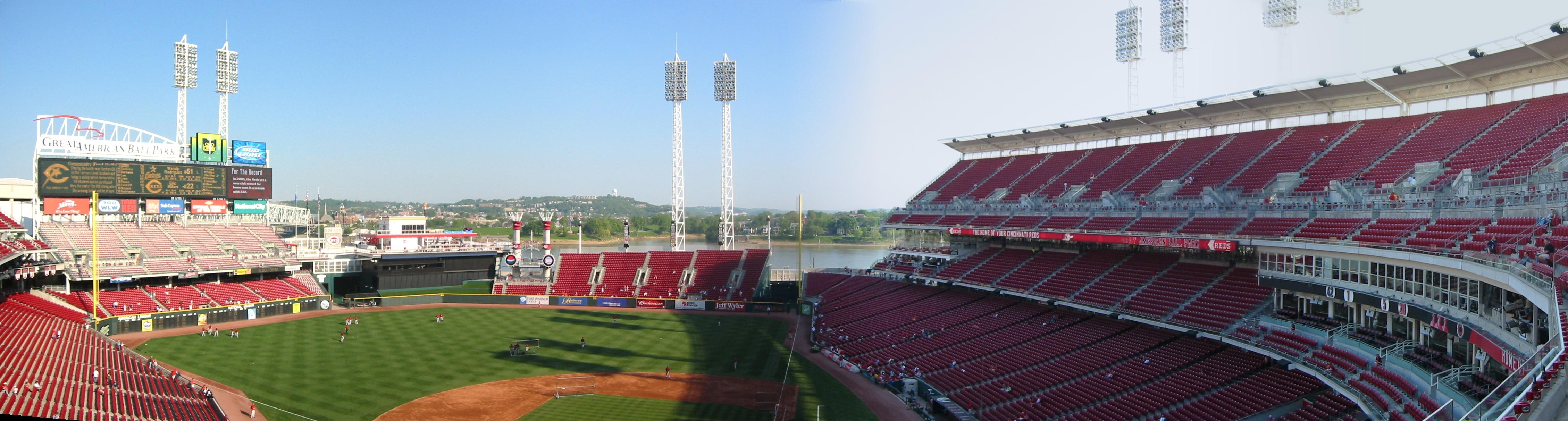
The Great American Ballpark on the banks of the Ohio River in Cincinnati is home to the oldest professional baseball team in America, the Reds, dating back to 1869.  The team that is, not the stadium.  The ballpark opened in 2003 and replaced the cookie-cutter like Riverfront Stadium, a dual-purpose football and baseball facility.  Baseball legends such as Pete Rose, Frank Robinson, and Johnny Bench have worn the uniform but did not play in this park.  More modern players such as the recently retired Ken Griffey, Jr., Scot Rolen, Joey Votto, and Bronson Arroyo have.  Here are the stats:

Photo courtesy of Wikimedia
Eric Kilby under CC-BY-SA license

Opened: 2003
Surface: Perennial Ryegrass
Construction cost: $290 million
Capacity: 42,271
Field dimensions: Left field - 328 ft; Left center - 379 ft; center field - 404 ft; right center - 470 ft; right field - 325 ft.
Home team: Cincinnati Reds (National League - MLB) 2003 - present
Events attended: 1 game


Watch the Video!

Good access but it would be nice if there were an accessible entrance from the river side.  There are several places you can walk up to the entrance level but they all have stairs.  There is on lobby by the left field foul pole with an elevator but it is closed to the public on game days.  A large accessible plaza is at home plate where you can pick up tickets from the will call booths.  The concourse is open so you can still keep tabs on the game when you go for snacks.

Wheelchair locations are at the top of the field level, at the top of the club level, mid level on the upper deck, one spot in the front row behind the plate, mid level in the outfield bleachers, and a section halfway up the bottom level behind home plate...these are probably the best wheelchair spots in the stadium.

Ticketing is fairly easy, just call the box office at 877-647-REDS.  We had no problem getting seats for the wheelchair and two companions.  Ticket prices start at $6 and go up to over $300, not including the suites, due to dynamic pricing. 

There is not a lot of good public transit to the game.  There is a local shuttle, $1.50, that cruises around the stadium area every 20 minutes or so and connects with Covington/Newport across the river in Kentucky.  It is easy to walk across the bridge from Kentucky and the downtown location makes it convenient to hotels there.

Many lodging choices are available.  The most lively area is across the river in Kentucky where many hotels, restaurants, bars, and attractions are available.

Food choices are minimal here.  Hot dogs, burgers, pizza, popcorn, and nachos are the staples.  Very few alternative choices are here.  The beer selection on tap is vast and inexpensive.

If it had better food and transit options, this stadium would be in our top five.  It's still a very nice stadium, several notches above our home stadium in Anaheim.

Darryl
Copyright 2012 - Darryl Musick
All Rights Reserved
Updated for 2013

Thursday, April 25, 2019

MOVING CHRONICLES: Easing the Property Tax Burden in a High Tax State


So why did we choose to move where we did? Why did we stay in California instead of moving to a lower tax state? How did we still do it affordably?

First off, we did consider moving out. California is a very high tax state and it's getting higher every year. Now they want to tax our soda, water, and even ding us for every mile we drive...in addition to the other myriad taxes we already pay.

We looked...Arizona, Colorado, Nevada, and even a few states farther away, like Tennessee and North Carolina...but, in the end there's no place like home. California is still the best we've seen and we don't want to be too far away from family.

How did we make it affordable? Well, contrary to common belief, not everywhere in California is suffering from sky-high home prices. Yes, you can pay well into the seven figures for a hovel in places like Los Angeles, Silicon Valley, and San Francisco, but there vast swaths of the state that are away from those high-priced locales where you can get some bargains.


We found it was almost impossible to live near the coast on our budget...however you can find reasonable near ocean house prices in the far north in places like Eureka...so we explore in the other direction.  Home prices in the Central Valley, Redding, Red Bluff, Chico, the deserts, and Sierras are very reasonable, it just became a search of where it would be reasonable and desirable.


The Motherlode region ended up being the most appealing. This is the historic area where gold was mined from the Motherlode in the foothills of the Sierra Nevada mountains during the Gold Rush. It extends...roughly...along highway 49 from the area around Auburn in the north down to Mariposa and Oakhurst in the south.

Great homes could be found here for our $400,000 maximum price. Heck, I can still go out and find decent homes in the area (and in the other areas mentioned above) for less than $200,000.

Why was that our maximum price? One reason...property taxes. We would not have a mortgage payment, since we could pay cash, but we'd need to keep those taxes down to a manageable level to be able to afford it on our fixed and small retirement income.


One tax that is under control in our Golden State is property taxes. Thanks to Proposition 13, passed four decades ago, property taxes are strictly controlled and not allowed to jump dramatically. It's something the politicians in Sacramento hate but it makes the state liveable for the rest of us.

The gist of it is this:

  • Basic property tax is 1% of the assessed value at the time of the sale, usually the sale price.
  • Only if 2/3 of the property owners in a defined area vote for an increase can that basic amount go higher than that...for instance, the local school district can put a 1/4% increase on the ballot to get more funds. If 2/3 of the property owners agree, then the local property tax would go to 1.25% of the assessed value at the time the sale.
  • The property tax can only be raised by a maximum of 2% a year so, if you paid $1,000 this year in property tax, next year expect to pay $1,020 - even if the assessed value of your house doubles or triples or more.
  • When the property is sold, the new buyer pays on the newly assessed amount.

It's this last point that makes it hard to relocate within the state sometimes. If you paid $100,000 for your house 30 years ago and, over time, your tax is now around $2,000...you could be on the hook for a lot more if the houses you're looking at cost half a million or more (an extremely common and low price in this state). That's at least $5,000 per year.

We figured we could afford up to $4,000 per year which defined our top end house price.

It took a year of very casually looking at houses up here and, believe it or not, one day of intense house hunting to find the home we ended up with in Amador County in the heart of the state's gold country.

There are also two other propositions out there, Prop 60 and Prop 90, aimed at tax relief for seniors 55 or older. Both are able to be used one time.

Prop 60 states that if you move to another part of the same county you live in, you can take your tax rate with you so, if you paying tax on the $50,000 house you bought in the 70's and buy a million dollar McMansion a few towns away, your property tax will not rise.

Prop 90 works the same way if you move to another county that reciprocates. Currently, there are 10 counties that do:

Alameda
Los Angeles
Orange
Riverside
San Bernardino
San Diego
San Mateo
Santa Clara
Tuolumne
Ventura

These counties include some pricey and desirable real estate such as La Jolla, Newport Beach, Palm Springs, Claremont, Pasadena, Palo Alto, Ojai, and Thousand Oaks.

In short, you might have to give up your dream of living beachfront in Malibu or Monterey, but there are plenty of areas in this 3rd largest state in the nation where you can find a new dream.

Darryl Musick
Copyright 2019 - All Rights Reserved

Monday, April 22, 2019

ADVENTURES CLOSE TO HOME: Micke Grove Park - Lodi, California


After almost 4 weeks of daily rain, it's nice to see a spectacularly sunny day. Looking for a cheap adventure close to our new home, we head down the hill to the central valley city of Lodi, located south of the capital and just north of the inland port city of Stockton.

Micke Grove Park is a large swath of green, shady recreational land just off highway 99. After paying our five dollars for park entrance, we slowly wind our way around picnic shelters that are designed for groups or large families to rent out for their parties.


We find the parking lot next to the zoo and pull in. It's another five dollars each to enter the zoo. I think we hit it just at the peak, on a Tuesday morning with a few other people, no hordes of school children on field trips, and all the flowers blooming in full glory.

It's a small zoo here in Lodi. The main path that makes an oval loop around the facility is probably about the same size as a high school track around a football field.


We start off seeing a pond full of turtles, then a sleepy fossa...a cat-like mammal from Madagascar that preys on lemurs...and a few birds of prey.


There's a very healthy looking bobcat next to some red lion tamarins.


A large exhibit well away from the fossa holds several lemurs.


An indoor annex also holds some reptiles and hissing cockroaches from Madagascar.


At the far end of our loop, we see a very sleepy snow leopard in his large enclosure, walk by a closed aviary (closed because of California's Newcastle Disease outbreak), and a marmoset enclosure.


Before you know it, we're back at the entrance.  It's an interesting and very pretty zoo. Very small, though, but definitely worth the small entrance fee.


Next door is Funtown.


This is a small amusement park that is open almost every day, year round. We could find no accessible rides or even any that would be feasible to transfer Tim onto. Mostly their just your basic carnival rides like a Tilt-a-Whirl and a small roller coaster.


We wait for the train to cross before we exit.


Back near the parking lot, we visit a very pretty Japanese garden.


Those blooming trees and flowers are making my allergies go haywire.


We see this Japanese bridge over the pond when Tim tells us the charge on his chair is running low on battery power.


Back in the van, we head to the nearby downtown and find Yume, a sushi bar and Japanese restaurant.


Letty has this brilliant plate of sushi...


...while I have the best bowl of pork ramen I've had since moving.


Tim digs in to this plate of katsu pork.

The day and meal behind us, we pack back into the van and head back up to the Motherlode to await our next adventure.

Darryl Musick
Copyright 2019 - All Rights Reserved

Friday, April 19, 2019

Climbing Every Mountain for a Costco Run: Carson Valley, Nevada - Part 3


Read Part One here and part two, here.

We wake up to a sunny morning on our last day here in the Carson Valley. Today, we'll finally get around to the somewhat-flimsy reason we came here for...to go shopping.

Mostly, I just wanted to get away from the trials of moving but the shopping angle made it a little more reasonable. We'd have a good reason to go, even though I mostly just wanted to get the family away for a little fun.

I'm also looking to get that cheap Costco gas in the cheap gas state of Nevada but, when I pull into the lot, I notice that the Costco station is closed for reconstruction. I ended up at a local Chevron where I paid $3.09, still about 30 cents less per gallon than the cheapest I could find in our neighborhood.


We fill up our cart with our rather long list of items at Costco, then head to Trader Joe's across the street to get a few more there, while Letty spends some time in Marshalls...which she's been missing since we moved.

The van is loaded. Actually, it's stuffed to the gills with our goods as we head up the mountains to head home.

Soon, we arrived in Lake Tahoe and stop in to the Lakeside Inn Hotel and Casino for a lunch stop.

The dining room is not really lakeside. In fact, you can't see the lake at all from here, but the food's good if the building seems a bit dated.

I lose a couple of bucks on an automated roulette machine and we're on our way.


We stop off at a showy beach to take a few pictures.


It's up to Hope Valley, a pristine alpine stretch about 20 miles south of the lake.

We stop again to take some pictures of the snow covered ground.


It's gorgeous up here where the Carson River starts it's journey back down to Nevada, where we just came from.

An hour later, we're pulling into our driveway and it's time to unload and rest up from the trip.

Darryl Musick
Copyright 2019 - All Rights Reserved

Monday, April 15, 2019

Climbing Every Mountain for a Costco Run: Carson Valley, Nevada - Part 2


Read Part One here.

It's gray and cool this morning at the Historian Inn in Gardnerville, Nevada. Chicken fried steak, french toast, and pancakes fortify the three of us for a day of sightseeing in the area.

Watch the Video!


Bundled up in our down jackets, we head back towards the mountains. There, hard against the eastern edge of the Sierras, lies the tiny burg of Genoa.

Back when this was still part of Utah Territory in 1850, a group of Mormon pioneers built a fortified trading post here. When Nevada split from Utah, this was the first capital until it was later moved to nearby Carson City.


The rain is pretty steady, the ground pretty muddy, so we scratch getting Tim out of the van here but Letty goes into the general store for some trinkets and takes a few pictures.

Plans are quickly rearranged to do something indoors and we start down Jacks Ridge Road towards Carson City. Along the way, I see an old cemetery off to the side. The gates are open so I drive through, mostly hoping to get some photo opportunities.


A minute after driving in, I see this sign.

John 'Snowshoe' Thompson, a Norwegian immigrant, was a volunteer mail carrier back around the time Genoa was founded. He is famous for his tenacity in his work, delivering mail deep into the cold, upper reaches of the Sierra mountains.

He fashioned a pair of planks to scoot around on the snow...his 'snowshoes'...and is now considered one of the founders of skiing in California.

His name is legend at ski areas from Mammoth to Squaw Valley.


Soon, we find the grave with a little help from Google.

Thompson is buried here with his son, who died at 11 years old, and his wife, who lived into the 20th century.


Until a few minutes ago, I never knew he was buried here in Genoa.

We continue on to the capital and pull into the lot of the Nevada State Museum. Located in the former Carson City Mint, Silver State history abounds from the prehistoric fish that used to inhabit the inland sea that was here to the glittering casinos that now call the state home.

It's very interesting and an elevator, disguised to look like a mine shaft, gets wheelchair users to all floors.

An old coin stamping machine sits where it used to pump out silver dollars, quarters, dimes, and more. On the last Friday of each month, the staff fires it up to stamp out the souvenir coins sold in the gift shop.

A 17,000 year old mammoth skeleton sits next to a 25,000 year old horse..


In the basement is a recreated mine shaft, complete with rails for ore cars in the floor that can make it tricky for wheelchair users, especially those in oversized chairs. Tim manages to get through the tunnel but it's a bumpy tight squeeze in some spots.

Letty is impressed by the hall of taxidermied animals.


We end the day back in Gardnerville.  We're fans of Basque restaurants and the very first one we ever tried was the Overland Hotel here. It's long gone but JT Basque sits right across the street.


We're feeling adventurous so we share an entree of pig's feet and tripe. It may sound nauseating but it was very delicious.


Along with the soup, salad, bread, beans, beef stew, fries, and ice cream for dessert, no one was leaving here hungry.

That's enough to sate us for the day. Tomorrow, we'll check out, do our shopping, and go home. We'll conclude this adventure then.

Darryl Musick
Copyright 2019 - All Rights Reserved

Friday, April 12, 2019

Climbing Every Mountain for a Costco Run: Carson Valley, Nevada - Part 1


Yes, there are Costcos closer to us. Lodi and Elk Grove are just over a half hour away. Rancho Cordova and Folsom aren't far, either. But we can combine a run to Costco with a quick getaway from the stress of moving by spending the night near Carson City, Nevada, just on the other side of the Sierra Nevada mountains from us.

Sounds simple but this has been the never-ending winter here. Even though I've put off the trip until April, the weather is still calling for heavy snow over the Carson Pass. The day before doesn't look so bad, though, so I book another night in the motel and we leave a day early.

It's rainy, but we make over the nearly 9,000 foot tall summit of the pass before any flakes start to fall.


Passing through a couple of avalanche zones...complete with evidence of earlier slides...is a bit unnerving but we make it through with no mishaps and end up at the Historian Inn in Gardnerville, Nevada, in just over 2 hours from the former gold fields of Amador County, California.

The room is a basic, maybe slightly nicer than basic, motel room with two queen beds. We think these narrow mattresses are more like full size, but we'll go with the flow.

The bathroom is nice and roomy with a roll-in shower.


It's dinner time when we check in, so we head across the street to Sharkey's Casino for a bite in their coffee shop.


It is a very good and cheap prime rib dinner for me...


...pasta Portofino with some large shrimp for Letty...


...and sliders for Tim.


We waste a buck or two playing the penny slots here.


It's a nightcap at the Silver Dollar bar as Tim decides this would be a perfect place for a pub crawl.

He's not wrong. There's the bar we're sitting in now, the Overland Pub across the street, JT Basque, almost next door to this casino, and three more bars between here and the hotel.

We get a couple of shots as we make our way back, then we'll finish up tomorrow for the next, new Cocktail Hour that'll be coming your way.

In the meantime, we'll call it a night and do some sight seeing tomorrow while we're here.

Darryl Musick
Copyright 2019 - All Rights Reserved