Showing posts with label berlin. Show all posts

Sunday, August 30, 2020

The Cocktail Hour: Biergartens of Germany


Beer is a way of life in Germany and the neighborhood biergarten is a way of life in the warmer months when all the people want to do is go outside and enjoy the fresh air.

You can find them almost anywhere, especially in Munich where over 400 biergartens call the city home and are almost on every corner.  They are more numerous there than Starbucks is in the states.

Here are some of the outdoor brewpubs we visited while we were in country, in the order we encountered them...


Luftgarten (German for Air Garden) sits on the perimeter of the former Tempelhof Airport. It's relaxing, sunny spot. You can even sit in their beach chairs.  Shade is a bit of a premium here because most of the area is open field without too many trees. A barbecue trailer cooks up specialties such as currywurst and there's a nice selection of Berlin brews to choose from.

It's also quite a walk from the nearest U Bahn station.


Berlin Zoo has a biergarten in the center, next to the kid's playground.  As in most, there's a nice, shady outdoor area to relax with your brew and a snack from the adjacent cafeteria.


Nice, but maybe just a step up from your average zoo snack bar.


Café am Neuen See is the 'biergarten in the tiergarten.' It shows up on many 'best of Berlin' lists including this 7 Best Places to Eat in Berlin from Wanderlust. I can't vouch for the food...we just had dessert and beer there...but it is an amazingly relaxing place with tables set around a small lake under a forest of nice, shady trees. One of the few biergartens we found in Berlin that serve beer in liter glasses.


Moving on to Munich, the biergartens multiply exponentially here. Literally, we'd find one around every corner.


We had two in the immediate vicinity of our hotel, one of which we made our local while we were there, the Alte Heide.  I did pretty much an entire post extolling the virtues of this tiny neighborhood biergarten that serves the best food we've ever had in Munich.
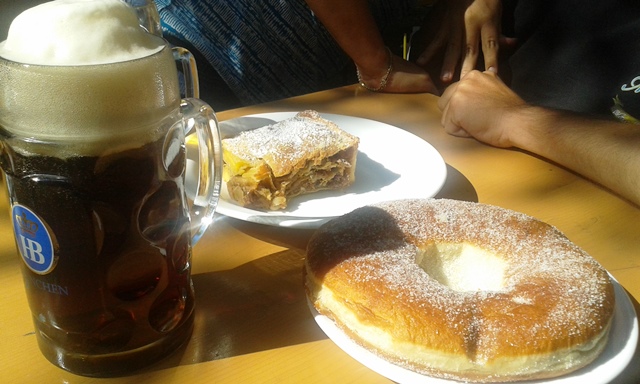


The Aumeister Biergarten sits at the north end of the massive Englischer Garten. Dating from 1810, it's big but not as big as some of the other biergartens in town. Very traditional space with plenty of outdoor tables and snack stands along the beer line. One of the places you can get the very delicious Auszogne (also called a Bavarian donut), though here they use regular sugar instead of powdered sugar to coat it. My wife really likes the dough they use here best, however.


It's at the top of the very forested north end of the park where there are dozens of trails for hiking and biking. It's very popular with both of those groups as a place to take a break in their activities.


(Please read our Covid 19 Statement first - Ed) The Chinesischer Turm is a massive biergarten towards the south end of the park. The name means 'Chinese Tower' and is overshadowed by a 25 meter tall pagoda. Thousands of drinkers can fit here, sometimes listening to musicians playing up in the tower.


Several food stalls surround the beer stand with all kinds of goodies to eat. Know that your price for beer includes a deposit for the glass. Return it to the counter around the back to get your fee back.


After passing the south end of the park, past the surfers on the Eisbach, eventually you'll reach the city's main plaza, Marienplatz. Just another block or so beyond that is a destination that every traveler to Munich needs to visit, the Viktulienmarkt.


This 2-block long market is where you can find just about any food or drink you can imagine from individual vendor stalls.  The New York Times said is was worth flying across the Atlantic just to visit this market and I have to agree, it's a wonderful place full of fascinating smells and tastes.


The biergarten in the middle of the market is where you can indulge in all those goodies you're going to buy from those vendors, along with food you can buy at several surrounding snack stands and, of course, the beer counter.


This is one of the best places to make friends with locals over a bier and a wurst.


Across from the Haupbahnhof (the main train station) is the expansive Augustiner Keller biergarten. One of our very favorites, this is the place to come for massive schweinhocken (pork shanks with very crispy and tasty skin) and a fluffy, pillowy Auszogne.

One of Munich's oldest breweries, Augustiner (not available in the U.S.) pours from old-fashioned wooden kegs into giant liter glasses.


Help yourself to a giant pretzel in the baskets near the cashier.


Eagle's Nest has a notorious past. This small, mountain top spot south of Munich on the border of Austria used to be Adolph Hitler's personal getaway. He was painfully afraid of heights so he only made the trip up here a few times.


Today, it's open to everybody and commands a spectacular view to go with your brew.


Back in the Schwabing neighborhood of Munich, there's another market that is as yet untouched by tourists. It's much smaller than Viktulienmarkt but Elisabethplatz still has everything you'll need or want, including a beer garden in the corner.


This is Wintergarten and serves some of the best sausages we had here, along with more great Augustiner beer.

There are hundreds more but the three of us can only make so much of a dent. The biergarten culture in Germany is alive and well, I only wish they'd export it over to us in the states.

Darryl Musick
Copyright 2016 - All Rights Reserved

Photos by Letty Musick
Copyright 2016 - All Rights Reserved

Friday, August 28, 2020

Jesse Owens and the Fuhrer: Olympic Stadion, Berlin


(Please read our Covid 19 Statement first - Ed) Our last, full day in Berlin. We've pretty much seen everything on our list. Now, it's a free day and we're looking for a way to pass the time.

"I see an Olympic stadium here on the map," my wife says while perusing another amazing Turkish breakfast.

Watch the Video!


The Olympic stadium!  I'd forgot...it's another big moment of Berlin history and I almost let it slip through my fingers.

It's a bit of a ride on the U-Bahn to the Olympicstadt station. From there, it's another long walk under a tunnel, up a little hill, through the woods, until you finally emerge at the stadium's parking lot.

An admission is paid at the visitor's center and then we're on our own (tours are available but we'd rather just explore at our leisure).


We find a ramp and a tunnel into the stadium. It's huge and imposing. It's also made out of marble, the height of Nazi chic at the time.


While the walls and façade are original, everything inside has been modernized. There's a well-maintained blue rubber track (that's being scrubbed by a beast that looks like the lovechild of a street sweeper and a Zamboni) and a flawlessly green soccer football pitch.


The Fuhrer's box has been replaced by some VIP seats and suites but it's not hard to imagine Adolph fuming from up above as a black man put lie to his 'master race' shenanigans.

The seats are serviceable metal folding chairs, bolted to the concrete. No armrests or cupholders.

The ever-present beer bar is open so we quaff one as we admire the view.


To the side, we find the old swimming and diving stadium, now being used by local kids to cool off in the crystal blue waters on this hot August day.


Eventually, we make our way to the other end of the stadium where we pose at the Olympic torch.

On the other side, we spot a bell from the old bell tower (it was destroyed in World War II and the current one is a rebuilt tower).


Although the swastika is illegal in Germany today, you can still see something suspicious on this old bell that the welders couldn't quite hide completely.


Closer to the stadium than the U-Bahn station is an S-Bahn station. From here, we catch a train back to central Berlin where we can walk through the Tiergarten.


We've been toying around the edges of this giant park for days but on this last day, we decide to walk through until we find a little lake with...of course...a biergarten at it's edge. It's here we'll have one more before signing off from Berlin.

Tomorrow, we'll go to the Hertz office and pick up a car to continue on.

Darryl Musick
Copyright 2016 - All Rights Reserved


Photos by Letty Musick
Copyright 2016 - All Rights Reserved

Monday, August 24, 2020

You, Belong in the Zoo...the Berlin Zoo!


(Please read our Covid 19 Statement first - Ed) After a few days of Very Important History touring, we're dialing it back a bit. This morning, we've learned about the joys of menemen (Turkish scrambled eggs) at La Fiamma near our hotel. Then, it's off to the nearest U-Bahn station at Bulowstrasse.

It's only three stops to our destination, the Berlin Zoo, just a short walk from the Zoologischer Garten Station on the U2 line. I also notice that the Hertz rental car office is across the street, which will come in handy in a few days.


Watch the Video!


The entrance to the zoo is Chinese themed. Once inside, it's broad avenues and pathways provide easy access for Tim's wheelchair to gently cruise through the park.  We pause at a convenient bench near the entrance to get our bearings and look at the zoo map.

Laid out in a large circle with various spokes running through the middle, we turn off into the primate area first.

The colorful macacques are in the first enclosure while a moping orangutan is next door.

Letty is taken with the chimp mom with a tiny baby on her back.

Tim and I take in the mountain gorillas and capuchins.

A small mountain is full of, what else, mountain goats.

Elephants browse their enclosure while giraffes ignore them across the way.


In the middle is a very large and fun looking playground for the kids with the ever-present biergarten next to that for the adults.


The lions and other big cats are inside their houses being fed so we get to hear a few good roars before their handlers shoo them back into their outdoor enclosures.

Before leaving, it's hot and we have some ice cream on a quiet bench. I look over my should and see an impala a few feet away looking at it hungrily.

Back on the U-Bahn, we head to the other end of Tiergarten...the vast, main, central park of the city...and hike a little along the banks of the river.


Soon, we exit that path into the driveway of a large, white palace. This is Bellevue, the official residence of the country's president, Joachim Gauck as of this writing (Angela Merkel is Chancellor).

No tours are available but we do notice a sign for an upcoming Open House...I guess this is the opportunity to see inside if you're interested.

Across the street, we enter the vast park and wander in the general direction to the south edge, where we can make our way back to the hotel.


First, we pass by the Victoria peace monument and a few naked Germans taking in the sun.

Next, it's through the heavily forested grounds until we come upon a small lake with...what else...a biergarten on it's shores.


We take advantage of the relaxing views to have a little dessert and a brew before calling it a day.

Darryl
Copyright 2016 - Darryl Musick
All Rights Reserved
Photos by Letty Musick
Copyright 2016 - All Rights Reserved

Friday, August 21, 2020

Ishtar and the Topography of Terror: Berlin, Germany


(Please read our Covid 19 Statement first - Ed) We're on the Cold War and Nazi trail here in Berlin. Earlier today, we visited the seat of the country's government at the Reichstag, visited for formerly forbidden Brandenberg Gate, and remembered the innocents slaughtered at the Holocaust Memorial.

Watch the Video!

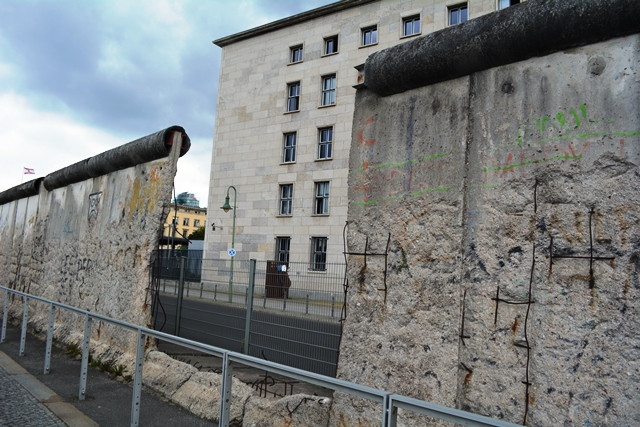
A few blocks away from Checkpoint Charlie's tourist horde, we find a more manageable leftover piece of the Berlin Wall.  About 200 yards of the barrier have been preserved as an open-air museum called the Topography of Terror.


An accessible path takes you along this section of wall, separating what was the bombed out ruins of the Third Reich's administrative buildings and the apartment buildings across the street in what used to be East Berlin. There is a chunk missing, where the first section of the hated wall was broken through giving access to the west for the Berliners of the east.


Many more holes are punched through the wall, exposing the rebar in the concrete, giving evidence of the citizens of the city rushing to tear down the wall with hammers, picks, and crowbars.

Ramps lead to a section below with many photos exhibits of the Nazi era events and locations that took place in this mostly vacant field.

The history here is enveloping and, since it's completely free, devoid of the tourist trap atmosphere that pervades the Checkpoint Charlie area on Friedrichstrasse.

It's time to break for lunch so we find a very nice Italian place, Ristorante Marinelli, across from the Anhalter Station.


There is still a façade standing at this old train station, the only thing left standing after World War II bombing raids. The only trains now are the S-Bahn trains running in the station underground.

During the war, Jews were rounded up and brought here to board trains to their awful fates in the concentration camps. This façade, and a few interpretive displays, were left as a memorial.


Below, we board a train heading for the eastern side of the city where we'll visit Museum Island to end our day.


It's a short walk from the Hackescher Markt station then a walk on a bridge across the River Spree, hard by the Berliner Dom cathedral, to reach Museum Island. Here, five state museums form a UNESCO Heritage Site where visitors can see some of the great treasures of this city.


Some parts still show war damage from seventy years ago.

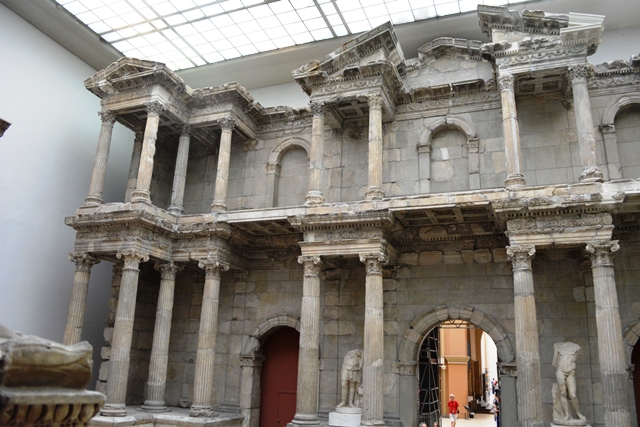
Our destination is the Pergamon  Museum, which features very large, reconstructed buildings from the ancient age. It's star attraction, the Pergamon Altar, is closed for renovation for a couple of years but we are able to see it's other great restorations.


The deep blue tiles of the Ishtar Gate, recovered from Iraq and brought to Berlin to be rebuilt, brick-by-brick, used to guard an entrance to Babylon. Three thousand years have not dulled the brilliant colors.

This was a "small" gate into the old city but we are dwarfed by its massive dimensions.

Dragons, lions, and other beasts are depicted on it's walls. The hall leading up to it is a reconstructed street that led up to the gate.


A model shows just how puny this reconstructed section is when compared to the entire gate complex.


Behind the gate, a Roman temple has also been brought to Germany and rebuilt in this massive hall.

Columns, mosaic floors, and busts of leaders who thought themselves gods adorn the walls.


I'm a bit blown away by the large temple but even more so when I turn around and notice the other half is behind me.

Our long day of Berlin touring, hitting all the major stops on our Cold War and World War II lists, has come to and end. We make our way back to the S-Bahn and on to Potsdamerstrasse to have another delicious Turkish dinner at Café Neffes near our hotel.

We'll rest up, drinking some great German Riesling while watching corny German language gameshows and continue on tomorrow.


Darryl
Copyright 2016 - Darryl Musick
All Rights Reserved
Photos by Letty Musick
Copyright 2016 - All Rights Reserved

Wednesday, August 19, 2020

Riding Public Transit in Berlin and Munich, Germany With or Without a Wheelchair


(Please read our Covid 19 Statement first - Ed) T
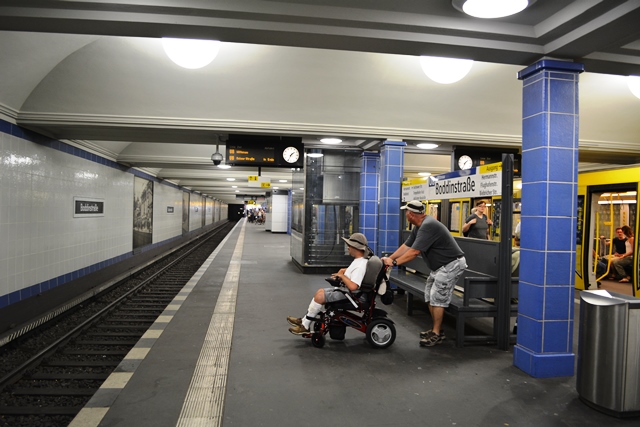
ransit in Berlin and Munich, at least, is very accessible. More so than in many U.S. ADA-covered cities like New York or Chicago even.

We like to use trains (such as the U-Bahn subway system) as much as we can but also know that the buses are accessible, too. While we'll get to the trains and trams below but first, the bus. 


Watch the Video!


Wave to flag the bus driver that you'll want to board the bus. You'll most likely enter via the rear door where a ramp can be deployed.  A wheelchair section will be at mid bus, the correct position is to sit rear-facing against the bracing board. Many buses also have a strap that you can request the driver put across you for added security.

You can tell the driver where you want to exit or press the button with the wheelchair symbol next to the wheelchair section. This will let the driver know that a wheelchair needs to exit at the next stop.


On buses, as with trams, you will most likely purchase your fare ticket on board (there are a few spots, like the airport or larger train stations where you can buy the ticket ahead of time). Please note that just purchasing the ticket does not make it valid...you must validate it on the bus or tram (or ahead of time, if you have access to a validator) with the machine that stamps it with the time and date.

This ticket must be shown to fare inspectors upon demand, who will check the time and date to see if it is expired or not (fare is good for two hours on a basic single ride ticket).

In larger German cities, the U-Bahn and S-Bahn are the backbone of the system. It's equivalent to the subways and commuter trains of larger American Cities.

For the U-Bahn and S-Bahn, you must buy and validate a ticket before getting on the train.  For all trains, buses, and trams, you can also buy multi-day passes.

Before riding on the U-Bahn or S-Bahn, it would be very helpful to check a subway system map to make sure the station you want to go to is wheelchair accessible. The system maps don't always show wheelchair symbols but they do have either an elevator icon, or a ramp icon indicating which type of access is available.

Berlin System Map
Munich System Map

If neither icon is showing, the station is not accessible to wheelchairs.


Most trams in both cities have either ramps or lifts into the vehicles. For any means of transit, the best place to wait is where the front of the train, tram, or bus will be so the driver can see you and deploy any ramps or lifts necessary.

All barrier-free (barrierefrie in German) stations have a folding ramp, so if you get a train with a gap that you cannot manage, the driver or station attendant is supposed to deploy that ramp for you.

For more information, please visit the respective websites below.

Berlin Public Transit
Munich Public Transit

Darryl Musick
Copyright 2016 - All Rights Reserved


Photos by Letty Musick
Copyright 2016 - All Rights Reserved


Monday, August 17, 2020

From No Man's Land to Tourist Trap: Cold War and Nazi Sites in Berlin


(Please read our Covid 19 Statement first - Ed) Forty years ago, I could be shot for standing on the spot where I'm at this morning. Today, it's a bit more innocuous with the McDonalds nearby, the 'Wall" museum, a replica of Checkpoint Charlie in the street median where actors in military garb will pose with you for three Euros, and a sandy beach bar on former No Man's Land behind the leftover segments of the wall that for three decades served as a focal point of the Cold War between the Soviet Union and the United States.


Watch the Video!


People have been killed for trying to pass this little strip...a line drawn on the map, basically...behind the cart selling t-shirts and trinkets off of Freidrichstrasse.  I'm having trouble dealing with the incongruity of it all.


Little did Erich Honecker realize when he built this barrier to keep his people from fleeing to the west that he was building one of the world's biggest, crassest, and Capitalistic tourist traps.  A bit ironic.

While this intersection around the most famous of border crossings between East and West Berlin has devolved into a crowded, money grabbing, photo opportunity, there is still plenty to see about the Cold War and World War II in today's Berlin without having to feel a bit like a sell-out to do so.

We've rested up for a couple of slow days and started off with another little Cold War excursion to the Bridge of Spies in suburban Potsdam yesterday. Now, we're in full gear as we have a full day of touring to accomplish in central Berlin.

Our hotel on Potsdamer Platz is two blocks away from three train stations. It depends on which way we're going as to which station we'll head to. Today, it's Yorkstrasse station. Three lines converge here but only the S1 is wheelchair accessible. That's the line we'll take.

We exit at the Brandenberg Gate station but the lift is out of order and has not been reported yet so we have to backtrack one station and walk an extra two blocks.  


We're starting at the seat of German government, the Reichstag, where we have an 8:30am reservation to take the lift up to the roof. We're reminded this is an official seat of government when we have to process through a rather strict security screening and get an official escort (because of the wheelchair, we have to take a slight detour to the lift) before we can go up.

At the top, we get an English language brochure and a player with an earpiece for an audio tour.  


Heavily damaged during World War II, the building has been rebuilt with a glass dome overlooking the Bundestag (the German Parliament).  A large terrace on the roof surrounds the dome where 360 degree views of the city greet us.  There's also a restaurant up here but we didn't take advantage of it today.


While Letty takes pictures, Tim and I take a slow lap around the roof looking towards the tall TV tower in the former east, the Brandenberg Gate, the very large Tiergarten park, and even a former CIA spy base on a hill off to the west.


When we're all set with the picture taking, it's time to climb the dome. This is where the audio tour kicks in. There are two spiral ramps, both wheelchair accessible, one for going up and the other for going down.


The audio tour tells us as we go up about the wall, the Brandenberg Gate, how all the trees in the Tiergarten were cut down for firewood after the war and all the trees we see now only date back to the 1960's. There's a solar panel that moves with the sun that shades the legislators working below.

It's all very interesting and fits in the budget...it's free.  You just need to make a reservation ahead of time on their website. It's one of the more spectacular buildings in Berlin.


Afterward, we make our way over to the Brandenberg Gate, another site where you could have could have been shot 40 years ago just for standing there. Next door is the U.S. embassy which leads us to the Holocaust memorial, a collection of thousands of stellaie commemorating the enormous loss of life due to Hitler's final solution.


Barely wheelchair accessible, it's a maze into the dark depths of the absolute depravity of the Nazi's view of the world. You start out with short, knee-high blocks and slowly descend until they're over your head and completely obliterate the city around you. It's a descent into darkness that you won't forget and an amazing effect.


Next, we amble down the block. Past the t-shirt and doner kabab stands to a little, unremarkable parking lot.

It's here that the nexus of evil in this world came to a gruesome end.  For years, no one wanted to mark this site but such an important and infamous site couldn't be hid forever.  It took until just a few years ago that the government finally decided to put up a rather plain little sign saying what the significance of this site is.


Under this parking lot, somewhere near the 5 mph speed limit sign, one of the most evil persons every to walk the face of the earth...Adolph Hitler...took his own life in his underground bunker as Soviet troops drew near.

The little grassy spot behind the sign, next to a couple of empty parking spots, is where his cronies attempted to burn his body.

This rather plain (and purposely so) parking lot is where the Third Reich met it's ignominious end.

That's probably enough for this post, we'll catch you up on this tour on the next installment.

Darryl
Copyright 2016 - Darryl Musick
All Rights Reserved

Photos by Letty Musick
Copyright 2016 - All Rights Reserved